
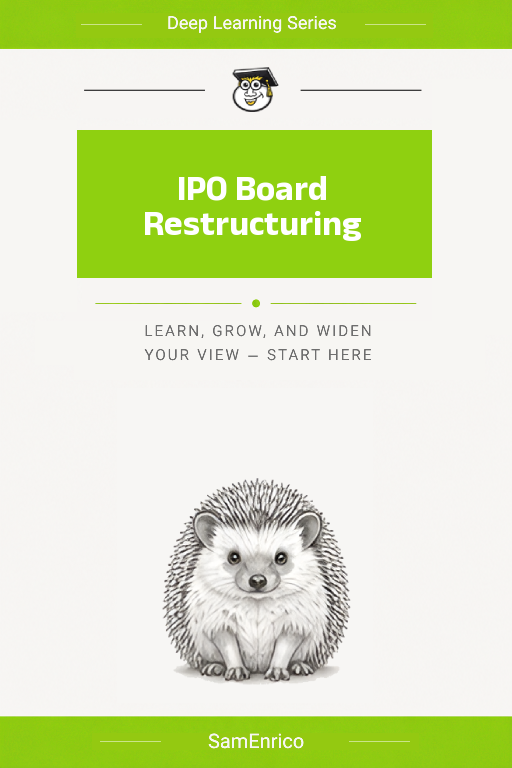
IPO Board Restructuring
Add independent directors before public listing. T
Add independent directors before public listing. This guide covers committee formation and governance upgrades for Nasdaq compliance.
Formats
About this book
Free sample
Chapter 1: The Independence Lie...-- Every founder believes their board is independent. Almost every founder is wrong. The difference between a director who is legally independent and one who merely feels independent can cost you your IPO timeline, your valuation, and potentially your career. This chapter dismantles the most dangerous misconception in pre-IPO governance: that independence is a matter of opinion or trust. It is not.
Independence under Nasdaq Rule 5605(a)(2) and SEC Rule 10A-3 is a mathematical calculation, a bright-line test with specific dollar thresholds, time periods, and relationship disqualifiers. Miss one by a single dollar or a single day, and your "independent" director is suddenly disqualified, your audit committee is non-compliant, and your S-1 filing is delayed by months.The $100 Million Misunderstanding Let us begin with a story. A fintech company we will call Pay Fast had raised over 200millionfromtop−tierventurecapitalfirms.Itsboardconsistedofthefounder−CEO,twoventurecapitalpartners,andthree"independent"directors:aretiredbanker,auniversityprofessor,andaformerregulator.Thecompanyhadfileditsdraft S−1confidentiallywiththe SECandwaspreparingforitspublicroadshow.The IPOwasexpectedtovaluethecompanyat200 million from top-tier venture capital firms. Its board consisted of the founder-CEO, two venture capital partners, and three "independent" directors: a retired banker, a university professor, and a former regulator. The company had filed its draft S-1 confidentially with the SEC and was preparing for its public roadshow.
The IPO was expected to value the company at 200millionfromtop−tierventurecapitalfirms.Itsboardconsistedofthefounder−CEO,twoventurecapitalpartners,andthree"independent"directors:aretiredbanker,auniversityprofessor,andaformerregulator.Thecompanyhadfileditsdraft S−1confidentiallywiththe SECandwaspreparingforitspublicroadshow.The IPOwasexpectedtovaluethecompanyat1.2 billion.During the due diligence process, the underwriters' counsel asked each director to complete a standard independence questionnaire. The retired banker checked "no" to every question about disqualifying relationships. He had no family members employed by Pay Fast. He had never worked for the company. He seemed clean.Then counsel asked a follow-up question: "Have you or any immediate family member received any consulting fees, advisory board compensation, or other payments from the company or its affiliates in the past three years?"The banker paused.
"Well, my son is a graphic designer. He designed the company's investor presentation deck last year. They paid him $15,000."Fifteen thousand dollars. That was the number that destroyed the company's timeline.Under Nasdaq Rule…
This is the end of the free sample. Get the eBook to keep going. Buy now
Contents
- Chapter 1
- Chapter 2
- Chapter 3
- Chapter 4
- Chapter 5
- Chapter 6
- Chapter 7
- Chapter 8
- Chapter 9
- Chapter 10
- Chapter 11
- Chapter 12
Details
- Author
- Brunson Esmeralda
- Publisher
- SamEnrico
- Language
- English
- Genre
- Non-Fiction, Startup Guide, Corporate Governance
- Released
- 2026-05-28
- Pages (approx.)
- 160
- Available as
- eBook, Audiobook

Read better in the ZLOADR app
Your eBooks on your phone or tablet. Sign in with your SamEnrico account and start reading.
More by Brunson Esmeralda
 Social Media Listening ValidationBrunson Esmeralda$11.99
 Summer Break Stress GuideBrunson Esmeralda$11.99
 Fasting and InflammationBrunson Esmeralda$11.99
 Affirmations for Success MindsetBrunson Esmeralda$11.99
 Group Idea MashupBrunson Esmeralda$11.99
 Prime Time Performance AccelerationBrunson Esmeralda$11.99
 Slow Productivity Movement GuideBrunson Esmeralda$11.99
 Malaysian Green Tax CreditsBrunson Esmeralda$11.99
 Habit Stacking MethodBrunson Esmeralda$11.99
 The Djinn and the Scholar's Lamp: A Pact of KnowledgeBrunson Esmeralda$11.99
 Whispers of the First Fleet: The Untold Stories of Australia’s Forgotten ArrivalsBrunson Esmeralda$11.99
 The Dancer's Guide to Odissi AKA OrissiBrunson Esmeralda$11.99