
Non-FictionSelf-HelpiOS Productivity
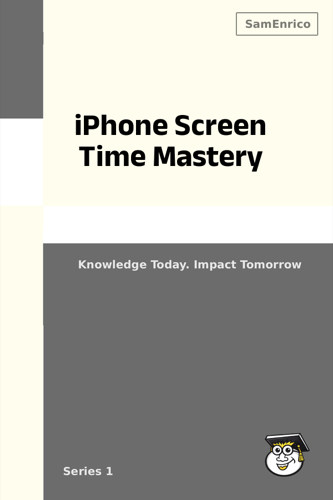
iPhone Screen Time Mastery eBook
Uses built-in iOS tools to set limits, downtime, a
by Swann Sommer
Uses built-in iOS tools to set limits, downtime, and app restrictions for healthier use.
Formats
Free sample
Chapter 1: The Dopamine Cage--You are not lazy. You are not weak-willed. And you are not addicted to your phone in the way you think you are.What you are, instead, is the unwitting subject of a multi-trillion-dollar experiment designed to exploit a fundamental quirk in your brain’s reward system. The engineers who built the notifications, the infinite scroll, the pull-to-refresh animation, and the red badge that never quite goes to zero did not wake up one morning wanting to ruin your attention span. They woke up wanting to maximize what Silicon Valley calls “engagement” – a polite word for how many minutes per day you spend looking at a screen.
And they discovered something terrifyingly effective: variable rewards.This chapter will show you exactly how your phone keeps you hooked, not through any failure of character but through predictable neurochemistry. More importantly, it will introduce you to the only tool that cuts through the fog: Screen Time’s raw metrics. By the end of this chapter, you will have completed a three-day audit of your actual behavior – not what you think you do, but what the data proves you do. And that data will become the foundation for everything else in this book.The Myth of the Weak-Willed User Let us clear the ground immediately. Most people who struggle with phone overuse believe they have a self-discipline problem.
They tell themselves: “If I just tried harder, I would put the phone down.” Or: “I used to have better focus – something is wrong with me now.”Neither is true.You are competing against approximately 4,000 engineers at Meta alone whose sole job is to increase time spent on their platforms. They run A/B tests on notification timing, button colors, and algorithm pacing. They know, with statistical precision, that a push notification sent at 9:47 PM on a Sunday receives a 22% higher open rate than one sent at 9:47 PM on a Tuesday. They know that removing the timestamp from a message makes you check twice as often because you cannot tell if the silence means someone is typing or has abandoned the conversation.Willpower is a finite resource. It depletes across the day, weakens when you are tired, and evaporates entirely when you are stressed, lonely, or bored.
The engineers know this too. That is why your most compelling notifications arrive precisely when your guard is down.The solution, therefore, cannot be more willpower. The solution must be structural. You need to change the environment so that the addictive choice becomes harder and the intentional choice becomes easier. This is not self-help rhetoric – this is behavioral economics.
And Screen Time is the only built-in lever that creates that structural change without requiring you to buy a dumbphone or move to a cabin in the woods.The Neuroscience of One More Scroll To understand why Screen Time works, you must first understand dopamine. Most people mistakenly believe dopamine is the pleasure chemical – the thing that makes you feel good when you eat chocolate or have sex. That is not quite right. Dopamine is the motivation chemical. It drives anticipation, not satisfaction.
It is the molecule of “more.”Here is the crucial distinction: your brain releases dopamine not when you receive a reward, but when you anticipate a reward that is uncertain. This is why a slot machine is more addictive than a vending machine. A vending machine gives you a candy bar every time you put in money – predictable, boring, low dopamine. A slot machine gives you a reward unpredictably – sometimes nothing, sometimes a little, rarely a lot – and that uncertainty floods your brain with dopamine.Your phone notifications operate on the exact same principle.When you hear a ding, you do not know whether it is a meaningful message from a loved one, a work email that requires immediate attention, or a marketing notification from a clothing store you visited once three years ago. That not knowing is the variable reward.
You check because the anticipation of a possible reward is neurologically more powerful than the reward itself.This explains the famous “phantom vibration syndrome” – the sensation that your phone buzzed in your pocket when it did not. Your brain became so sensitized to the possibility of a notification that it hallucinated the trigger. That is not a sign of weakness. That is a sign that your neurochemistry has been successfully hijacked.The Bottomless Bowl Strategy Now consider the design of your most-used apps. Every social media platform, every news aggregator, every video streaming service has eliminated natural stopping cues.
A newspaper ends. A television episode has credits. A book has a final page.But Tik Tok, Instagram Reels, You Tube Shorts, and even Twitter’s timeline have no end. They autoplay the next piece of content before you have consciously decided whether to continue. This is called the “bottomless bowl” – a reference to an experiment where researchers gave participants soup bowls that refilled imperceptibly from the bottom.
People ate 73% more soup than those with normal bowls because they never saw the bottom. They never received the signal to stop.Your phone apps do the same thing. You scroll past a post you do not care about, and the next one loads instantly. You watch a video, and the next one starts automatically. You check your email, and there is always one more message to archive.
The bottom never arrives.This is why telling yourself “just five more minutes” never works. Five minutes turns into twenty because your brain is not receiving the stopping signal it evolved to expect. The only way to create a stopping cue is to introduce external friction – a timer that cuts off access, a gray screen that blocks content, a passcode you do not know. That is exactly what Screen Time provides.Introducing Screen Time Metrics: The Unblinking Mirror Before you change anything, you must know where you stand. Screen Time provides four metrics that matter more than any other.
You will memorize these because every subsequent chapter refers back to them.Pickups: This is the number of times per day you unlock your phone. The average adult picks up their phone 96 times per day – once every ten waking minutes. Heavy users exceed 150 pickups. Each pickup fragments your attention, even if you only glance at the screen for two seconds. The cost is not the two seconds; the cost is the ten minutes of cognitive reorientation required to return to what you were doing before the pickup.First Pickup: The time between when you wake up and when you first unlock your phone.
Research shows that checking your phone within the first fifteen minutes of waking increases cortisol (stress hormone) levels for the entire morning and reduces creative problem-solving capacity by approximately 40%. The ideal first pickup time is sixty minutes or more – enough time to hydrate, move your body, and set an intention for the day before the digital firehose hits.Notifications per Hour: Screen Time tracks how many notifications each app sends and how many you receive. The average smartphone user receives 46 push notifications per day. Each notification fragments attention regardless of whether you act on it – the mere presence of an unread badge…
This is the end of the free sample. Get the eBook to keep going. Buy now
About this book
Details
- Author
- Swann Sommer
- Publisher
- SamEnrico
- Language
- English
- Genre
- Non-Fiction, Self-Help, iOS Productivity
- Released
- 2026-06-08
- Pages (approx.)
- 139
- Available as
- eBook, Audiobook

Read better in the ZLOADR app
Your eBooks on your phone or tablet. Sign in with your SamEnrico account and start reading.
More by Swann Sommer
 Atomic Habits For KindnessSwann Sommer$11.99
 Cultural Body Language DifferencesSwann Sommer$11.99
 The Authenticity at Work HandbookSwann Sommer$11.99
 Remote Work for InsomniacsSwann Sommer$11.99
 Infection Signs RecognitionSwann Sommer$11.99
 Circadian Master GuideSwann Sommer$11.99
 Greek Orator Memory SecretsSwann Sommer$11.99
 The Poisoned Inkwell: The Deadly Deeds of Delphine LaLaurieSwann Sommer$11.99
 The Skywalker’s Gambit: How the Thunderbird Toppled the Glass TowerSwann Sommer$11.99
 How to Produce Musical Instrument Amplifier TubesSwann Sommer$11.99
 Growing BuddlejaSwann Sommer$11.99
 Ghana VAT on Dropshipped GoodsSwann Sommer$12.99
You may also like
 Hong Kong Handover 1997Dunn Johnnie$11.99
 Zumba For Postnatal Recovery CourseNeal Christian$11.99
 Zumba for BeginnersLadner Nikia$11.99
 YouTube Comment Mining GuideHumes Pandora$12.99
 Worry Box MeditationCarlin Rudy$11.99
 Workplace Stress MeditationNguyen Lynn$11.99
 Workplace Stress and Sleep RepairHawley Ivory$11.99
 Workplace Perfectionism CureDelaney Jeffry$11.99
 Workplace Injustice Anger GuideWallen Isabelle$11.99
 Work Addiction and Burnout LinkGreenwood Ester$11.99
 Women in Yoga and WellnessBeattie Galina$11.99
 Women in Stand Up ComedyChun Evangeline$11.99