
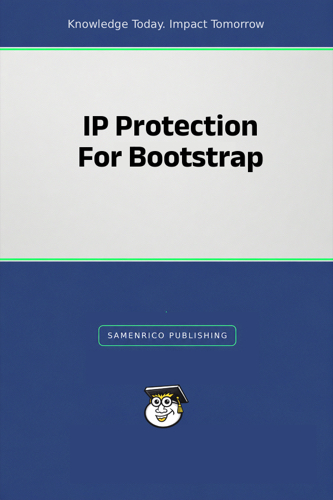
IP Protection For Bootstrap eBook
Secure trademarks provisional patents and trade se
Secure trademarks provisional patents and trade secrets without expensive lawyers.
Formats
Free sample
Chapter 1: The Blind Spot…–- Every entrepreneur I have ever met shares the same blind spot. You can talk to them about trademarks, patents, and trade secrets until you lose your voice, and they will nod politely, shift in their chairs, and then ask the same question: “That’s all great, but I don’t actually have anything to protect. I just started.”If that thought has ever crossed your mind, you are not alone. You are also not correct. And that misunderstanding is currently costing you real money.Let me prove you wrong in the next sixty seconds.
Look around your workspace right now. On your computer, you have website copy, email sequences, a logo, perhaps some custom code, or a spreadsheet that calculates your pricing in a way nobody else has figured out. In your drawer, you have a customer list, a supplier contract, and a handwritten note with a manufacturing shortcut that saves you fifteen minutes per unit. In your head, you have a recipe, a process, or a unique way of solving a problem that your competitors have not cracked yet.All of that is intellectual property. All of it has value.
And right now, without any paperwork, without any lawyers, and without any government filings, you already own legal rights to some of it.The problem is not that you lack IP. The problem is that you do not know what you own, and you do not know how to protect what you have. That ends today.This chapter is your IP audit. By the time you finish reading, you will have a complete inventory of your intellectual property assets, a clear understanding of which ones matter most, and a simple one-page document that will guide every legal decision you make for the next twelve months. No jargon.
No billing by the hour. Just a practical, boots-on-the-ground approach to finding your invisible fortune.The Four Pillars of Invisible Wealth Intellectual property law divides your intangible assets into four distinct categories. Think of these as four different types of containers. Each container holds a different kind of value, and each container requires a different kind of protection. Mix them up, and you will try to lock a door with a password or encrypt a secret that should have been patented.
The categories are clear once you see them.Trademarks: The Face of Your Business A trademark is anything that identifies the source of your goods or services. That sounds formal, but it simply means your brand. Your business name is a trademark. Your logo is a trademark. Your tagline, if you have one, is a trademark.
If you have named a specific product, like the “Ultimate Edition” of your software or the “Pro Model” of your hardware, that name is also a trademark. Even unique packaging, a distinct color scheme, or a sound can function as a trademark under the right circumstances.Here is what most people miss entirely. You gain rights to a trademark simply by using it in commerce. The moment you put that logo on your website, that name on your invoice, or that tagline in your email signature, you have what lawyers call “Common Law” trademark rights. You can legally add the ™ symbol immediately.
No registration required. No fees. No lawyers.But here is the catch, and it is a big one. Common Law rights are geographically limited to your actual trading area. If you sell only in Austin, Texas, your trademark rights exist only in Austin, Texas.
If a company in Portland, Oregon starts using the same name for the same type of product next week, you cannot stop them. Your rights do not cross state lines. Federal registration, which we cover in Chapters 3 and 4, fixes that problem by giving you nationwide priority as of your filing date. But for now, just know that you already own something. Your brand, even if you launched last week, already has legal value.
It is just limited value.Patents: The Guts of Your Invention Patents protect how something works or how something looks. A utility patent protects the function, the method, the process, or the way the parts interact. A design patent protects the ornamental appearance, the unique visual shape that has no functional purpose. Most bootstrappers start with a provisional patent application, which we cover in Chapter 6. A provisional patent costs between sixty and three hundred dollars, depending on whether you qualify for Micro Entity status, and it gives you twelve months of “Patent Pending” status without requiring formal claims or legal jargon.Here is what you need to know for your audit.
A patentable invention does not have to be a complex, high-tech, never-before-seen miracle. It just has to be new, useful, and non-obvious to someone skilled in your field. That new bracket you designed to mount a shelf faster? Potentially patentable. That software workflow that reduces a five-click process to two clicks?
Potentially patentable. That unique shape of your candle that fits perfectly in a car cupholder? Potentially patentable as a design patent.Write down everything you have built, designed, coded, or prototyped that is not obvious to everyone else in your industry. If you looked at it and said, “Huh, I wonder why nobody thought of that before,” put it on the list. That moment of surprise is often the signal that you have stumbled onto something truly novel.Trade Secrets: The Crown Jewels Trade secrets are the most misunderstood category, and they are also the most valuable for many bootstrappers.
A trade secret is any information that derives economic value from not being generally known, and that you take reasonable steps to keep secret. Customer lists, supplier contracts, pricing models, algorithms, recipes, manufacturing processes, and even a failed experiment that taught you what does not work can all be trade secrets.The Coca-Cola formula is a trade secret. The Google search algorithm was a trade secret for many years before portions were patented or published. The KFC blend of eleven herbs and spices is a trade secret. None of these are registered with the government.
None of them expire after twenty years like a patent. They last forever, as long as they remain secret and as long as you continue to take reasonable steps to protect them.Here is the critical distinction for your audit. If a competitor can buy your product, take it apart, and figure out your secret through reverse engineering, it cannot be a trade secret. You must patent it. But if your secret is a customer relationship, which cannot be reverse-engineered, or a manufacturing process that happens behind closed doors, or a recipe that is not discernible from the final product, then trade secret protection is not only possible but preferable.
It costs nothing to file, because you do not file anything with the government, and it lasts forever. The only cost is the security you implement, which we cover in Chapter 10.Copyrights: The Expression of Your Ideas Copyright is the automatic right you receive when you create an original work of authorship and fix it in a tangible medium. That last phrase is important. An idea in your head is not copyrighted. Once you…
This is the end of the free sample. Get the eBook to keep going. Buy now
About this book
Details
- Author
- Tripp Reynalda
- Publisher
- SamEnrico
- Language
- English
- Genre
- Non-Fiction, Startup Guide, Intellectual Property
- Released
- 2026-06-10
- Pages (approx.)
- 124
- Available as
- eBook, Audiobook

Read better in the ZLOADR app
Your eBooks on your phone or tablet. Sign in with your SamEnrico account and start reading.
More by Tripp Reynalda
 The Office Chair Stretch RoutineTripp Reynalda$11.99
 Presentation Persuasion SkillsTripp Reynalda$11.99
 Conflict Resolution Self WorthTripp Reynalda$11.99
 The Samurai of the Pitch: How a Japanese Tactician Revolutionized 18th-Century FootballTripp Reynalda$11.99
 How to Start a Bowling Alley Equipment Business (Beginners Guide)Tripp Reynalda$11.99
 Learn to Play the LangeleikTripp Reynalda$11.99
 MeditationTripp Reynalda$11.99
 LinkedIn Open to Work GuideTripp Reynalda$12.99