
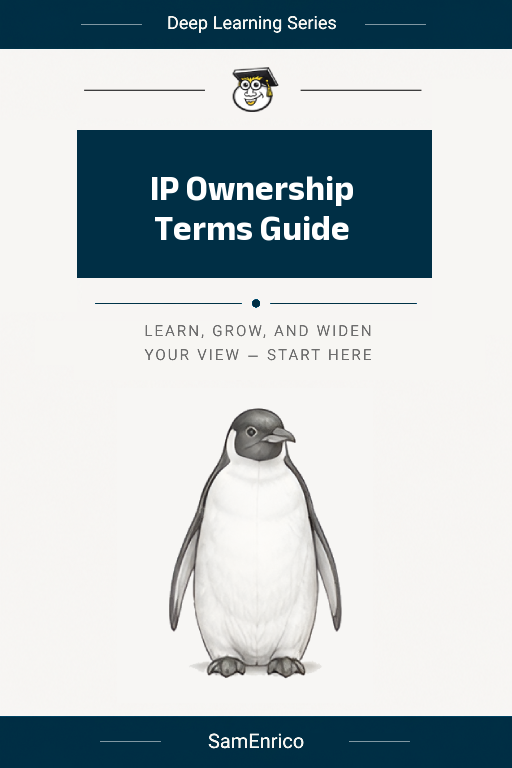
IP Ownership Terms Guide eBook
Specify intellectual property ownership in your te
Specify intellectual property ownership in your terms of service for user-generated content, licenses, and moral rights.
Formats
Free sample
Chapter 1: The Copyright Lie...--–- You own what you create. That is what every photographer, You Tuber, podcaster, and writer believes when they upload their work to the internet. It feels true. It sounds fair. And for the most part, it is true—until the moment you click “I agree” on someone else’s terms of service.
In that single click, the legal reality of ownership splits into two parallel universes: what you think you own, and what you have actually licensed away. This chapter exposes what I call the Copyright Lie—not a deliberate deception by platforms, but a dangerous gap between creator intuition and contract law. The lie is this: that creating something automatically gives you full control over how it is used everywhere, forever, by everyone. The truth is more complicated, more nuanced, and far more important to understand before you build a business on user-generated content or before you post your next creative work online.The Copyright Lie persists because copyright law itself is counterintuitive. Under the Copyright Act of 1976 in the United States (and similar statutes in virtually every other country), copyright protection attaches the moment an original work is “fixed in a tangible medium of expression.” That sounds like strong protection.
And it is—against the rest of the world. But against a platform whose terms of service you have agreed to, that protection is only as strong as the license you granted when you signed up. This chapter will walk you through three fundamental concepts that most non-lawyers get wrong: fixation, originality, and the critical distinction between the physical file and the intellectual property it contains. By the end of this chapter, you will understand why a live stream has no copyright, why a two-word comment is legally worthless, and why the platform that hosts your photo may own the bytes while you own the idea—and why that distinction matters more than any other in the entire book.The Fixation Trap: Why Your Live Stream Isn't Copyrighted Let us start with a scenario that has played out in courtrooms multiple times. A musician performs a live original song on a streaming platform.
No recording is saved. No replay is available. The performance is ephemeral—it exists only in the moment. Another user screen-records that performance without permission and uploads it to a video platform. The musician sues for copyright infringement.
Who wins?The musician loses. Not because what the other user did was ethical, but because the musician’s performance was never “fixed.” Under US copyright law (17 U.S.C. § 102), copyright protection subsists in original works of authorship “fixed in any tangible medium of expression.” A live, unrecorded performance is not fixed. It is like a speech given in a town square with no recording—you cannot copyright the spoken words until they are written down or recorded. The person who made the screen recording, however, did fix the performance.
That screen recording is a tangible medium. So ironically, the person who stole the performance may own the copyright to the recording of that performance, even though they do not own the underlying musical composition.This is the Fixation Trap. Every platform that allows live streaming must warn users that if they want copyright protection, they need to hit “record.” The fleeting nature of live content means that users are often licensing something to the platform that the platform could arguably copy freely anyway because no copyright ever attached. For platform operators, this creates a strange asymmetry: you may have fewer obligations to protect live content than recorded content, because live content may not be copyrightable subject matter at all. For creators, the lesson is brutal: if you did not save it, you do not own it in the eyes of the law.The Fixation Trap extends beyond live streams.
Consider a real-time collaborative document like Google Docs. As users type, their words appear on collaborators’ screens instantly. Are those words fixed? Yes—the moment they are written to a server, which happens continuously during typing. But what about a disappearing message on an ephemeral messaging app?
Those messages may be fixed temporarily (in RAM, cache, or server logs) but deleted shortly after. Courts have generally held that fixation requires some duration, but there is no clear time threshold. A message that exists for one second in RAM before being overwritten may or may not be fixed, depending on the jurisdiction. The safe answer is that any content that users can later retrieve or that the platform stores beyond the immediate moment of transmission is likely fixed. Any content that truly vanishes with no retrievable copy is likely not fixed.For terms of service drafting, the Fixation Trap has two implications.
First, if your platform hosts live or ephemeral content, your license grant should clarify that you are seeking a license only to the extent copyright exists—and if no copyright attaches, the license is superfluous. Second, you should warn users explicitly that live content may not receive copyright protection. Most platforms bury this warning, if they include it at all. A best-selling platform would put it in plain language at the point of live streaming: “Remember: live streams are not automatically copyrighted. Record your stream if you want legal protection.”The Originality Threshold: Why Your Two-Word Comment Belongs to Everyone The second major misunderstanding in the Copyright Lie is originality.
Creators assume that anything they write, draw, or record is automatically original enough for copyright. That is false. Copyright requires a modicum of creativity—a low bar, but a bar nonetheless. The Supreme Court made this clear in Feist Publications, Inc. v.
Rural Telephone Service Co. (1991), holding that a telephone directory sorted alphabetically lacked the creativity necessary for copyright protection because it was “utterly lacking in creative spark.” The names and numbers themselves are facts, and facts are not copyrightable.Apply this to user-generated content. A comment that says “Great post!” is almost certainly not copyrightable. It is too short, too common, and too lacking in creative expression. A comment that says “Your analysis of the interplay between moral rights and AI training overlooks the French requirement of inalienability, which creates a genuine conflict for multinational platforms” is likely copyrightable.
It is lengthy, expresses an opinion, and shows creative arrangement of ideas. The line between these two examples is fuzzy, and courts hate drawing it, but the line exists.For platform operators, the originality threshold creates a risk management problem. If a user uploads thousands of two-word comments and later claims copyright infringement when another user copies them, that claim would likely fail for lack of originality. But the user might sue anyway, and defense costs money. The better approach is to include a warranty clause (covered in depth in Chapter 8) requiring users to warrant that their content meets the originality threshold.
That warranty shifts the risk back to the user.For creators, the originality threshold is a warning: do not assume everything you post is protected. Short phrases, common symbols, and purely factual statements may be free for anyone to copy. This is why memes are legally fascinating—most memes combine an unoriginal image (often a stock photo or a screenshot…
This is the end of the free sample. Get the eBook to keep going. Buy now
About this book
Details
- Author
- Peek Heriberto
- Publisher
- SamEnrico
- Language
- English
- Genre
- Non-Fiction, First 30 Days
- Released
- 2026-05-30
- Pages (approx.)
- 137
- Available as
- eBook, Audiobook

Read better in the ZLOADR app
Your eBooks on your phone or tablet. Sign in with your SamEnrico account and start reading.
More by Peek Heriberto
 Reverse Mortgage or Traditional DownsizingPeek Heriberto$11.99
 Self Talk for Divorce RecoveryPeek Heriberto$11.99
 Auth0 Identity OutagePeek Heriberto$11.99
 CrossFit Nutrition for PerformancePeek Heriberto$11.99
 The Business Structure Change GuidePeek Heriberto$11.99
 The Bloodied Fields of Shiga: Yamato's Last Stand (478 AD)Peek Heriberto$11.99
 How to Start a Derricks Business (Beginners Guide)Peek Heriberto$11.99
 Public Relations CoordinatorPeek Heriberto$11.99
 Understanding Von Gierke DiseasePeek Heriberto$17.99
 Startup Visa Health InsurancePeek Heriberto$12.99
You may also like
 Hong Kong Handover 1997Dunn Johnnie$11.99
 Zumba For Postnatal Recovery CourseNeal Christian$11.99
 Zumba for BeginnersLadner Nikia$11.99
 YouTube Comment Mining GuideHumes Pandora$12.99
 Worry Box MeditationCarlin Rudy$11.99
 Workplace Stress MeditationNguyen Lynn$11.99
 Workplace Stress and Sleep RepairHawley Ivory$11.99
 Workplace Perfectionism CureDelaney Jeffry$11.99
 Workplace Injustice Anger GuideWallen Isabelle$11.99
 Work Addiction and Burnout LinkGreenwood Ester$11.99
 Women in Yoga and WellnessBeattie Galina$11.99
 Women in Stand Up ComedyChun Evangeline$11.99