
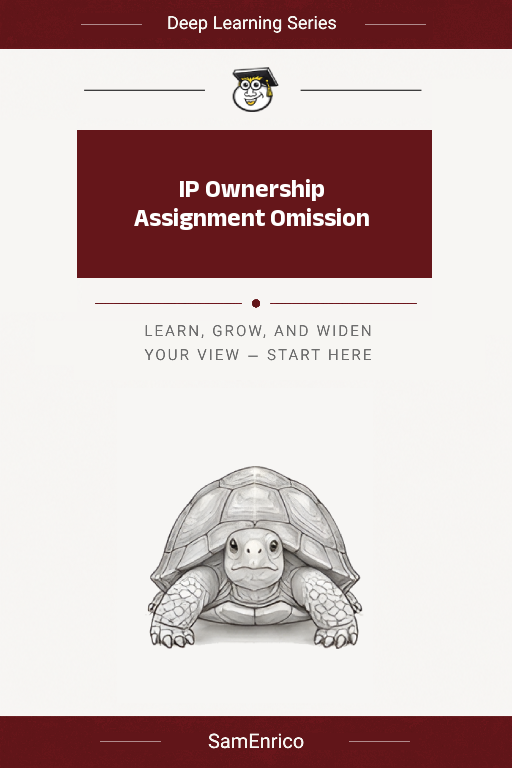
Non-FictionBusiness BriefIntellectual Property
IP Ownership Assignment Omission eBook
Sign written invention assignment agreement before
by Coker Crissy
Sign written invention assignment agreement before first day of work. Without it, employee owns everything they create including your core product.
Formats
Free sample
Chapter 1: The Founder’s Blind Spot...--You believe you own your company. That is a dangerous assumption.Not because you lack vision, funding, or talent. You likely have all three. The danger is much more subtle. It hides in plain sight, buried in the gap between what you assume and what the law actually says.
You assume that because you paid for the work—because you wrote the checks, provided the laptops, rented the office, and set the deadlines—that you own the fruits of that labor. Every founder assumes this. Almost every founder is wrong.This chapter is about that assumption. It is the single most expensive mistake I have seen repeat across hundreds of startups, from garage-based two-person operations to well-funded Series B companies on the verge of unicorn status. The mistake is believing that payment creates ownership.
It does not. Not automatically. Not by default. Not without a specific, signed, properly worded, and timely executed piece of paper.The law has a different starting point. It is a simple rule, brutal in its clarity: the creator owns the creation.
The person who writes the code owns the code. The engineer who designs the circuit owns the circuit. The writer who drafts the copy owns the copyright. Until and unless that creator signs a written agreement explicitly transferring ownership to your company, you are not the owner. You are at best a licensee.
At worst, you have nothing at all.This is not a theoretical risk buried in obscure legal treatises. It is the reason startups lose funding. It is the reason acquisitions collapse during due diligence. It is the reason founders have watched their life’s work get held hostage by a former employee who simply refused to sign a piece of paper—and was legally entitled to refuse.I have seen a company lose its Series A financing because the CTO built the core product during his first week, before signing the invention assignment agreement. The investor’s counsel asked for the signed agreement.
It did not exist. The CTO had left the company amicably six months earlier, but when asked to sign a retroactive assignment, his new lawyer advised him to demand ten percent of the company. The investor walked. The company folded within a year.I have seen a medical device startup discover during due diligence that its lead engineer had a “shop right” rather than full ownership of the patented technology. The engineer had never signed an assignment agreement.
Under default law, the company had a non-exclusive, non-transferable license to use the invention internally—but could not sell the company, grant an exclusive license, or stop the engineer from selling the same technology to a competitor. The valuation dropped from forty million dollars to four million overnight. The founders walked away with nothing.I have seen a founder-built prototype become a tax disaster because the founder assigned the intellectual property to the company after it had appreciated in value, triggering a six-figure capital gains tax bill on a transaction that generated no cash.These are not edge cases. They are the predictable consequences of ignoring a simple truth: intellectual property does not automatically belong to the person who pays for it. It belongs to the person who creates it.
Everything else—every assumption, every handshake agreement, every “we’ll get to the paperwork later”—is a gamble with your company as the stakes.The Myth of Automatic Ownership The assumption that payment equals ownership is so deeply embedded in founder psychology that it feels like common sense. You hire someone. You pay them a salary. They build something for you. Of course you own it.
What else would happen?The law answers that question with uncomfortable clarity. In the United States and most jurisdictions worldwide, the default legal position is that the creator—the natural person who actually wrote the code, drew the schematic, or composed the text—is the first and original owner of the intellectual property rights in that creation. This is not a loophole. It is not an oversight in the law. It is a deliberate feature of intellectual property systems, rooted in the constitutional purpose of copyrights and patents: to reward individual creators for their inventive and artistic efforts.For patents, the rule is absolute.
Under the U.S. Patent Act, the inventor is the first owner. Period. There is no “work for hire” doctrine for patents. No exception for employees.
No exception for “but I paid them.” The only way your company can own a patent invented by an employee or contractor is through an express, written assignment of those rights from the inventor to the company. Without that assignment, the inventor retains ownership. You may have a license to use the invention—depending on the circumstances—but you do not own the patent.For copyrights, the rule has a narrow exception, but it is narrower than most founders believe. The “work made for hire” doctrine does allow an employer to be treated as the author and owner of certain works created by employees. But this doctrine applies only to employees—not independent contractors—and only to works created within the scope of their employment.
Even then, careful documentation is required. For independent contractors, the “work made for hire” doctrine applies only to nine specific categories of works (motion pictures, compilations, translations, and similar narrow categories), and even within those categories, a signed written agreement is mandatory. Software, app development, website design, and most of what startups create do not qualify.This is not academic nitpicking. It is the difference between owning your core technology and discovering, at the worst possible moment, that you do not.The Perilous Middle Ground: The Shop Right Before we go further, you need to understand a concept that most founders have never heard of: the “shop right.” It is a doctrine that saves some companies from total disaster while simultaneously preventing them from ever achieving a successful exit. Understanding the shop right is essential because it explains the gap between “we probably own this” and “we definitely do not own this.”A shop right is an automatic, non-exclusive, non-transferable license that arises under certain circumstances when an employee creates an invention using your time, resources, equipment, or facilities, but without a signed invention assignment agreement.
The doctrine is rooted in fairness: if you paid for the work—the salary, the lab equipment, the time—you should at least have the right to use the invention internally. Courts in most jurisdictions agree.But a shop right is not ownership. It is the bare minimum. The key features of a shop right are devastating for any company seeking investment or an acquisition:First, it is non-exclusive. You cannot prevent the employee from using the same invention themselves, licensing it to others, or selling it to your competitors.
The employee retains full ownership and can exploit the invention in any way they choose, limited only by any separate confidentiality or non-compete obligations they may have.Second, it is non-transferable. You cannot sell the shop right. You cannot transfer it as part of an asset sale or merger. If you sell your company, the shop right does…
This is the end of the free sample. Get the eBook to keep going. Buy now
About this book
Details
- Author
- Coker Crissy
- Publisher
- SamEnrico
- Language
- English
- Genre
- Non-Fiction, Business Brief, Intellectual Property
- Released
- 2026-05-30
- Pages (approx.)
- 153
- Available as
- eBook, Audiobook

Read better in the ZLOADR app
Your eBooks on your phone or tablet. Sign in with your SamEnrico account and start reading.
More by Coker Crissy
 Air Purifier for Indoor ToxinsCoker Crissy$11.99
 Financial Stress And Divorce Recovery GuideCoker Crissy$11.99
 Breath for AnxietyCoker Crissy$11.99
 The Menstruation ConfidenceCoker Crissy$11.99
 Etsy Shop Sales Envy GuideCoker Crissy$11.99
 Ford Vertical IntegrationCoker Crissy$11.99
 Protein Timing for SarcopeniaCoker Crissy$11.99
 Crisis Hotline Operator StressCoker Crissy$11.99
 Tycho Brahe and the Celestial Revolution: The Man Who Measured the HeavensCoker Crissy$11.99
 The Silent Summit: How a Forgotten Climber Conquered Kilimanjaro’s Deadly SecretsCoker Crissy$11.99
 The Last Dance of the Red Baron: Aerial ObsessionCoker Crissy$11.99
 The Dancer's Guide to SiganosCoker Crissy$11.99
You may also like
 Hong Kong Handover 1997Dunn Johnnie$11.99
 Zumba For Postnatal Recovery CourseNeal Christian$11.99
 Zumba for BeginnersLadner Nikia$11.99
 YouTube Comment Mining GuideHumes Pandora$12.99
 Worry Box MeditationCarlin Rudy$11.99
 Workplace Stress MeditationNguyen Lynn$11.99
 Workplace Stress and Sleep RepairHawley Ivory$11.99
 Workplace Perfectionism CureDelaney Jeffry$11.99
 Workplace Injustice Anger GuideWallen Isabelle$11.99
 Work Addiction and Burnout LinkGreenwood Ester$11.99
 Women in Yoga and WellnessBeattie Galina$11.99
 Women in Stand Up ComedyChun Evangeline$11.99