
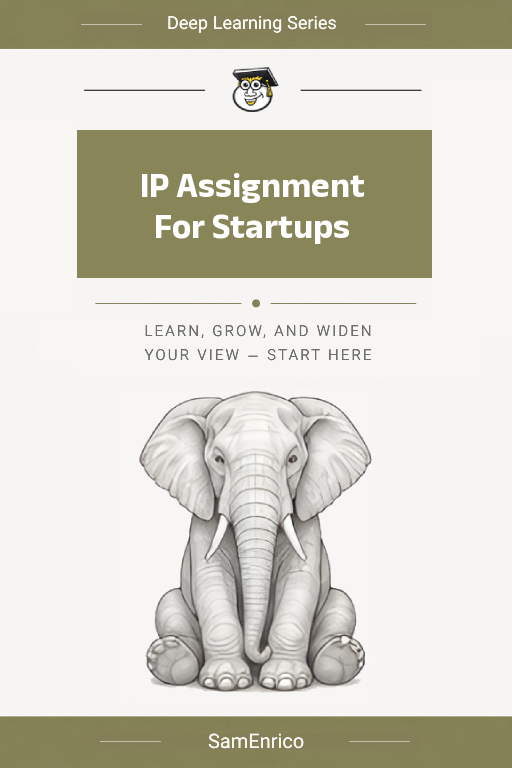
Non-FictionStartup GuideIP AssignmentLegal
IP Assignment For Startups eBook
Assign intellectual property to your startup befor
Assign intellectual property to your startup before raising pre seed to satisfy investor due diligence.
Formats
Free sample
Chapter 1: The Founder’s Ghost...--–- The email arrived at 11:47 PM on a Tuesday. The founder, let’s call him Alex, had been celebrating. His startup had just received a term sheet for a $2 million seed round. The lead investor’s lawyer had one final request before signing: “Please upload the IP assignment agreements for all four co-founders to the data room.” Alex opened his laptop, searched his Google Drive, and found three agreements. The fourth—the CTO who had left six months ago—was missing.
Alex called the former CTO, who laughed and said, “I wrote the core algorithm on my own laptop before we incorporated. I never assigned it. I want 10% of the company or the code stays with me.” The deal collapsed. The startup folded six months later. The ghost of the missing assignment had come back to haunt them.This is not a hypothetical.
This is the single most common, most preventable, and most devastating mistake that pre-seed founders make. They assume that because someone was a “co-founder,” because they worked “for the startup,” or because they had good intentions, the intellectual property automatically belongs to the company. It does not.Welcome to Chapter 1. By the time you finish reading these pages, you will understand exactly why your pre-incorporation work is not yours to bring into the company—it is yours to assign to the company. You will learn the one document that every founder must sign before receiving a single share.
And you will never, ever let a co-founder leave without signing it first.The Great Illusion: “We’re Founders, So We Own It Together”Let me dispel a myth that has destroyed more startups than failed product launches or missed revenue targets. The myth is this: when a group of people agrees to start a company together, everything they create before incorporation is automatically owned equally by everyone.Under US law, and under the laws of virtually every developed economy, the opposite is true. Before a company exists as a legal entity—a corporation or an LLC—it has no capacity to own anything. The individuals who create intellectual property before incorporation own that IP as individuals. Not as co-founders.
Not as a team. As separate human beings, each holding full, sole ownership over the code they wrote, the designs they drew, and the provisional patents they filed.Here is what this means in practice. Imagine three founders: Alice writes the backend code, Bob designs the logo and user interface, and Charlie writes the business plan and files a provisional patent. They work for three months from their各自的apartments. They then incorporate as a Delaware C-corporation.
Under the law, Alice owns the backend code exclusively. Bob owns the logo and UI exclusively. Charlie owns the business plan and provisional patent exclusively. The new corporation owns exactly nothing. Zero.
Zilch.If Alice decides to leave the day after incorporation, she can legally take “her” code with her. She can license it back to the company for a million dollars. She can sell it to a competitor. The company has no claim to it whatsoever. The other founders cannot stop her.
No court will help them. They did not get a signature on a piece of paper before incorporation, and now they are paying the price.This is not a bug in the legal system. It is a feature. The law respects individual ownership until an individual voluntarily transfers that ownership to an entity. The mechanism for that transfer is a written agreement.
Nothing less will suffice.The Case That Every Founder Should Know: Hill v. Touchlight Genetics The most instructive example of this disaster is not a hypothetical. It is a real UK case called Hill v. Touchlight Genetics, which has become required reading for startup lawyers on both sides of the Atlantic.The facts are straightforward. Dr.
Hill was a scientist who developed a groundbreaking DNA amplification technology. He worked on it before his company, Touchlight, was formally incorporated. He later became a director and shareholder. The company became successful, worth hundreds of millions of dollars. Then Dr.
Hill left. The company claimed ownership of the patents. Dr. Hill claimed he never assigned them.The litigation lasted years. It cost millions in legal fees.
Both sides hired expert witnesses. The court examined every email, every notebook, every conversation. In the end, the court found that Dr. Hill had not assigned his pre-incorporation IP to the company. The company had to pay him substantial royalties to continue using its own core technology.
The company survived, but it was crippled. Investors who had put in millions saw their returns slashed.The lesson from Hill is brutal but clear: the absence of a written IP assignment agreement turns a startup into a lawsuit waiting to happen. Investors know this. That is why, during due diligence, the first document they ask for after the certificate of incorporation is the founder IP assignments. If those assignments are missing, they assume the worst.
They discount your valuation by 20 to 50 percent. Or they walk away entirely.The Solution: The Founder IP Assignment Agreement The document that prevents this nightmare is called the Founder IP Assignment Agreement. Some lawyers call it a Technology Assignment Agreement or a Founder Assignment of Intellectual Property. In this book, we use the term Founder IP Assignment Agreement to emphasize its purpose: it is the agreement by which each founder assigns all of their pre-incorporation and post-incorporation IP to the company.This document does one thing, but it does it absolutely. It transfers ownership of every invention, work of authorship, design, patent, trademark, trade secret, and piece of source code that the founder created before incorporation or will create during their relationship with the company.
It is a present-tense, irrevocable transfer. It does not say “will assign.” It says “hereby assigns.” The difference is legally critical. “Will assign” is a promise to do something in the future. A promise can be broken. “Hereby assigns” is the act of assignment itself.
It happens the moment the founder signs.The Founder IP Assignment Agreement is typically combined with a Restricted Stock Purchase Agreement. That second document governs the founder’s shares—how many they receive, how they vest over time, and what happens if they leave. The two documents work as a pair. The first brings the IP into the company. The second gives the founder equity in exchange.
You never do one without the other.The Anatomy of a Founder IP Assignment Agreement Every Founder IP Assignment Agreement has four essential components. Miss any one of them, and the agreement is incomplete. Investors will flag it as a deficiency. Lawyers will ask for a revised version.Component 1: The Assignment Clause This is the heart of the agreement. It must use present-tense, irrevocable language.
A properly drafted assignment clause reads something like this:“For good and valuable consideration, the receipt and sufficiency of which are hereby acknowledged, the Founder hereby irrevocably assigns and transfers to the Company all of the Founder’s right, title, and interest in and to all Intellectual Property, including but not limited to all Inventions, Works of Authorship, Patents, Trademarks, Trade Secrets, and Software created, conceived…
This is the end of the free sample. Get the eBook to keep going. Buy now
About this book
Details
- Author
- Easter Mitchel
- Publisher
- SamEnrico
- Language
- English
- Genre
- Non-Fiction, Startup Guide, IP Assignment, Legal
- Released
- 2026-05-30
- Pages (approx.)
- 124
- Available as
- eBook, Audiobook

Read better in the ZLOADR app
Your eBooks on your phone or tablet. Sign in with your SamEnrico account and start reading.
More by Easter Mitchel
 Georgian Mafia Post SovietEaster Mitchel$11.99
 Pinterest VA For Fashion BrandsEaster Mitchel$11.99
 The Ear Pain Meditation GuideEaster Mitchel$11.99
 False Positive Mammogram GuideEaster Mitchel$11.99
 Binge Eating in Men WorkbookEaster Mitchel$11.99
 The Lost Kingdom of the Deep: Unraveling the Secrets of the Sunken City of Muara JawaEaster Mitchel$11.99
 The Grand Illusion: How Conrad Hilton Built an Empire on Charm and ChaosEaster Mitchel$11.99
 STEM Degree Country CompareEaster Mitchel$12.99
 A Beginners Guide to Australia (Volume 1)Easter Mitchel$11.99
 Understanding Compartment SyndromeEaster Mitchel$17.99
 Front of House OfficerEaster Mitchel$11.99
You may also like
 Hong Kong Handover 1997Dunn Johnnie$11.99
 Zumba For Postnatal Recovery CourseNeal Christian$11.99
 Zumba for BeginnersLadner Nikia$11.99
 YouTube Comment Mining GuideHumes Pandora$12.99
 Worry Box MeditationCarlin Rudy$11.99
 Workplace Stress MeditationNguyen Lynn$11.99
 Workplace Stress and Sleep RepairHawley Ivory$11.99
 Workplace Perfectionism CureDelaney Jeffry$11.99
 Workplace Injustice Anger GuideWallen Isabelle$11.99
 Work Addiction and Burnout LinkGreenwood Ester$11.99
 Women in Yoga and WellnessBeattie Galina$11.99
 Women in Stand Up ComedyChun Evangeline$11.99