
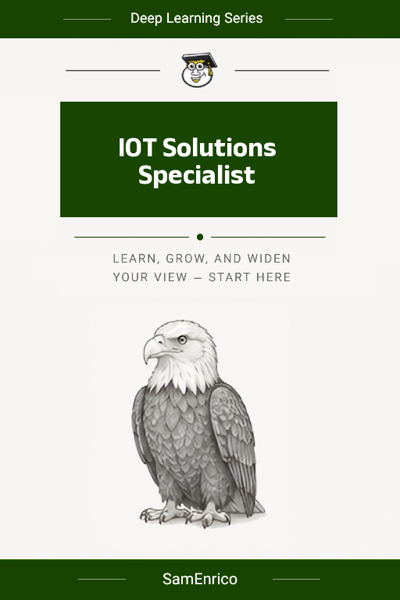
Non-FictionInformativeEducational
IOT Solutions Specialist eBook
A Coursebook on IOT Solutions Specialist
A Coursebook on IOT Solutions Specialist
Formats
Free sample
Chapter 1: Beyond the Gadget--– The first mistake most Io T projects make is believing that buying a connected device is the same as building an Io T solution. A smart lock on your front door that you can open with a phone app is a gadget. A fleet of a thousand smart locks across a university campus that report battery levels, access logs, and tamper attempts, while automatically revoking keys for expelled students and notifying security of a door left ajar – that is an Io T solution. The difference is not technology. The difference is architecture, scale, and the hard-won understanding that Io T is never about one thing.
It is about systems of systems.This chapter exists to rewire your thinking. By the time you finish reading, you will never again look at a “smart” product and mistake it for a solution. You will see the layers beneath. You will see the data flowing, the decisions being made, the actions taken or ignored. You will see the difference between telemetry and control, between a dashboard and a closed loop, between a prototype and a production system that can survive the real world.Before we write a single line of code or select a single sensor, we must build the mental model that separates Io T Solutions Specialists from hobbyists and well-intentioned engineers who learn the hard way – by watching their projects fail in production.Let us begin with a story.
Not a hypothetical one. A real post-mortem from a smart building project that cost its investors nearly two million dollars and eighteen months of wasted time.The $2 Million Data Lake with No One Swimming In 2019, a mid-sized commercial real estate firm decided to retrofit its flagship office tower with Io T sensors. The goal seemed straightforward: reduce energy costs by monitoring HVAC performance, occupancy, and window shade positions. They hired a respected systems integrator. The integrator deployed 1,200 temperature sensors, 400 motion detectors, and 80 rooftop HVAC controllers.
Every device streamed data to a cloud data lake. The dashboard was beautiful – real-time temperature maps, occupancy heatmaps, and historical trends.The system ran for six months. Energy costs did not change. When asked why, the facilities team said, “We didn’t know we were supposed to do anything with the data.” The integrator had built a perfect Create, Communicate, and Aggregate pipeline. They had even included Analyze – pretty charts and alerts.
But they forgot the Act step. No valve was turned. No setpoint was adjusted. No one was paged when a floor hit eighty-eight degrees on a winter afternoon because a damper failed. The system produced information but no action.
It was a data lake with no one swimming, let alone building a dam.The firm eventually scrapped the project and hired a new team – one that understood the Value Loop. The second team did not add more sensors. They added actuators, control logic, and a rule engine that closed the loop. When a conference room exceeded seventy-two degrees, the system did not just send an email. It commanded the HVAC damper to adjust.
Energy costs dropped twenty-two percent in three months.That second team was led by an Io T Solutions Specialist.The Three-Tier Architecture That Will Save Your Career Throughout this book, we will use a single architectural model for every use case, every lab, and every capstone project. It is called the Three-Tier Architecture, and it consists of:Tier 1: The Device Tier – This is where physics meets electrons. Sensors measure temperature, vibration, humidity, motion, or any other physical phenomenon. Actuators change the physical world – opening a valve, turning on a motor, locking a door. The device tier also includes the microcontrollers or microprocessors that run the firmware, plus the radios that transmit data.
In later chapters, we will spend hundreds of pages on the trade-offs within this tier: MCU versus MPU, battery versus line power, Lo Ra WAN versus cellular. For now, understand that the device tier is where data is born and where commands die if they are not acted upon.Tier 2: The Edge Tier – This is the layer of intelligence just outside the cloud. Edge devices can be gateways (a Raspberry Pi collecting data from a dozen Bluetooth sensors), industrial PCs, or even the device itself if it has enough compute power. The edge tier performs three critical functions: protocol translation (turning Zigbee into MQTT), data normalization (converting raw analog voltages into degrees Celsius), and immediate action (closing a valve when a pressure spike is detected, without waiting for the cloud). The edge tier exists because the cloud is too slow.
A round trip from a sensor in a factory to a cloud server in another region and back to an actuator can take hundreds of milliseconds – an eternity for a motor about to overheat. The edge tier acts in milliseconds.Tier 3: The Cloud Tier – This is where long-term memory, cross-fleet analytics, and human interfaces live. The cloud aggregates data from thousands or millions of devices. It runs machine learning models that can detect patterns invisible to any single device. It stores years of historical data for compliance and trend analysis.
It hosts dashboards that let operators see the health of their entire fleet. And it provides APIs that allow other systems – ERP, CRM, maintenance scheduling – to consume Io T data. But the cloud should never be the only path to action. If your system requires cloud connectivity to close a safety-critical valve, you have already lost.A note for readers who have encountered other architectural models: You may have seen a four-layer model (Sensor, Gateway, Edge, Cloud) or a five-layer model that includes a “Fog” layer between edge and cloud. Those models are not wrong.
They simply split the edge tier into finer granularity. In this book, we collapse everything between the device and the cloud into a single edge tier because the principles remain the same regardless of how many sub-layers you name. The only sin is not having an edge at all. Many failed Io T projects – including the smart building I described – had devices talking directly to the cloud with no local intelligence. Every action required a cloud round trip.
Every alert waited for cloud processing. And when the internet went down, the building went blind.The Value Loop: Create, Communicate, Aggregate, Analyze, Act The architecture tells you where things are. The Value Loop tells you what they must do. Every Io T solution, regardless of industry or scale, must complete this loop continuously. Break any link, and you have a gadget at best, an expensive log file at worst.Create – This is the act of sensing or generating data.
A temperature sensor reads 22.3 degrees Celsius. A vibration sensor produces a time series of accelerometer readings. A camera captures an image. Creation happens in the device tier, and its fidelity determines the value of everything downstream. If your sensor is inaccurate, no amount of cloud analytics can fix it.
If your sampling rate is too low, you will miss the transient event that matters. If your sensor drifts over time, your alarms will become noise.Communicate – This is the transport of data from the device tier to the edge and cloud. Communication consumes power…
This is the end of the free sample. Get the eBook to keep going. Buy now
About this book
Details
- Author
- Stacy Maryellen
- Publisher
- SamEnrico
- Language
- English
- Genre
- Non-Fiction, Informative, Educational
- Released
- 2026-05-11
- Pages (approx.)
- 140
- Available as
- eBook, Audiobook

Read better in the ZLOADR app
Your eBooks on your phone or tablet. Sign in with your SamEnrico account and start reading.
More by Stacy Maryellen
 Affirmations For PatienceStacy Maryellen$11.99
 Underwater Archaeology TechniquesStacy Maryellen$11.99
 Walking Meditation in SummerStacy Maryellen$11.99
 The Assertiveness Self Compassion LinkStacy Maryellen$11.99
 Software and SaaS Inflation PricingStacy Maryellen$12.99
 International Student Coding ChoiceStacy Maryellen$12.99
 Understanding Ophthalmoplegia Ataxia HypoacusisStacy Maryellen$17.99
 How to Become a Shake Backboard NotcherStacy Maryellen$11.99
You may also like
 Hong Kong Handover 1997Dunn Johnnie$11.99
 Zumba For Postnatal Recovery CourseNeal Christian$11.99
 Zumba for BeginnersLadner Nikia$11.99
 YouTube Comment Mining GuideHumes Pandora$12.99
 Worry Box MeditationCarlin Rudy$11.99
 Workplace Stress MeditationNguyen Lynn$11.99
 Workplace Stress and Sleep RepairHawley Ivory$11.99
 Workplace Perfectionism CureDelaney Jeffry$11.99
 Workplace Injustice Anger GuideWallen Isabelle$11.99
 Work Addiction and Burnout LinkGreenwood Ester$11.99
 Women in Yoga and WellnessBeattie Galina$11.99
 Women in Stand Up ComedyChun Evangeline$11.99