
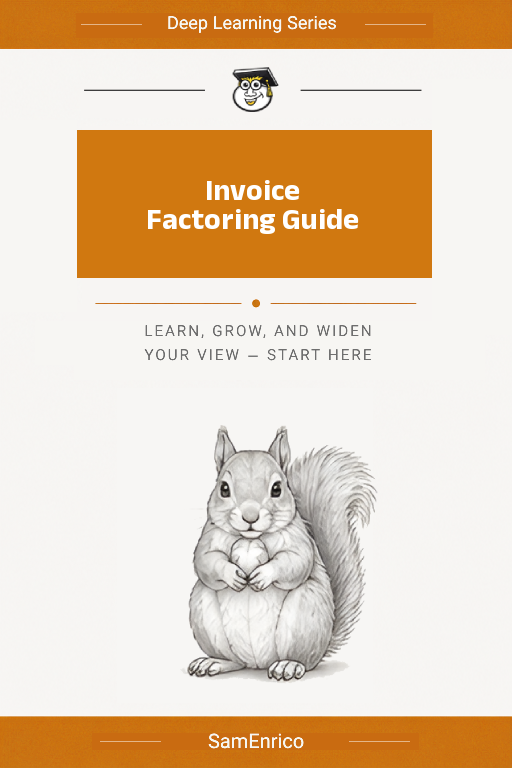
Non-FictionBusiness BriefInvoice Factoring
Invoice Factoring Guide eBook
Sell unpaid export invoices to factoring companies
Sell unpaid export invoices to factoring companies for immediate cash at a discount including cost calculations for African SMEs.
Formats
Free sample
Chapter 1: The Waiting Economy--–- The most expensive word in business is not "interest" or "default" or "bankruptcy." It is "tomorrow."Fatima Diallo learned this lesson on a Tuesday afternoon in Dakar, sitting on a plastic chair in an empty warehouse, staring at a stack of invoices that represented everything she had worked for over the past seven years.The invoices were beautiful, in their way. Crisp white paper. Blue company letterhead she had designed herself, paying a graphic designer three times what a local printer would have charged because she wanted to look professional. Clean columns of numbers: product descriptions, quantities, unit prices, totals. Each one stamped with her company name – Sénégal Soap Collective – and signed in her own hand.Together, they represented $342,000 of organic shea butter soaps shipped to buyers in France, Germany, and the United Kingdom.Together, they were worthless – until someone paid them.And no one was going to pay them for another sixty to ninety days.Fatima had started her business in 2016 with $500 and a single grandmother who knew how to extract shea butter the traditional way.
Seven years later, she employed forty-two women – grandmothers themselves now – in a cooperative that produced the highest-quality organic soap base in West Africa. She had won export awards. She had been written up in a French business magazine. She had a waiting list of European buyers who wanted her product.She also had a problem.The problem was not demand. The problem was time.Her production cycle worked like this: she bought raw shea nuts from rural women's cooperatives, paid them cash on delivery, processed the nuts into butter, turned the butter into soap base, packaged the base, shipped it to Europe, waited sixty to ninety days, received payment, and then – and only then – had the money to buy more shea nuts.The gap between paying her suppliers and receiving payment from her buyers was seventy-five days on average.
For those seventy-five days, Fatima had no cash. She could not buy more nuts. She could not pay her forty-two women. She could not accept new orders – even though new orders were arriving every week.In the three years before that Tuesday in her warehouse, Fatima had turned down over $1.2 million in orders. Not because she could not produce the soap.
Because she could not afford to wait to be paid for the soap she had already produced.She was trapped in what I call the Waiting Economy.The Hidden Tax on African Exporters The Waiting Economy is not a metaphor. It is a measurable, predictable, and devastating tax on businesses exactly like Fatima's. Every day that an exporter waits for payment, their money loses value – not just from inflation, but from opportunity cost. The cash that is sitting in someone else's bank account could be buying new inventory, hiring more workers, or accepting larger orders.Let me show you the math.Imagine you run an export business with a healthy 20% profit margin. You receive a $100,000 order from a European buyer.
You deliver the goods. The payment terms are 90 days.During those 90 days, your 100,000invoiceisnotavailabletoyou.Buttheopportunitycostisnotjustthe100,000 invoice is not available to you. But the opportunity cost is not just the 100,000invoiceisnotavailabletoyou.Buttheopportunitycostisnotjustthe100,000. It is the $100,000 plus the profit you could have earned if you had turned that money over again.If you could have used that $100,000 to produce and ship another order within 30 days, earning another 20% margin, then used that money to produce another order, and so on – how many times could you have turned over that capital in 90 days?At a 30-day production cycle, you could have turned it over three times. That means your 100,000invoiceisnotjust100,000 invoice is not just 100,000invoiceisnotjust100,000 of trapped cash.
It is 100,000ofcashthatcouldhavegenerated100,000 of cash that could have generated 100,000ofcashthatcouldhavegenerated60,000 in additional profit (20% margin × 3 turns) if only you had access to it.Ninety days of waiting costs you $60,000 in lost profit – on a single invoice.This is why the Waiting Economy is so destructive. It does not just starve you of cash today. It starves you of the growth you could have achieved with that cash tomorrow.The Three Lies Banks Tell African SMEs Fatima, like most African exporters, tried the traditional solution first. She went to her bank.She sat across from a loan officer in an air-conditioned office, wearing her best outfit, carrying three years of audited financial statements, export contracts, and letters of credit. She explained her business.
She showed her growth. She pointed to the waiting list of European buyers.The loan officer listened politely, nodded in the right places, and then said: "You need collateral."Fatima offered her warehouse. Not enough.She offered her equipment. Not enough.She offered her personal savings. Not enough.The bank wanted collateral worth 120% of the loan amount.
Fatima did not have it. She was denied.This is not because the bank is evil or incompetent. It is because banks are designed to lend against what you own, not what you are owed. Their risk models are built on physical assets – buildings, machines, inventory – that they can seize and sell if you default. They have no reliable way to value your invoices, because your invoices depend on your buyers, and your buyers are in another country, under another legal system, and the bank has no relationship with them.So the bank tells you three lies – not malicious lies, but functional lies that hide the real solution.Lie #1: "You need a loan." You do not need a loan.
You need cash. There is a difference. A loan creates debt. Selling an invoice creates liquidity. One makes you a borrower.
The other makes you a seller.Lie #2: "We need to see your balance sheet." Your balance sheet is irrelevant to the question of whether your buyer will pay. What matters is your buyer's balance sheet. The bank is asking the wrong question.Lie #3: "Factoring is too expensive." The bank says this because factoring competes with their loan products. But is factoring expensive compared to turning down $1.2 million in orders? Is it expensive compared to paying 28% interest on a microfinance loan?
Is it expensive compared to bankruptcy?The truth is that factoring is not expensive. It is priced appropriately for the risk it carries. And for African SMEs locked out of traditional banking, it is often the only option that exists.The Forty-Eight Hour Solution Now let me show you what Fatima should have done.After her bank rejection, Fatima spent six months researching alternatives. She found a fintech factor that specialized in African exports to Europe. She submitted her largest invoice – $142,000 to a French cosmetics company – along with proof of delivery and the buyer's purchase order.Within forty-eight hours, she received $113,600 in her account.
That was 80% of the invoice value.With that cash, she bought two months' worth of raw shea nuts, paid her forty-two women their full salaries plus a bonus, and accepted three new orders she would have otherwise rejected.When the French buyer paid the factor ninety days later, the factor released the remaining 28,400minus28,400 minus 28,400minus3,200 in fees. Fatima's total cost for accessing 113,600sixtydaysearlierthanshewouldhaveotherwise:113,600 sixty days earlier than she would have otherwise: 113,600sixtydaysearlierthanshewouldhaveotherwise:3,200, or 2.25% of the invoice value.Compare that to…
This is the end of the free sample. Get the eBook to keep going. Buy now
About this book
Details
- Author
- Echevarria Marin
- Publisher
- SamEnrico
- Language
- English
- Genre
- Non-Fiction, Business Brief, Invoice Factoring
- Released
- 2026-05-29
- Pages (approx.)
- 150
- Available as
- eBook, Audiobook

Read better in the ZLOADR app
Your eBooks on your phone or tablet. Sign in with your SamEnrico account and start reading.
More by Echevarria Marin
 Volunteer Event Small Talk CourseEchevarria Marin$11.99
 The Sense of Wonder RevisitedEchevarria Marin$11.99
 Nobel Laureates In SuperconductivityEchevarria Marin$11.99
 Snow Walking Mindfulness GuideEchevarria Marin$11.99
 Good Enough Dieting GuideEchevarria Marin$11.99
 Blood Moon Murders: The Ripper’s Shadow in the Digital AgeEchevarria Marin$11.99
 The Quantum Whisperer: How John Preskill Shaped the Future of ComputingEchevarria Marin$11.99
 Freemium Dark Pattern AvoidanceEchevarria Marin$12.99
 Prosthetic Limb Cleaner and MaintainerEchevarria Marin$11.99
 Understanding Goodpasture Pneumorenal SyndromeEchevarria Marin$17.99
 How to Become a Kiln LoaderEchevarria Marin$11.99
You may also like
 Hong Kong Handover 1997Dunn Johnnie$11.99
 Zumba For Postnatal Recovery CourseNeal Christian$11.99
 Zumba for BeginnersLadner Nikia$11.99
 YouTube Comment Mining GuideHumes Pandora$12.99
 Worry Box MeditationCarlin Rudy$11.99
 Workplace Stress MeditationNguyen Lynn$11.99
 Workplace Stress and Sleep RepairHawley Ivory$11.99
 Workplace Perfectionism CureDelaney Jeffry$11.99
 Workplace Injustice Anger GuideWallen Isabelle$11.99
 Work Addiction and Burnout LinkGreenwood Ester$11.99
 Women in Yoga and WellnessBeattie Galina$11.99
 Women in Stand Up ComedyChun Evangeline$11.99