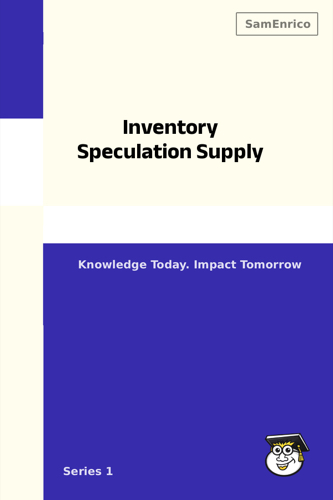
Inventory Speculation Supply eBook
Understand how suppliers withhold stock expecting
Understand how suppliers withhold stock expecting higher future prices.
Formats
Free sample
Chapter 1: The Silent Corner...--–- The warehouse looked like any other industrial building on the outskirts of Rotterdam—gray concrete, razor wire, a faded shipping logo barely visible under decades of grime. But inside, stacked in neat, towering rows, sat $400 million worth of aluminum. Not aluminum destined for a factory. Not aluminum waiting to be turned into airplane wings or beer cans. Aluminum that was simply...
waiting. The owner had leased the space for eighteen months. He had no buyers lined up. He had no manufacturing plant of his own. What he had was a bet: that somewhere between the day he bought this metal and the day he sold it, something would go wrong in the world.
A war. A sanctions regime. A pandemic. A power outage in a smelting hub. And when that something happened, the price would double.
He would sell. He would walk away with $400 million. And no law would have been broken.Across the Atlantic, six months earlier, a different scene unfolded. A factory manager in Ohio stared at an empty bin where semiconductor chips should have been. His assembly line had gone silent.
He had orders to fill, payroll to meet, customers screaming for delivery. But his suppliers—the same ones who had promised just-in-time deliveries for a decade—had nothing. They hadn't been cut off by a natural disaster or a trade war. Their warehouses were full. They were simply holding.
Waiting for prices to rise higher. The manager laid off two hundred workers that Friday. They didn't know their unemployment was the result of a spreadsheet calculation in a hedge fund's office, where someone had decided that holding chips for three more weeks would yield an extra 15 percent margin.This book is about the space between those two stories. It is about the inventory that disappears from active supply chains—not consumed, not in transit, not lost—but deliberately, strategically held back. The inventory that sits in the "silent corner" of the market, invisible to most, waiting for the right price to emerge.
And the people who make that decision: the suppliers, traders, hedge funds, state-owned enterprises, and sometimes even governments who choose to withhold stock today because they expect higher prices tomorrow.This is not a book about hoarding in the panic-buying, toilet-paper-in-a-pandemic sense. That is a different phenomenon—defensive, fearful, reactive. This book is about offensive hoarding: cold, calculated, profit-seeking speculation conducted by professionals who understand the mathematics of storage, the psychology of scarcity, and the loopholes in global supply chains. These actors do not hoard because they are afraid of running out. They hoard because they have run the numbers and concluded that the market has mispriced the future.
And they intend to profit from that mispricing.The strategy has many names: withholding, stockpiling, warehousing, carrying, and in its most sophisticated form, "contango capture." But the underlying logic is always the same. A supplier looks at the price today, looks at the price that can be locked in for delivery six months from now, subtracts the cost of storing the goods, and asks a simple question: does the math work? If the answer is yes, they buy. They store. They wait.
And when the future becomes the present, they sell. This is not gambling. It is not irrational exuberance. It is arithmetic dressed in work boots and a hard hat.Yet for all its mathematical clarity, the world of inventory speculation is surprisingly misunderstood. Journalists call it "price gouging." Politicians call it "market manipulation." Economists call it "competitive storage under rational expectations." But none of these labels capture the full picture.
The truth is more interesting and more disturbing: inventory speculation is not a bug in the system. It is a feature. It emerges naturally from any market where storage is possible, where prices can move, and where human beings can form expectations about the future. You cannot regulate it away. You cannot shame it into submission.
You can only understand it—and then decide how to play the game.This chapter introduces the foundational concepts that will guide the rest of the book. We will establish a clear typology of hoarding that distinguishes between profit-seeking offensive speculation and risk-avoidant defensive stockpiling. We will define the key terminology—contango, backwardation, convenience yield, the bullwhip effect—that forms the vocabulary of this hidden world. And we will explain why now, in an era of fractured supply chains, geopolitical chaos, and climate-driven disruptions, inventory speculation has moved from a niche hedge fund strategy to a mainstream corporate imperative.Most importantly, we will answer the question that haunts every executive, trader, and policymaker who has ever watched a price spike and wondered: who is doing this, and how do I see them coming?The Silent Corner Defined The term "silent corner" comes from an old trading floor expression. When a speculator began buying up physical supply without announcing their intent—taking delivery, renting warehouses, quietly accumulating—other traders would say they were "cornering the market in silence." The silent corner was the position that no one could see until it was too late.
Today, the term has broadened. It refers to any inventory that has left the visible, measurable, reported supply chain but has not yet been consumed. It is in the shadows. It is off the books. And it is waiting.Consider how most supply chains operate.
A mining company produces copper. It sells to a smelter. The smelter sells to a wire manufacturer. The wire manufacturer sells to an auto parts supplier. The auto parts supplier sells to a car factory.
At each step, inventory is tracked, reported, and accounted for. Governments publish statistics. Industry groups release reports. Analysts build models. Everyone thinks they know how much copper exists.But what happens when a hedge fund steps in between the smelter and the wire manufacturer?
The fund buys the copper, pays the smelter, takes delivery, and moves the metal to a leased warehouse. The wire manufacturer, still needing copper, now must buy from the fund at whatever price the fund demands. The inventory still exists. It just isn't where the models expect it to be. It has entered the silent corner.The effect on price is predictable and profound.
By removing supply from the active chain, the fund creates an artificial scarcity. The wire manufacturer panics, orders extra, and passes that panic upstream. The auto parts supplier, seeing the wire manufacturer's desperation, doubles its own order. The car factory, hearing rumors of a shortage, triples its request. By the time the metal finally emerges from the silent corner, the price has doubled—and the fund sells into a market that has been conditioned to expect even higher prices.This is not theory.
It happened with aluminum in 2014, when Goldman Sachs and other financial players were accused of controlling over 80 percent of available inventory in some LME warehouses. It happened with oil in 2009, when supertankers became floating storage units. It happened with copper in 2021, with natural gas in 2022, with cocoa in 2010, and with nickel in 2022. Every time, the pattern was the same: quiet accumulation, visible inventory drawdowns, price spikes, and then—eventually—a flood of…
This is the end of the free sample. Get the eBook to keep going. Buy now
About this book
Details
- Author
- Nettles Jeffie
- Publisher
- SamEnrico
- Language
- English
- Genre
- Non-Fiction, Business Brief, Inventory Strategy
- Released
- 2026-06-06
- Pages (approx.)
- 137
- Available as
- eBook, Audiobook

Read better in the ZLOADR app
Your eBooks on your phone or tablet. Sign in with your SamEnrico account and start reading.
More by Nettles Jeffie
 The Social Media and FriendshipNettles Jeffie$11.99
 HIIT For Cardiovascular HealthNettles Jeffie$11.99
 Sugar Addiction Detox ProtocolNettles Jeffie$11.99
 Trafalgar: Nelson's Last Stand – The Naval Battle That Ruled the WavesNettles Jeffie$11.99
 10 Ways to Use Grapefruits (Recipe Book)Nettles Jeffie$11.99
 Board Report Mistakes GuideNettles Jeffie$12.99
 Learn to Play the YazhengNettles Jeffie$11.99
 Personal Support WorkersNettles Jeffie$11.99