
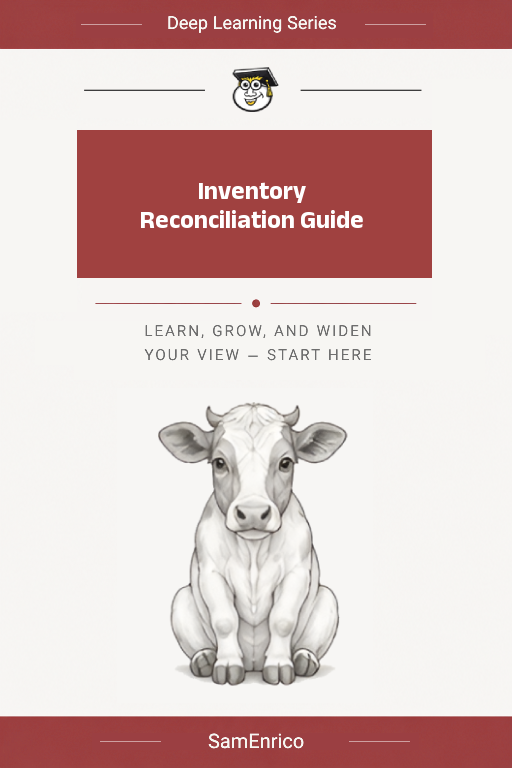
Non-FictionAI OperatorInventory Reconciliation
Inventory Reconciliation Guide eBook
Use AI workflows to automatically reconcile invent
Use AI workflows to automatically reconcile inventory counts between systems and physical logs.
Formats
Free sample
Chapter 1: The 91% Lie...--–- The email arrived at 4:47 PM on a Thursday, which Maya had long ago learned was the chosen hour for career-ending news. "Inventory variance: $412,000. Please explain by Monday close." The sender was the CFO. The subject line had no greeting, no pleasantries, just the cold mathematics of her impending humiliation.Maya Chen had been the Director of Inventory Operations at Green Leaf Home Goods for eleven years. She had survived three CEOs, two warehouse fires, and the great shipping container crisis of 2021.
But she had never seen a single-line variance this large. Four hundred and twelve thousand dollars. Not missing—because missing implied someone knew where it was. Just... unexplained.
A hole in the balance sheet large enough to drive a forklift through.She pulled up the inventory ledger. The system said Green Leaf had 12,847 units of their premium "Heritage Oak" dining table in stock across five warehouses and thirty-two retail stores. The physical count from yesterday's cycle count suggested they had 11,092. The difference: 1,755 tables. At 235wholesaleeach.235 wholesale each.
235wholesaleeach.412,425.The system wasn't just wrong. It was catastrophically, auditor-baitingly wrong.Maya's first call was to Tom, her senior cycle count supervisor. "Tell me this is a counting error.""It's not," Tom said. He sounded tired. "We recounted the three worst bins twice.
They're not there, Maya. The system says we have them. The warehouse says we don't. That's all I've got.""Check the receiving logs for the past six months. Cross-reference PO receipts against bin assignments.""Already did.
That's the problem. The receiving logs match the system. Every PO, every packing slip, every scan says those tables arrived. But physically? They evaporated."Maya stared at her screen.
The numbers blurred. She thought about the 2,400 hours her team had spent on spreadsheet reconciliation in the past year. She thought about the 14 different Excel files currently open on her computer, each one a different version of the truth. She thought about the fact that she had no idea—none—whether the $412,000 was theft, data error, supplier fraud, or a rounding mistake that had compounded over 18 months.She thought about updating her resume.This is not a story about bad people or incompetent teams. Maya's team was good.
Green Leaf's systems were standard—a respectable ERP, a functional WMS, barcode scanners, cycle count schedules, all the tools the consultants said they needed. The problem wasn't the tools. The problem was trust. Specifically, the problem was that Green Leaf trusted its inventory system 100% and its physical reality 100%, but the two numbers had not agreed in years. The gap between them—the 9% gap, as Maya would soon discover—was where careers went to die.The Inventory Trust Gap: What 91% Really Means Let us pause Maya's crisis for a moment to establish a baseline.
Industry studies across retail, manufacturing, and distribution consistently find that SKU-level inventory accuracy—meaning the system's total on-hand quantity for a given product matches the physical count within a tolerable range—typically falls between 91% and 95%. This is not a failure. This is considered normal. Best-in-class operations might reach 97%. The average hovers around 93%.Now consider what 93% means.
For every 100 units the system believes you have, 7 are somewhere else. Sometimes those 7 are in the wrong bin, mislabeled, or in transit. Sometimes they were stolen, damaged, or never arrived despite being recorded as received. Sometimes they exist only as a phantom—a digital artifact of a data entry error made eighteen months ago by a temp worker who no longer works for the company.For a company with 50millionininventory,750 million in inventory, 7% represents 50millionininventory,73.5 million of uncertainty. That is not a rounding error.
That is a material misstatement. That is the kind of number that gets publicly traded companies in trouble with the SEC. And yet, most inventory managers accept this 7-9% gap as an immutable law of physics, like gravity or entropy. Inventory gets messy, they say. You can't count everything all the time.
Shrinkage happens.Maya had believed this for eleven years. She had built her career on managing the gap, not closing it. She had become an expert at variance explanations—the art of telling the CFO that $412,000 was actually fine, actually normal, actually just the cost of doing business.But on this Thursday afternoon, sitting in the glow of her monitor, she realized something: the gap was not inevitable. The technology to close it existed. It had existed for years.
She just hadn't been allowed to use it.The Human Cost of Manual Reconciliation To understand why Maya was in this position, you have to understand how inventory reconciliation actually works in most companies. It does not look like the textbooks. It does not involve elegant algorithms or real-time data synchronization. It looks like spreadsheets.Specifically, it looks like Maya's senior analyst, Priya, who spent twelve hours last week comparing the ERP's month-end inventory report to the WMS's bin-level count sheet. The ERP said Warehouse A had 847 units of SKU 4472 (a mid-century coffee table).
The WMS said 823. Priya exported both reports to Excel, used a VLOOKUP to align them by bin, and manually investigated the 24 discrepancies. Six were timing differences (goods received after month-end cutoff). Four were unit-of-measure errors (the ERP counted in cases of 2; the WMS counted in eaches). Twelve were unexplained.Priya then created a "variance bridge" spreadsheet—a beautiful, color-coded document that explained 8,700ofthe8,700 of the 8,700ofthe412,000 variance.
The remaining $403,300 went into a line item labeled "Other Adjustments" because she had run out of time before the close deadline.This is not an isolated story. Across industries, inventory managers spend 8 to 15 hours per week manually comparing spreadsheets, pivot tables, printed count sheets, and handwritten logs. For a team of ten people at an average fully-loaded cost of 60perhour,thatis60 per hour, that is 60perhour,thatis62,400 to $117,000 per month in labor—just to identify discrepancies, not to resolve them. Over a year, that's three-quarters of a million dollars spent on the act of discovering that you have a problem, with little capacity left to fix it.Worse, manual reconciliation is not merely expensive. It is slow.
By the time Priya finished her variance bridge, the information was already obsolete. New shipments had arrived. New sales had occurred. New errors had been made. The reconciliation was a snapshot of a moving target, useful for audit compliance but useless for operations.Maya had known this for years.
She had pleaded for automation. She had requested a dedicated reconciliation module. She had even offered to pilot a small AI project on a single SKU family. The answer was always the same: "Not in the budget. Not this quarter.
Make do with what you have."So she made do. And now she had a $412,000 hole in her balance sheet.Cognitive Reconciliation: A New Definition Let us propose a different way. Not incremental improvement. Not faster spreadsheets or better training. A fundamentally different approach to the problem of comparing what the system says to what the warehouse has.Cognitive Reconciliation is the use of artificial intelligence—specifically Large Language Models (LLMs) for understanding human-generated variance notes and, as detailed in Chapter 6, computer vision for validating physical documents—to automate the comparison, classification, and resolution of inventory discrepancies.
Unlike traditional Robotic Process Automation (RPA), which follows rigid rules and breaks when formats change, cognitive reconciliation adapts. It reads.…
This is the end of the free sample. Get the eBook to keep going. Buy now
About this book
Details
- Author
- Ridgeway Basil
- Publisher
- SamEnrico
- Language
- English
- Genre
- Non-Fiction, AI Operator, Inventory Reconciliation
- Released
- 2026-05-30
- Pages (approx.)
- 151
- Available as
- eBook, Audiobook

Read better in the ZLOADR app
Your eBooks on your phone or tablet. Sign in with your SamEnrico account and start reading.
More by Ridgeway Basil
 Self Esteem Activities for TeensRidgeway Basil$11.99
 Mindful Chores MBSR HandbookRidgeway Basil$11.99
 Ayurvedic Oil Selection GuideRidgeway Basil$11.99
 The Polish IT Offshoring Talent ShiftRidgeway Basil$11.99
 Teen Self Esteem and CodingRidgeway Basil$11.99
 VP Customer Onboarding and EnablementRidgeway Basil$11.99
 Brazil Dropshipping Niche SelectionRidgeway Basil$12.99
 Understanding Microcephaly Brain Defect Spasticity HypernatremiaRidgeway Basil$17.99
 How to Start a Private Hospital Business (Beginners Guide)Ridgeway Basil$11.99
You may also like
 Hong Kong Handover 1997Dunn Johnnie$11.99
 Zumba For Postnatal Recovery CourseNeal Christian$11.99
 Zumba for BeginnersLadner Nikia$11.99
 YouTube Comment Mining GuideHumes Pandora$12.99
 Worry Box MeditationCarlin Rudy$11.99
 Workplace Stress MeditationNguyen Lynn$11.99
 Workplace Stress and Sleep RepairHawley Ivory$11.99
 Workplace Perfectionism CureDelaney Jeffry$11.99
 Workplace Injustice Anger GuideWallen Isabelle$11.99
 Work Addiction and Burnout LinkGreenwood Ester$11.99
 Women in Yoga and WellnessBeattie Galina$11.99
 Women in Stand Up ComedyChun Evangeline$11.99