
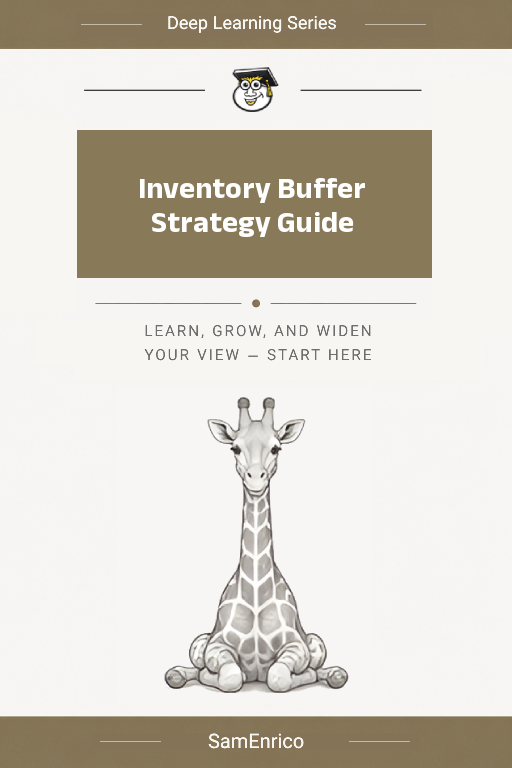
Non-FictionAnnual CheckupInventory ManagementBuffer
Inventory Buffer Strategy Guide eBook
Optimize safety stock levels to protect against su
by Dias Shawnta
Optimize safety stock levels to protect against supply chain disruptions without tying up excessive working capital.
Formats
Free sample
Chapter 1: The Stockout Paradox--–- Alex Rivera had been staring at the same spreadsheet for four hours, and her vision was starting to blur. Three monitors glowed on her desk, each filled with columns of inventory data that told two completely different stories. On the left screen, a dashboard showed $47 million worth of inventory sitting in three warehouses. On the center screen, a list of urgent stockout alerts scrolled endlessly—fifteen SKUs that had run dry in the past week alone. On the right screen, an email from the CFO glowed like a warning flare: "We need to talk about your inventory turns.
My office. 9 AM tomorrow."Alex leaned back in her chair and rubbed her eyes. She was the Supply Chain Director at Nova Goods, a mid-sized consumer products company that made everything from camping gear to kitchen gadgets. The company had grown fast—too fast—and somewhere along the way, inventory had become a monster that no one knew how to tame. Warehouses were bursting at the seams, yet customers kept calling to complain that the items they wanted most were out of stock.
The sales team blamed operations. Operations blamed procurement. Procurement blamed the suppliers. And everyone, it seemed, blamed Alex.She pulled up the numbers again. Total inventory value: 124million.Annualcarryingcostestimate:roughly124 million.
Annual carrying cost estimate: roughly 124million.Annualcarryingcostestimate:roughly30 million. Stockout rate over the past six months: 8.4 percent. Lost sales due to stockouts: an estimated 12millioninrevenue.Alexdidthemathinherhead.Theywerespending12 million in revenue. Alex did the math in her head. They were spending 12millioninrevenue.Alexdidthemathinherhead.Theywerespending30 million to hold inventory, and that inventory was failing to capture $12 million in sales because the wrong things were in the wrong places at the wrong times.This was the Stockout Paradox.The Great Misunderstanding The Stockout Paradox is simple to describe but maddeningly difficult to solve.
Most companies simultaneously hold too much inventory and too little inventory. They are drowning in cash-draining stock that nobody wants, while running out of the products that customers actually buy. It is a contradiction that defies common sense. How can you have too much and too little at the same time?The answer lies in how companies think about safety stock. Safety stock is the extra inventory held beyond expected demand—the buffer that protects against uncertainty.
If demand spikes or a supplier ships late, safety stock is supposed to save the day. But for most companies, safety stock has become a dumping ground for bad decisions. When a buyer is unsure about a forecast, they add a few extra cases. When a warehouse manager worries about a stockout, they pad the reorder point. When a supplier announces a price increase, procurement orders six months of supply "just in case." These individual decisions, each reasonable in isolation, compound into a mountain of excess inventory.
At the same time, because this excess is allocated to the wrong SKUs, the items that actually sell quickly run out.Alex had seen this pattern play out again and again. Nova Goods carried 127 days of inventory for a slow-moving stainless steel water bottle that sold maybe 200 units a month. But their best-selling backpack—the one that generated $400,000 in monthly revenue—regularly ran out of stock because no one had bothered to increase its safety stock after a viral Tik Tok video drove demand up 300 percent.The problem was not a lack of inventory. The problem was a lack of strategy.The Trillion-Dollar Problem Alex was not alone. Across the global economy, companies are sitting on a mountain of excess inventory that is quietly destroying shareholder value.
According to industry estimates, the average company holds inventory worth 20 to 30 percent of its annual revenue. For a 500millioncompany,thatmeans500 million company, that means 500millioncompany,thatmeans100 million to $150 million tied up in warehouses and distribution centers. Of that amount, experts estimate that 15 to 25 percent is unnecessary—safety stock that serves no strategic purpose and could be eliminated without any negative impact on customer service.Multiply that across all the manufacturers, distributors, and retailers in the United States, and you are looking at a trillion-dollar problem. A trillion dollars in working capital that could be invested in new products, marketing, research and development, or simply returned to shareholders. Instead, it sits on pallets, gathering dust and costing money every single day.The costs are staggering.
Inventory carrying costs typically range from 20 to 30 percent of inventory value annually. That means for every 1millioninexcessinventory,acompanyisburning1 million in excess inventory, a company is burning 1millioninexcessinventory,acompanyisburning200,000 to 300,000everyyearinstorage,insurance,taxes,handlinglabor,opportunitycost,andobsolescencerisk.Overfiveyears,that300,000 every year in storage, insurance, taxes, handling labor, opportunity cost, and obsolescence risk. Over five years, that 300,000everyyearinstorage,insurance,taxes,handlinglabor,opportunitycost,andobsolescencerisk.Overfiveyears,that1 million in excess inventory becomes $2 million in wasted cash. And that is just the direct cost. The indirect costs—slower innovation, reduced agility, lower employee morale, and damaged customer relationships—are even larger.Alex thought about what she could do with an extra $30 million in working capital.
She could launch two new product lines. She could upgrade the company's ancient ERP system. She could give her team the raises they deserved. Instead, that money was locked up in corrugated boxes, stacked twenty feet high in a warehouse sixty miles from headquarters.The Hidden Drivers of Excess Inventory How does excess inventory creep into a supply chain? The answer is rarely a single bad decision.
Instead, it is the cumulative effect of dozens of small, seemingly rational choices made by different people with different incentives.The Buyer's Bias Buyers are typically measured on two things: cost savings and supplier performance. If a buyer negotiates a lower unit price by ordering larger quantities, they look good. If they run out of stock, they look bad. The natural result is that buyers have a strong incentive to order more inventory than necessary. They might call it "economies of scale" or "volume discounts," but the effect is the same: excess inventory that someone else has to pay to store.At Nova Goods, one of Alex's buyers had negotiated a 15 percent discount on plastic water bottles by ordering a full container—50,000 units.
The discount saved 22,500onpaper.Butthosewaterbottlestookup200palletpositionsinthewarehouseforninemonths.At22,500 on paper. But those water bottles took up 200 pallet positions in the warehouse for nine months. At 22,500onpaper.Butthosewaterbottlestookup200palletpositionsinthewarehouseforninemonths.At25 per pallet per month in storage and handling costs, that was $45,000 in carrying costs. The "savings" had cost the company twice as much in hidden expenses.The Salesperson's Optimism Salespeople are optimists by nature. They have to be.
When a salesperson submits a forecast, they are not trying to predict the future. They are trying to create a future in which they hit their number. This leads to systematic forecast inflation, especially for new products or promotional items. The salesperson's inflated forecast becomes the basis for procurement and production. When the actual demand falls short, the excess becomes inventory.
When the salesperson blames "market conditions" and cuts the next forecast, the excess remains.At Nova Goods, the sales team had forecast 80,000 units of a new camping stove for the holiday season. The marketing team added another 20,000 units for a planned promotion. Procurement ordered 100,000 units. Actual sales: 42,000 units. The…
This is the end of the free sample. Get the eBook to keep going. Buy now
About this book
Details
- Author
- Dias Shawnta
- Publisher
- SamEnrico
- Language
- English
- Genre
- Non-Fiction, Annual Checkup, Inventory Management, Buffer
- Released
- 2026-05-30
- Pages (approx.)
- 146
- Available as
- eBook, Audiobook

Read better in the ZLOADR app
Your eBooks on your phone or tablet. Sign in with your SamEnrico account and start reading.
More by Dias Shawnta
 Ransom Payment and Recovery Protocol GuideDias Shawnta$11.99
 Psychotherapy For Persistent DepressionDias Shawnta$11.99
 Congress Member Seniority PowerDias Shawnta$11.99
 BPH Natural Supplements GuideDias Shawnta$11.99
 UK Global Tariff System GuideDias Shawnta$11.99
 Dust and Data: How a Forgotten Desert Town Became the Internet’s BackboneDias Shawnta$11.99
 The Lost Rivers of the Kalahari: Laetoli’s Forgotten ExplorersDias Shawnta$11.99
 China Visa Photo RequirementsDias Shawnta$12.99
 Understanding Congenital Hypotrichosis MiliaDias Shawnta$17.99
 Program ClerkDias Shawnta$11.99
 How to Start a Preparation and Linkage of Digital Data Business (Beginners Guide)Dias Shawnta$11.99
You may also like
 Hong Kong Handover 1997Dunn Johnnie$11.99
 Zumba For Postnatal Recovery CourseNeal Christian$11.99
 Zumba for BeginnersLadner Nikia$11.99
 YouTube Comment Mining GuideHumes Pandora$12.99
 Worry Box MeditationCarlin Rudy$11.99
 Workplace Stress MeditationNguyen Lynn$11.99
 Workplace Stress and Sleep RepairHawley Ivory$11.99
 Workplace Perfectionism CureDelaney Jeffry$11.99
 Workplace Injustice Anger GuideWallen Isabelle$11.99
 Work Addiction and Burnout LinkGreenwood Ester$11.99
 Women in Yoga and WellnessBeattie Galina$11.99
 Women in Stand Up ComedyChun Evangeline$11.99