
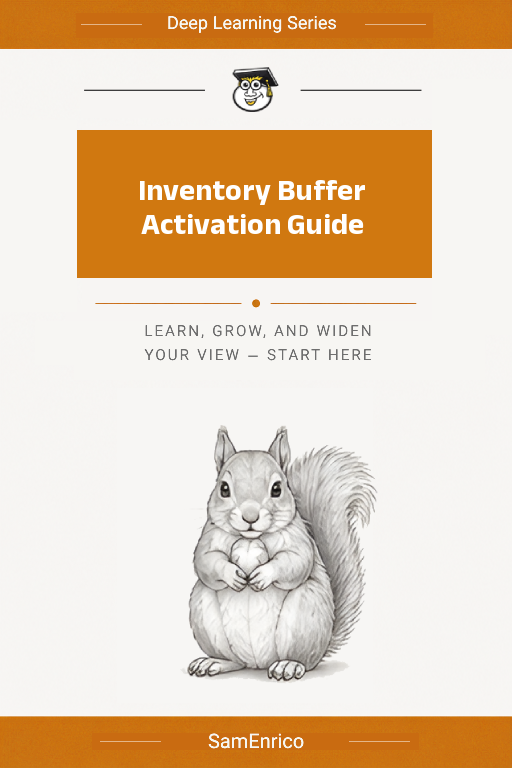
Non-FictionCrisis ManagementLogistics ResilienceStock Guide
Inventory Buffer Activation Guide eBook
Deploy safety stock, consignment inventory, and ju
Deploy safety stock, consignment inventory, and just-in-case buffers when disruptions hit. Covers storage cost triggers, SKU prioritization, and expiration management for extended holds.
Formats
Free sample
Chapter 1: The Inventory Lie--For three decades, supply chain professionals were taught that inventory was a sin. It was waste. It was capital prison. It was the visible symptom of a poorly managed operation. The lean movement, Six Sigma, just-in-time—all of them pointed to the same conclusion: hold less, turn faster, and any excess will rot on your balance sheet.
Then the world changed. A virus shut down factories across three continents. A single container ship blocked the Suez Canal for six days, holding up $9 billion in trade. A rail strike in Canada left grain rotting on prairies while buyers in Asia paid triple prices. And suddenly, the companies with empty warehouses were not the heroes of efficiency.
They were the casualties. The ones with dusty pallets in the back—the ones the consultants had mocked—those were the companies still shipping.This book is not about returning to the dark ages of bloated warehouses. It is about learning a new skill: the art of the strategic buffer. When to hold, when to release, and how to calculate exactly how much inventory is insurance versus how much is just expensive dust. This first chapter dismantles the old religion, introduces the two-tier buffer system that will underpin everything that follows, and gives you the five triggers that tell you when to stop trusting your suppliers and start trusting your own stock.The Autopsy of a Broken Religion Let us begin with three stories.
Each one is true. Each one cost real companies real millions. And each one exposes the lie that zero inventory is a virtue.Story One: The Mask Gap In January 2020, a large Midwestern hospital system had perfected its supply chain. It ran on lean principles. Its inventory turns were in the top decile of its peer group.
Its consultants had given it awards. When the first whispers of a novel coronavirus emerged, the system had exactly seven days of N95 masks on hand. That was the calculation: seven days of safety stock, based on normal demand and normal lead times. Within 72 hours of the first local case, those masks were gone. Emergency sourcing cost 4million.Nursesworebandanas.Electivesurgeriesstopped.Acompetitorfiftymilesaway,onethattheconsultantshadcalled“old−fashioned”becauseitkeptathirty−daybufferofcritical PPE,servedpatientsforeightweekswithoutinterruption.Thefinancialgapbetweenthetwosystemswas4 million.
Nurses wore bandanas. Elective surgeries stopped. A competitor fifty miles away, one that the consultants had called “old-fashioned” because it kept a thirty-day buffer of critical PPE, served patients for eight weeks without interruption. The financial gap between the two systems was 4million.Nursesworebandanas.Electivesurgeriesstopped.Acompetitorfiftymilesaway,onethattheconsultantshadcalled“old−fashioned”becauseitkeptathirty−daybufferofcritical PPE,servedpatientsforeightweekswithoutinterruption.Thefinancialgapbetweenthetwosystemswas3.8 million in favor of the one that ignored lean orthodoxy. That is the buffer paradox: holding cost looks expensive on a spreadsheet.
Stockout cost looks catastrophic in real life.Story Two: The Ship That Stole Christmas On March 23, 2021, the Ever Given ran aground in the Suez Canal. For six days, the artery of global trade was blocked. A European auto parts distributor had spent years reducing its inventory. Its warehouse was a model of efficiency. Its lead time from Asia was four weeks.
When the canal closed, that lead time jumped to twelve weeks overnight. The distributor had a six-week buffer. It lost two weeks of sales. A smaller competitor, one that the larger firm had dismissed as unsophisticated, kept a twelve-week buffer. It lost no sales.
After the crisis, the larger firm calculated that the incremental holding cost of a twelve-week buffer would have been 210,000peryear.Thelostsalesfromthesix−daycanalclosureexceeded210,000 per year. The lost sales from the six-day canal closure exceeded 210,000peryear.Thelostsalesfromthesix−daycanalclosureexceeded3 million. The math was not close.Story Three: The Grain Train In late 2023, a labor dispute shut down Canada’s two largest rail carriers. A grain exporter had optimized its supply chain to move product directly from farm to port. No storage in between.
No buffer. When the trains stopped, the exporter faced 15millionindemurrageandcancellationfees.Acompetitorthatowned500railcarsofbufferstorage—silosatstrategictransshipmentpoints—lostnothing.Thecompetitor’sannualholdingcostforthosesiloswas15 million in demurrage and cancellation fees. A competitor that owned 500 rail cars of buffer storage—silos at strategic transshipment points—lost nothing. The competitor’s annual holding cost for those silos was 15millionindemurrageandcancellationfees.Acompetitorthatowned500railcarsofbufferstorage—silosatstrategictransshipmentpoints—lostnothing.Thecompetitor’sannualholdingcostforthosesiloswas800,000. The first exporter paid nineteen times that in a single strike.These three stories share a common pathology.
In each case, the victim had been told for years that inventory was waste. The victor had quietly ignored that advice. The difference was not luck. It was a willingness to hold strategic reserves—and a clear framework for deciding when and how much.The Two-Tier Buffer System Before we go any further, we need a common language. Throughout this book, you will see references to two distinct types of inventory.
They are not the same. They serve different purposes, require different calculations, and are activated under different circumstances. Confusing them is the fastest way to waste money.Tier 1: Dynamic Safety Stock This is the inventory you hold in your normal pick faces. It is calculated using the methods in Chapter 2. It absorbs routine variability: a supplier that is three days late, a customer order that is 20 percent larger than forecast, a truck that breaks down on the highway.
Tier 1 stock is always accessible to your warehouse management system. Pickers can take it without special approval. It turns over regularly—typically every thirty to sixty days. Think of Tier 1 as your shock absorber for everyday bumps in the road.Key characteristics:Held in normal storage locations Accessible without authorization Replenished through routine reorder points Reviewed monthly or quarterly Target holding period: 30–60 days Tier 2: Strategic Reserve (Just-in-Case Buffer)This is the inventory you hide in the back corner of the warehouse. It is segregated, labeled, and off-limits to routine picks.
You do not touch it unless one of the five triggers from the next section fires. Tier 2 stock is calculated using different logic—often scenario-based rather than statistical. It turns over slowly, sometimes only once or twice a year. It is expensive to hold. That is the point.
You are paying for insurance, not for working capital. Think of Tier 2 as your fire extinguisher. You hope you never need it. But when a fire starts, nothing else will do.Key characteristics:Held in segregated zones (cages, bulk reserve, offsite)Requires executive authorization to access Activated only when a trigger event occurs Reviewed weekly (see Chapter 9)Target holding period: 90–180 days Most companies confuse these two. They use Tier 1 calculations (based on standard deviations and service levels) to justify Tier 2 holdings.
Or they use Tier 2 segregation rules for Tier 1 stock, creating unnecessary friction. This book will keep them separate. When you see “safety stock,” think Tier 1. When you see “buffer” or “strategic reserve,” think Tier 2. When you see “consignment,” think supplier-owned stock that could serve either tier depending on the agreement.The Five Triggers: When to Stop Trusting and Start Stocking You cannot activate a buffer based on a vague feeling.
“I think things might get worse” is not a trigger. It is anxiety. Triggers are measurable, observable, and verifiable. They come from external data, not internal hunches. Here are the five triggers that will appear again in Chapter 10 when we discuss the activation drill.
Learn them now.Trigger 1: Supplier Bankruptcy When a key supplier files for Chapter 11 or its credit rating drops below…
This is the end of the free sample. Get the eBook to keep going. Buy now
About this book
Details
- Author
- Valenzuela Sanjuana
- Publisher
- SamEnrico
- Language
- English
- Genre
- Non-Fiction, Crisis Management, Logistics Resilience, Stock Guide
- Released
- 2026-06-01
- Pages (approx.)
- 136
- Available as
- eBook, Audiobook

Read better in the ZLOADR app
Your eBooks on your phone or tablet. Sign in with your SamEnrico account and start reading.
More by Valenzuela Sanjuana
 Car Wash Operation Prison InterviewsValenzuela Sanjuana$11.99
 Wondershare Filmora AI GuideValenzuela Sanjuana$11.99
 The Sober Creative Unblocking ManualValenzuela Sanjuana$11.99
 Benzo Parenting Recovery GuideValenzuela Sanjuana$11.99
 The Claustrophobia Exposure GuideValenzuela Sanjuana$11.99
 The Serpent’s Gambit: A Spy Among the NagasValenzuela Sanjuana$11.99
 Understanding ImpetigoValenzuela Sanjuana$17.99
 How to Start a Briefs for Men and Boys Business (Beginners Guide)Valenzuela Sanjuana$11.99
 Virtual Cooking Class HostValenzuela Sanjuana$11.99
 Farm Vehicle Autonomy GuideValenzuela Sanjuana$12.99
You may also like
 Hong Kong Handover 1997Dunn Johnnie$11.99
 Zumba For Postnatal Recovery CourseNeal Christian$11.99
 Zumba for BeginnersLadner Nikia$11.99
 YouTube Comment Mining GuideHumes Pandora$12.99
 Worry Box MeditationCarlin Rudy$11.99
 Workplace Stress MeditationNguyen Lynn$11.99
 Workplace Stress and Sleep RepairHawley Ivory$11.99
 Workplace Perfectionism CureDelaney Jeffry$11.99
 Workplace Injustice Anger GuideWallen Isabelle$11.99
 Work Addiction and Burnout LinkGreenwood Ester$11.99
 Women in Yoga and WellnessBeattie Galina$11.99
 Women in Stand Up ComedyChun Evangeline$11.99