
Non-FictionAI OperatorSupply Chain
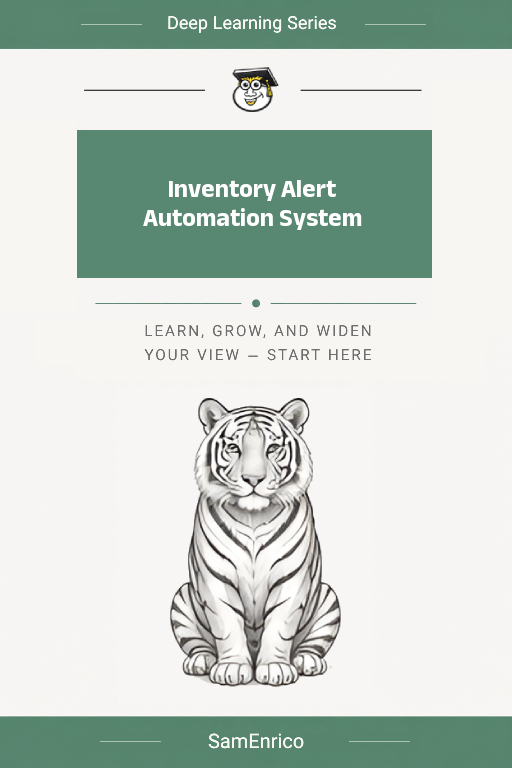
Inventory Alert Automation System eBook
Implement AI workflows that monitor inventory leve
Implement AI workflows that monitor inventory levels and trigger reorder alerts automatically for ops teams.
Formats
Free sample
Chapter 1: The $340,000 Jacket--The email arrived at 7:43 AM on the Friday after Thanksgiving.Subject line: "Stockout Alert – Style 4472 – Navy – Size M – 0 units remaining"Sarah Chen, Operations Manager at Haven Apparel, barely glanced at it. Her phone had buzzed 47 times since midnight with similar alerts. She swiped it away and reached for her coffee. Fifteen minutes later, her VP called."Sarah, why is our best-selling jacket showing zero inventory on the busiest shopping weekend of the year?"That was the moment Sarah learned the difference between an alert and a warning. Her system had generated an alert, yes.
Forty-seven of them, actually. But not one of those alerts had been a warning—a signal carrying enough urgency, context, and authority to break through the noise and demand attention.The jacket sold out completely by 9:00 AM. By the end of Cyber Monday, Haven Apparel had lost 340,000inrevenue.Twelvehundredcustomershadreceived"backordered"notifications.Twohundredofthemhadpostedcomplaintsonsocialmedia.Sarahspentthenextthreeweeksexpeditingfreightfromsuppliers,eating340,000 in revenue. Twelve hundred customers had received "backordered" notifications. Two hundred of them had posted complaints on social media.
Sarah spent the next three weeks expediting freight from suppliers, eating 340,000inrevenue.Twelvehundredcustomershadreceived"backordered"notifications.Twohundredofthemhadpostedcomplaintsonsocialmedia.Sarahspentthenextthreeweeksexpeditingfreightfromsuppliers,eating47,000 in rush shipping fees, and explaining to her board why a company with a "real-time inventory system" had no idea its hottest product was about to evaporate.Here is what her system did wrong. Here is what most systems do wrong. And here is how AI fixes it.The Invisible 40%Let us begin with a number that should terrify every operations leader: forty percent.According to a 2023 study of supply chain organizations across retail, manufacturing, and distribution, operations teams spend an average of 40% of their time chasing low-priority inventory alerts, manually validating data, and fighting fires that could have been prevented. That is two full days per week. Eighty days per year.
An entire month of working time—gone.Not spent on strategy. Not spent on supplier relationships. Not spent on process improvement. Spent on firefighting.Where does that 40% go? Let us follow a typical day in a reactive operations team's life.At 8:30 AM, the team lead opens the ERP dashboard.
There are 143 active inventory alerts. Some are for high-value A-items that would cost the company 50,000perhouriftheystockout.Someareforslow−moving C−itemsthatselltwiceayearandhave50,000 per hour if they stock out. Some are for slow-moving C-items that sell twice a year and have 50,000perhouriftheystockout.Someareforslow−moving C−itemsthatselltwiceayearandhave500 of inventory value total. The system treats them identically—a red exclamation mark next to each SKU, sorted alphabetically by part number.The team spends the next two hours clicking through alerts, checking spreadsheets, calling warehouses to confirm counts, and manually calculating whether to order more. By 10:30 AM, they have processed twelve alerts.
One hundred thirty-one remain. New alerts arrive faster than they can close old ones.At 2:00 PM, a critical alert arrives for a high-margin component used in three different product lines. The team sees it, but it is buried under forty-seven other notifications. By the time they get to it at 4:15 PM, the component has already stocked out. A production line will idle tomorrow.
Cost of idling: $12,000 per hour.This is not an exaggeration. This is the daily reality for thousands of operations teams.The problem is not that alerts are bad. The problem is that most alerts are useless.The Pathology of Static Alerts To understand why traditional alert systems fail, we must understand how they work. Most enterprise resource planning (ERP) systems and inventory management platforms use a logic that dates back to the 1970s: minimum and maximum thresholds.An item has a minimum quantity. When inventory falls below that minimum, the system generates an alert.
Someone reviews it, calculates an order quantity (often based on a fixed formula), and creates a purchase order. When inventory rises above a maximum threshold, the system may generate an overstock warning.This logic worked reasonably well in a world of stable demand, predictable lead times, and limited data. That world no longer exists.Consider the three fatal flaws of static thresholds.Flaw One: They ignore demand variability.A static minimum assumes that tomorrow's demand will look like yesterday's demand. But demand is rarely stable. Seasonality, promotions, competitor actions, weather, social media trends, and economic conditions all shift demand patterns.
A jacket that sold ten units per day in October might sell one hundred units per day in December. A static minimum set to fifty units works fine in October—but in December, inventory would hit fifty units at noon and be gone by 3:00 PM, with no alert triggered until it was too late.Flaw Two: They ignore lead time drift.The formula for a reorder point assumes that a supplier will deliver in a predictable number of days. But suppliers are not predictable. They change production schedules. They have raw material shortages.
Their own suppliers fail. A component that used to arrive in five days might now take twelve. A static reorder point calculated for a five-day lead time will trigger a replenishment order far too late when lead times stretch to twelve days. The result is a stockout that feels sudden but was actually predictable.Flaw Three: They create alert fatigue.When every alert looks the same, the brain learns to ignore them. This is not a character flaw—it is neuroscience.
The reticular activating system, the part of the brain responsible for filtering sensory input, suppresses repeated, low-stakes signals. After the fiftieth red exclamation mark that turned out to be a low-priority item with plenty of time to reorder, the brain stops treating red exclamation marks as urgent.The result is a system that generates lots of activity but very little action. Alerts fire. Emails send. Dashboards light up.
But nothing changes because no one trusts the signals.The True Cost of Stockouts (Visible and Hidden)When a stockout occurs, most organizations calculate the visible cost: lost revenue from the units that would have sold. If a jacket sells for 100andyoumissedselling1,000ofthem,youlost100 and you missed selling 1,000 of them, you lost 100andyoumissedselling1,000ofthem,youlost100,000 in revenue.But this calculation misses most of the damage.Customer churn. A study by the Harvard Business Review found that customers who experience a single stockout are 35% less likely to make a second purchase from the same retailer. For subscription or repeat-purchase businesses, the lifetime value loss can be five to ten times the revenue loss of the single transaction.Expedited shipping costs. When a stockout is discovered, the scramble begins.
Rush orders, air freight, split shipments, and courier services all carry premiums. Haven Apparel spent $47,000 on expedited shipping after its jacket stockout—nearly 14% of the lost revenue amount.Warehouse inefficiency. Rush orders disrupt warehouse operations. Workers must stop their regular picking to handle emergency shipments. Overtime increases.
Error rates rise. A study of distribution centers found that emergency orders take 3x longer to process than planned orders and have 5x higher error rates.Brand damage. Customers who receive a backorder notification often share their frustration online. A single viral complaint can reach hundreds of thousands of potential customers. The brand damage is difficult to quantify but impossible to ignore.Supplier relationship strain.
Repeated emergency orders strain supplier relationships. Suppliers begin to view your company as unreliable and unpredictable. They may require prepayment…
This is the end of the free sample. Get the eBook to keep going. Buy now
About this book
Details
- Author
- Rosser Christen
- Publisher
- SamEnrico
- Language
- English
- Genre
- Non-Fiction, AI Operator, Supply Chain
- Released
- 2026-06-01
- Pages (approx.)
- 132
- Available as
- eBook, Audiobook

Read better in the ZLOADR app
Your eBooks on your phone or tablet. Sign in with your SamEnrico account and start reading.
More by Rosser Christen
 Navigating Vaccine and Health Choice TalksRosser Christen$11.99
 Mindfulness For Sleep RecoveryRosser Christen$11.99
 MBSR for PTSD GuideRosser Christen$11.99
 Ayurvedic Skin Care GuideRosser Christen$11.99
 Teen Self Esteem MindfulnessRosser Christen$11.99
 The Star Keepers of Axum: Africa's Celestial ArchitectsRosser Christen$11.99
 Understanding Metaphyseal Dysplasia Pyle TypeRosser Christen$17.99
 Ghana Logistics Last Mile DeliveryRosser Christen$12.99
 Tower Crane OperatorRosser Christen$11.99
 Ultimate Handbook Guide to Xiaoshan : (China) Travel GuideRosser Christen$11.99
You may also like
 Hong Kong Handover 1997Dunn Johnnie$11.99
 Zumba For Postnatal Recovery CourseNeal Christian$11.99
 Zumba for BeginnersLadner Nikia$11.99
 YouTube Comment Mining GuideHumes Pandora$12.99
 Worry Box MeditationCarlin Rudy$11.99
 Workplace Stress MeditationNguyen Lynn$11.99
 Workplace Stress and Sleep RepairHawley Ivory$11.99
 Workplace Perfectionism CureDelaney Jeffry$11.99
 Workplace Injustice Anger GuideWallen Isabelle$11.99
 Work Addiction and Burnout LinkGreenwood Ester$11.99
 Women in Yoga and WellnessBeattie Galina$11.99
 Women in Stand Up ComedyChun Evangeline$11.99