
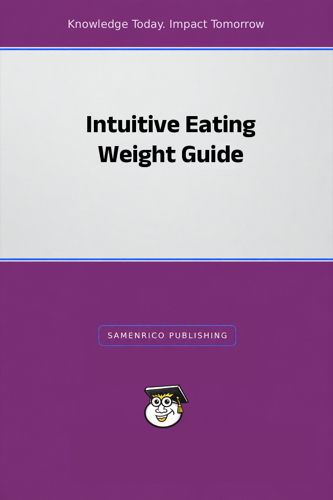
Non-FictionHealth & WellnessIntuitive
Intuitive Eating Weight Guide eBook
Reject diet mentality and honor hunger fullness an
Reject diet mentality and honor hunger fullness and satisfaction for natural weight.
Formats
Free sample
Chapter 1: The 95% Lie...--If you are holding this book, there is a very good chance you have lost and regained the same ten, twenty, or even fifty pounds at least three times. Perhaps you have done it five times. Perhaps you have stopped counting. You have tried keto, paleo, intermittent fasting, calorie counting, Weight Watchers, Noom, or that cleanse your friend swore would change your life. Each time, something similar happened: the first two weeks felt like a miracle.
The scale moved. You felt proud, almost euphoric. You told yourself, This time is different. This time I have willpower. Then, somewhere between week three and month six, the wheels came off.
You ate something you "shouldn't" have—a piece of cake at a birthday party, a late-night bowl of pasta, a handful of chips while standing in the kitchen. The guilt arrived within seconds, followed by the familiar inner monologue: Why can't I just stick to something? What is wrong with me? Maybe you tried to compensate by eating less the next day. Maybe you exercised harder.
But within a week, the diet was over. Not because you decided to quit, but because your body and brain staged a mutiny. You were hungrier than ever. You were thinking about food constantly. And eventually, you ate everything you had denied yourself—and then some.
The weight came back, often with a few extra pounds as a punishment for your rebellion. And you concluded, as most people do, that you lack willpower. That you are broken. That your body cannot be trusted.Here is the truth that the $72 billion diet industry has spent decades hiding from you: You are not broken. The diet is broken.
And the reason 95% of diets fail is not because people are weak. It is because diets are designed to fail. They are designed to work just long enough to keep you coming back for more, like a slot machine that pays out a tiny jackpot on the first pull and then eats your quarters for the next three hours. The diet industry does not profit from your success. It profits from your repeat business.
A person who loses weight and keeps it off forever is a lost customer. A person who loses weight, gains it back, and feels ashamed? That person will buy the next book, the next program, the next detox, the next meal plan. That person is the ideal customer.This chapter is going to show you the science behind the 95% failure rate. More importantly, it is going to introduce you to a concept that will change everything: Diet Bottom.
This is the moment of exhaustion, clarity, and绝望 that finally convinces you to stop doing the thing that has been hurting you. It is the moment you realize that the diet is the problem, not the solution. And it is the only place from which real, lasting change can begin.The Weight Spectrum Trap Before we can understand why diets fail, we need to understand the fundamental assumption that underlies every diet you have ever tried. Let us call it the Weight Spectrum Trap. Here is how it works: almost everyone believes that weight exists on a simple, linear spectrum.
On one end is "too heavy" (bad, unhealthy, shameful). On the other end is "just right" (good, healthy, acceptable). Somewhere in the middle is a target weight—a number on the scale that supposedly represents health, discipline, and worthiness. The diet industry has sold you the idea that moving from "too heavy" to "just right" is simply a matter of willpower, calories, and time. Eat less, move more, and the needle slides down the spectrum.
If it does not slide, you are not trying hard enough.This assumption is false. And it is not just false in a minor, technical way. It is false in a way that has caused millions of people to spend decades hating their bodies and blaming themselves for a biological reality they never had a chance to outrun.The truth is that your body does not see weight on a spectrum. Your body sees weight as a set point—a narrow range of about ten to twenty pounds that it defends as vigorously as it defends your body temperature. You probably know that your body keeps your temperature at approximately 98.6 degrees Fahrenheit regardless of whether you are sitting in an air-conditioned room or standing in the sun.
If you get too hot, you sweat. If you get too cold, you shiver. These are not failures of your body's temperature regulation. They are evidence that your body is working exactly as it should. The same is true for weight.
Your body has a preferred weight range, and it will use every tool in its biological toolbox to keep you inside that range. When you eat less than your body needs, your metabolism slows down. Your hunger hormones increase. Your satiety hormones decrease. You start thinking about food more often.
You lose energy for non-essential movement like fidgeting, standing, or taking the stairs. Your body is not sabotaging you. It is trying to keep you alive.This brings us to the central lie of the Weight Spectrum Trap: the belief that willpower can override biology. It cannot. Not for you.
Not for anyone. The people you see on social media who appear to have "perfect" control over their eating? Either they are genetically lucky (their set point happens to align with cultural beauty standards), or they are engaged in a level of constant, exhausting vigilance that you do not see on Instagram. Or, most commonly, they are lying. The human body does not lose weight and keep it off through willpower alone.
The scientific literature is unanimous on this point.The Science of Metabolic Adaptation Let us get specific about what happens inside your body when you diet. The process is called metabolic adaptation, and it is the single most important biological concept you will learn in this book.When you reduce your calorie intake—whether through portion control, intermittent fasting, keto, or any other method—your body does not know that you are trying to fit into a wedding dress or lower your blood pressure. Your body knows only one thing: food is scarce. Calories are dropping. This might be a famine.
And in a famine, the number one priority is survival. Not weight loss. Not abs. Survival.Your body responds to calorie restriction by activating a series of ancient survival mechanisms. First, your resting metabolic rate—the number of calories you burn just by being alive, breathing, pumping blood, and maintaining body temperature—drops.
Studies have shown that after just a few weeks of calorie restriction, the body can reduce its resting metabolic rate by fifteen to thirty percent. This means that the same body that used to burn two thousand calories a day at rest now burns only fourteen hundred. You are eating less, but you are also burning less. The math of "calories in, calories out" changes the moment you start restricting.Second, your hunger hormones go haywire. Ghrelin, the hormone that signals hunger to your brain, increases significantly during calorie restriction.
You feel hungrier not because you are weak, but because your body is screaming for fuel. Meanwhile, leptin, the hormone…
This is the end of the free sample. Get the eBook to keep going. Buy now
About this book
Details
- Author
- Townsend Sadie
- Publisher
- SamEnrico
- Language
- English
- Genre
- Non-Fiction, Health & Wellness, Intuitive
- Released
- 2026-06-06
- Pages (approx.)
- 142
- Available as
- eBook, Audiobook

Read better in the ZLOADR app
Your eBooks on your phone or tablet. Sign in with your SamEnrico account and start reading.
More by Townsend Sadie
 Group Creative Risk Taking CourseTownsend Sadie$11.99
 Chinese Student Return TrendsTownsend Sadie$11.99
 Gambling Withdrawal HelpTownsend Sadie$11.99
 Core Beliefs That Fuel AngerTownsend Sadie$11.99
 The Siege of the Grand Hotel: The Day a Terrorist Took a City HostageTownsend Sadie$11.99
 The Phantom of the Dark WebTownsend Sadie$11.99
 Local Meetup Validation GuideTownsend Sadie$12.99
 Industrial Manufacturing BuyersTownsend Sadie$12.99
 Programmatic Media Buying and OptimizationTownsend Sadie$11.99
 Understanding Chromosome 6, Monosomy 6q1Townsend Sadie$17.99
 How to Start a Farm Supplies Merchant Wholesaler BusinessTownsend Sadie$11.99
You may also like
 Hong Kong Handover 1997Dunn Johnnie$11.99
 Zumba For Postnatal Recovery CourseNeal Christian$11.99
 Zumba for BeginnersLadner Nikia$11.99
 YouTube Comment Mining GuideHumes Pandora$12.99
 Worry Box MeditationCarlin Rudy$11.99
 Workplace Stress MeditationNguyen Lynn$11.99
 Workplace Stress and Sleep RepairHawley Ivory$11.99
 Workplace Perfectionism CureDelaney Jeffry$11.99
 Workplace Injustice Anger GuideWallen Isabelle$11.99
 Work Addiction and Burnout LinkGreenwood Ester$11.99
 Women in Yoga and WellnessBeattie Galina$11.99
 Women in Stand Up ComedyChun Evangeline$11.99