
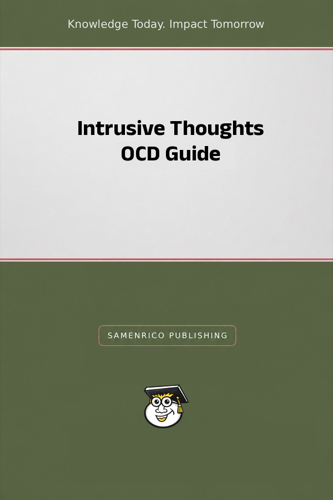
Non-FictionHealth & WellnessIntrusive Thoughts
Intrusive Thoughts OCD Guide eBook
Manage unwanted violent, sexual, or blasphemous th
Manage unwanted violent, sexual, or blasphemous thoughts with CBT techniques.
Formats
Free sample
Chapter 1: The Uninvited Guest--–- It arrives without knocking. One moment you are folding laundry, driving to work, or saying goodnight to your partner, and the next—a vicious, appalling image tears through your mind. You see yourself doing something unthinkable. Something that violates every moral instinct you possess. Your stomach drops.
Your heart races. And before you can catch your breath, a terrifying question echoes in your skull: Where did that come from? What kind of person thinks something like that?If you are reading these words, you already know exactly what I am describing. You have been visited by the uninvited guest—an intrusive thought so repulsive, so contrary to your true character, that it has left you questioning your own sanity, your morality, perhaps even your right to exist among decent people. You have spent hours, days, maybe years trying to push these thoughts away, to analyze them, to confess them, to neutralize them with silent prayers or mental rituals.
And the harder you have fought, the stronger they have become.This chapter is your first step off that doomed battlefield. You are about to learn something that will change everything: The problem is not the thought. The problem is what you have been taught to believe the thought means.The Most Terrifying Question You Will Ever Ask Let me begin by naming the fear that sits like a stone in your chest. You have probably never said it out loud. You may have been afraid to even think it clearly.
But here it is, in black and white: What if thinking this terrible thing means some part of me actually wants to do it?Every person with intrusive thoughts OCD has asked this question. The loving mother who imagines throwing her baby against the wall asks it. The devout believer who hears a blasphemous curse during prayer asks it. The gentle pacifist who sees himself stabbing his best friend asks it. The question is the engine of your suffering.
And the answer—the true answer, the one backed by decades of clinical research and neurological evidence—is going to shock you.No. Thinking something does not mean you want it. In fact, for people with this specific pattern of OCD, the presence of the thought combined with the presence of distress proves the exact opposite.Let that land. Read it again. The presence of the thought combined with the presence of distress proves the exact opposite.
You are not horrified because you secretly desire the act. You are horrified because you are a decent person whose brain has generated random noise, and your threat-detection system has mistakenly labeled that noise as an emergency.The Universal Human Experience You Were Never Told About Before we go any further, I need to tell you a secret that the mental health field kept hidden for decades. Intrusive thoughts—including violent, sexual, and blasphemous ones—are not rare. They are not a sign of madness. They are not evidence of a hidden darkness.
They are universal.In the 1970s and 1980s, researchers began asking ordinary people without any psychiatric diagnosis about their inner mental lives. The results were astonishing. In study after study, more than 90% of participants reported having unwanted, intrusive thoughts that ranged from mildly annoying to deeply disturbing. A young woman imagined pushing a stranger onto subway tracks. A clergyman had a sexual image of Christ.
A new father saw himself dropping his infant on purpose. These were not patients. These were your neighbors, your coworkers, your friends. They just never told anyone.Why did no one know this? Because human beings are experts at hiding their inner chaos.
We assume everyone else’s mind is tidy, peaceful, and under control. We assume our own dark visitors mean we are broken. So we suffer in silence, convinced we are alone, while the person next to us on the bus is fighting the same secret battle.The difference between those ordinary people and someone with OCD is not the presence of intrusive thoughts. The difference is the interpretation of those thoughts. A person without OCD has a violent image flash through their mind.
They think, That was weird, and they move on. The thought fades like a cloud. A person with OCD has the same image, but their brain screams, That was important! That means something terrible about you! You need to figure this out or you might act on it!
And in that moment of terrified attention, the thought solidifies. It becomes sticky. It begins to loop.You are not broken because you have these thoughts. You are experiencing a malfunction in your brain’s filtering system. And that malfunction can be repaired.The Brain’s Alarm System: Why Evolution Made You Miserable To understand why your brain generates these horrifying images, you need to take a brief trip into human evolution.
I promise it will be worth it.Your brain is not a single, unified organ. It is a collection of systems that evolved at different times for different purposes. The oldest part—sometimes called the reptilian brain—handles basic survival: breathing, heart rate, the fight-or-flight response. Above that sits the limbic system, which processes emotion and memory. And wrapped around both is the neocortex, the thinking brain that makes you consciously aware of your own existence.The limbic system has one job: keep you alive.
It does this by constantly scanning the environment for threats. But here is the critical detail—the limbic system does not know the difference between a real threat and an imagined one. It cannot tell the difference between a tiger in the bushes and a mental image of a tiger. To your limbic system, both are emergencies.This system evolved in a world where missing a threat could get you killed. So natural selection favored brains that overreacted.
Better to jump at a hundred false alarms than to miss one real danger. Your limbic system generates random threat scenarios constantly. What if I jumped off this bridge? What if I grabbed that knife? What if I shouted a curse in church?
Most of the time, your neocortex dismisses these as noise. Weird, it says, but not relevant.In OCD, that dismissal system is broken. The neocortex grabs the random threat scenario and holds onto it. It analyzes it. It asks, Why did that happen?
What does it mean about me? And in that moment of analysis, the thought transforms from neural static into an obsession.The Moral Compass Test: How to Tell If You Are Actually Dangerous Here is a question that may feel dangerous to ask, but it is essential: How can you know for certain that you are not the monster the thoughts seem to suggest?The answer is simpler than you think. Look at your emotional reaction.A person who genuinely wanted to harm children would not be tormented by thoughts of harming children. They might find such thoughts pleasurable, or neutral, or even boring. They would not lose sleep.
They would not confess to a therapist in tears. They would not spend hours googling “am I a pedophile?” The very fact that the thought causes you distress—the…
This is the end of the free sample. Get the eBook to keep going. Buy now
About this book
Details
- Author
- Wadsworth Mohamed
- Publisher
- SamEnrico
- Language
- English
- Genre
- Non-Fiction, Health & Wellness, Intrusive Thoughts
- Released
- 2026-06-06
- Pages (approx.)
- 143
- Available as
- eBook, Audiobook

Read better in the ZLOADR app
Your eBooks on your phone or tablet. Sign in with your SamEnrico account and start reading.
More by Wadsworth Mohamed
 Future Self Visualization GuideWadsworth Mohamed$11.99
 The Immigrant Exit StrategyWadsworth Mohamed$11.99
 CV 22 Osprey PilotWadsworth Mohamed$11.99
 Tina Reynolds Work PrisonsWadsworth Mohamed$11.99
 Cold Exposure for NumbnessWadsworth Mohamed$11.99
 Fear of Failure for Remote WorkersWadsworth Mohamed$11.99
 Do Not Disturb ProtocolWadsworth Mohamed$11.99
 Ashen Echoes: The Thera Cataclysm That Shaped CivilizationWadsworth Mohamed$11.99
 Gold and Glory: How Napoleon Bankrupted Europe to Fuel His WarsWadsworth Mohamed$11.99
 How to Produce Vehicle Steering Wheel LocksWadsworth Mohamed$11.99
 How to Start a Cooking Equipment for Commercial Catering (electric) Business (Beginners Guide)Wadsworth Mohamed$11.99
 How to Produce Landscape Pathway LightingWadsworth Mohamed$11.99
You may also like
 Hong Kong Handover 1997Dunn Johnnie$11.99
 Zumba For Postnatal Recovery CourseNeal Christian$11.99
 Zumba for BeginnersLadner Nikia$11.99
 YouTube Comment Mining GuideHumes Pandora$12.99
 Worry Box MeditationCarlin Rudy$11.99
 Workplace Stress MeditationNguyen Lynn$11.99
 Workplace Stress and Sleep RepairHawley Ivory$11.99
 Workplace Perfectionism CureDelaney Jeffry$11.99
 Workplace Injustice Anger GuideWallen Isabelle$11.99
 Work Addiction and Burnout LinkGreenwood Ester$11.99
 Women in Yoga and WellnessBeattie Galina$11.99
 Women in Stand Up ComedyChun Evangeline$11.99