
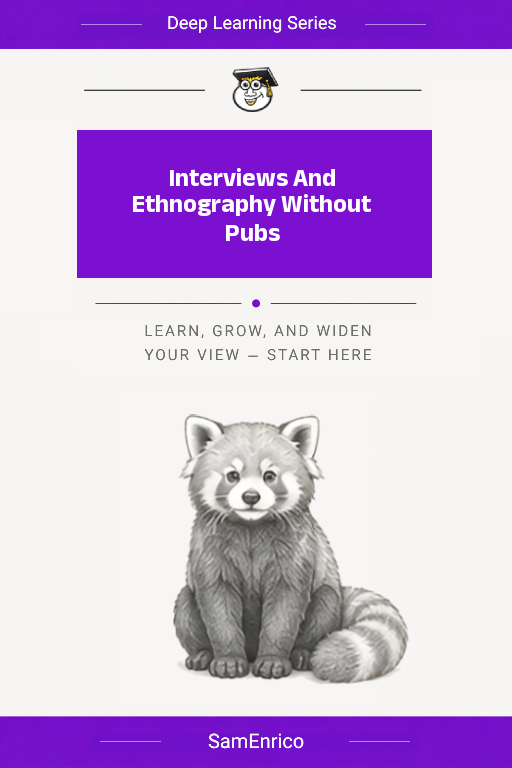
Interviews And Ethnography Without Pubs
Describe transcription coding and thematic analysi
by Spann Lou
Describe transcription coding and thematic analysis work that generated qualitative research insights.
Formats
About this book
Free sample
Chapter 1: The $2 Million Pause...--–- The email arrived at 9:47 AM on a Tuesday. Sarah Chen, a mid-level UX researcher at a retail giant called "Shop Fast," had just finished her 217th customer support call analysis. Her conclusion, delivered in a 47-slide deck with bar charts and confidence intervals, was clear: customers want faster shipping. The data showed it. Call after call, people said "shipping is slow," "took too long," and "I expected it yesterday." Sarah's recommendation was expensive but simple: invest $2 million in logistics infrastructure to cut delivery times by 1.5 days.
Leadership approved it within a week. Six months later, the infrastructure was in place. Delivery times dropped. And customer satisfaction scores did not move. Not one point.
Sarah was called into a windowless conference room and asked a simple question: "What did we miss?"Enter Marcus, a 24-year-old junior analyst who had not been part of the original project. Marcus had no formal training in qualitative methods. He had never taken a research methods class. But he had one habit that Sarah did not: he listened to calls with the transcript turned off. While Sarah searched for keywords like "shipping" and "delivery," Marcus listened for hesitations, repetitions, and what people said after they thought the conversation was over.
On his third listen to a random sample of calls, he noticed something strange. In call after call, customers would say something like, "Yeah, the shipping took eight days, but that's not really..." and then trail off. Or: "I wouldn't mind waiting if someone had just..." and then change the subject. Marcus extracted those incomplete sentences and found the pattern. Customers were not angry about speed.
They were angry about silence. The real quotes, the ones Sarah's keyword search had missed, said: "No one told me it was delayed." "I got a tracking number but it never updated." "I had to call three times to find out where my stuff was." The problem was not logistics. It was communication. The company had spent $2 million solving the wrong problem because the researcher had listened for topics instead of emotions, for…
This is the end of the free sample. Get the eBook to keep going. Buy now
Contents
- Chapter 1
- Chapter 2
- Chapter 3
- Chapter 4
- Chapter 5
- Chapter 6
- Chapter 7
- Chapter 8
- Chapter 9
- Chapter 10
- Chapter 11
- Chapter 12
Details
- Author
- Spann Lou
- Publisher
- SamEnrico
- Language
- English
- Genre
- Non-Fiction, Student's Shortcut
- Released
- 2026-05-30
- Pages (approx.)
- 142
- Available as
- eBook, Audiobook

Read better in the ZLOADR app
Your eBooks on your phone or tablet. Sign in with your SamEnrico account and start reading.
More by Spann Lou
 Churn Reason Validation GuideSpann Lou$11.99
 Thunberg Parent SupportSpann Lou$11.99
 Teen Athlete Confidence GuideSpann Lou$11.99
 Budgeting For Peace Of Mind GuideSpann Lou$11.99
 Work Habit SystemsSpann Lou$11.99
 Kicking Imposter Syndrome ForeverSpann Lou$11.99
 Addressing Sexual DysfunctionSpann Lou$11.99
 NFL Draft Scouting Your LifeSpann Lou$11.99
 Toxic Workplace BurnoutSpann Lou$11.99
 Where the Sky Split Open: The Navajo Emergence MythSpann Lou$11.99
 The Bloodlines of Gettysburg: DNA and Destiny in the Civil War's Turning PointSpann Lou$11.99
 Echoes of the Forgotten: The Untold Story of Sister Rosetta Tharpe, the Godmother of Rock 'n' RollSpann Lou$11.99
You may also like
 LSE Online Program LengthAgee Letisha$11.99
 Harvard Extension School for Working AdultsRoush Yer$11.99
 LSE Online Reading ListAshford Ludivina$11.99
 LSE Online Language RequirementsWhitten Daphine$11.99
 LSE Online Class SizeHughey Garret$11.99
 LSE Online Alumni MentorshipWild Lyla$11.99
 London School of Economics Alumni NetworkDutton Chantal$11.99
 Harvard Extension School Student SupportCantrell Christene$11.99
 Harvard Extension School Library AccessSantana Adah$11.99
 Harvard Extension School Degree CompletionBray Wyatt$11.99
 Harvard Extension School Course AuditingAbbott Craig$11.99
 Harvard Extension School Extension DiplomaNew Joane$11.99