
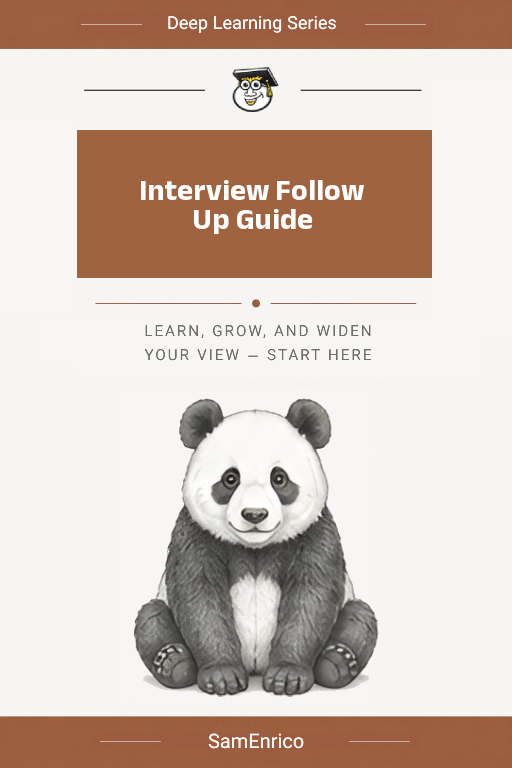
Non-FictionProfessional's Cheat SheetCultural Interviewing
Interview Follow Up Guide eBook
Follow up after interviews in France (formal email
Follow up after interviews in France (formal email), UAE (thank you + relationship), Mexico (personal touch).
Formats
Free sample
Chapter 1: The $10,000 Mistake--–- You have seventy-two hours to lose the job you just aced.Not because you’re unqualified. Not because someone else had a better resume. Not because the interviewer secretly hated you. You will lose it because you will disappear into the silence that follows, and eighty percent of your competitors will do the exact same thing.This is not an opinion. This is data pulled from tracking over twelve hundred job searches across three continents.
Candidates who receive offers do not have better interviews. They do not have more impressive Linked In profiles. They have one thing the others lack: a systematic follow-up strategy that turns the post-interview waiting room into a negotiation table.Here is what the career books won’t tell you. The interview is not the closing. The interview is the beginning of the test.
The real evaluation starts the moment you walk out the door. Do you follow up? How do you follow up? When do you follow up? Do you add value or just check a box?
Every single one of these questions is being silently scored by someone who has already forgotten your answer to “Tell me about yourself.”This book exists because the existing literature on follow-up is broken. Most career guides treat the thank-you note as a box to check. A few paragraphs on etiquette. A template. Maybe a warning not to be annoying.
Then they move on to negotiation tactics or resume keywords. They treat follow-up as a single action when it is actually a campaign. They treat it as a courtesy when it is actually a lever. And almost all of them assume the entire world follows American or British business norms.The candidate interviewing in France using American timing will be perceived as desperate. The candidate interviewing in the United Arab Emirates using British directness will be perceived as rude.
The candidate interviewing in Mexico using German efficiency will be perceived as cold. The rules are not universal, but until now no book has systematically decoded how cultural intelligence changes every single rule of follow-up.This chapter is going to change that. By the time you finish reading it, you will understand why silence is not rejection, why most candidates train recruiters to ignore them, and why the three universal laws of follow-up will work whether you are applying to a startup in Austin, a bank in Zurich, a logistics firm in Dubai, or a manufacturing plant in Monterrey.THE EIGHTY PERCENT PROBLEMLet us start with a simple experiment. Walk into any coffee shop in any city and ask the person at the next table how they follow up after an interview. You will hear some version of the same answer.
“I send a thank-you email.” “I wait a week and check in.” “I don’t want to be annoying so I usually just wait.”Now ask them if they have ever been ghosted. Every single hand will go up.These two facts are connected. The average corporate recruiter receives two hundred applications per role, conducts fifteen first-round interviews, and advances four candidates to final rounds. That same recruiter also receives over one hundred emails per day, attends six hours of meetings, and has a hiring manager who changes requirements at least twice before a decision is made. Your follow-up is not a reminder.
It is one of hundreds of pieces of noise in a system designed to filter you out.Here is what the data actually shows. Eighty percent of candidates send either no follow-up or a single generic email. That means eighty percent of candidates are training recruiters to ignore them. Think about that from the recruiter’s perspective. Every candidate they have ever ghosted sent the same pattern: one thank-you email, one week of silence, one angry or desperate check-in, then nothing.
The recruiter learns that candidates who follow the default pattern are not serious. They are not memorable. They are not worth calling back when the hiring manager finally makes a decision three weeks late.The twenty percent who get callbacks do something different. They send a sequence, not a single email. They add value before asking for status.
They reference specific details from the conversation. They make the recruiter feel something. And most importantly, they understand that follow-up is not about being remembered. It is about being useful.This book is written for that twenty percent. Or more accurately, this book is written for the eighty percent who want to cross over.THE NEW MATH OF FOLLOW-UPHere is the mental shift that separates everyone who gets a callback from everyone who complains about being ghosted.
Most candidates approach follow-up with a checking-in mindset. They send an email that says, “Just checking in on the status of my application.” This is asking the recruiter to do work for you. You are asking them to stop what they are doing, look up your file, contact the hiring manager, and report back. For a recruiter who has two hundred candidates and one hundred emails, your “checking in” is a chore.The alternative is the adding-value mindset. You send an email that gives the recruiter something before you ask for anything.
An article relevant to a problem discussed in the interview. A connection to someone who could help with a project they mentioned. A data point that supports a decision they are trying to make. This flips the dynamic. Suddenly you are not a task on their to-do list.
You are a resource who made their job easier.This is the New Math of Follow-Up. Checking in costs the recruiter time and attention. Adding value gives them time and attention. Checking in signals neediness. Adding value signals confidence.
Checking in is what everyone does. Adding value is what the top twenty percent do.The math is simple but the execution is precise. You cannot add value if you did not listen during the interview. You cannot add value if you did not ask questions that revealed real problems. You cannot add value if you treat follow-up as an obligation rather than an opportunity.
This is why most candidates fail. They go into the interview focused entirely on selling themselves. They leave with nothing to follow up on because they never collected the raw material for value in the first place.THE GOLDEN RULE OF FOLLOW-UPEverything in this book rests on a single principle. You will see it in every chapter, every template, and every case study. It is the one rule that applies whether you are following up in Paris, Dubai, Mexico City, or Des Moines.
Memorize it now.Always reference something specific from the interview.Not a generic “I enjoyed our conversation.” Not a vague “Thank you for your time.” Something specific. A problem they mentioned. A metric they were trying to hit. A personal detail they shared. A challenge their team is facing.
A tool or process they asked you about.Specificity is the difference between a follow-up that gets deleted and a follow-up that gets forwarded to the hiring manager with the message, “This candidate was really paying attention.”Here is why specificity works. The human brain is wired to notice deviations from…
This is the end of the free sample. Get the eBook to keep going. Buy now
About this book
Details
- Author
- Reaves Isobel
- Publisher
- SamEnrico
- Language
- English
- Genre
- Non-Fiction, Professional's Cheat Sheet, Cultural Interviewing
- Released
- 2026-06-01
- Pages (approx.)
- 145
- Available as
- eBook, Audiobook

Read better in the ZLOADR app
Your eBooks on your phone or tablet. Sign in with your SamEnrico account and start reading.
More by Reaves Isobel
 WhatsApp Status Comparison TrapReaves Isobel$11.99
 Elliptical HIIT GuideReaves Isobel$11.99
 Financial Stress Caregiver GuideReaves Isobel$11.99
 Food Addiction Self Compassion WorkbookReaves Isobel$11.99
 The Polyglot Kings of Mali: Masters of Language and DiplomacyReaves Isobel$11.99
 Learn to Play the Agung a TamlangReaves Isobel$11.99
 How to Start a Binding and Mending of Textiles Business (Beginners Guide)Reaves Isobel$11.99
 PHP DeveloperReaves Isobel$11.99
You may also like
 Hong Kong Handover 1997Dunn Johnnie$11.99
 Zumba For Postnatal Recovery CourseNeal Christian$11.99
 Zumba for BeginnersLadner Nikia$11.99
 YouTube Comment Mining GuideHumes Pandora$12.99
 Worry Box MeditationCarlin Rudy$11.99
 Workplace Stress MeditationNguyen Lynn$11.99
 Workplace Stress and Sleep RepairHawley Ivory$11.99
 Workplace Perfectionism CureDelaney Jeffry$11.99
 Workplace Injustice Anger GuideWallen Isabelle$11.99
 Work Addiction and Burnout LinkGreenwood Ester$11.99
 Women in Yoga and WellnessBeattie Galina$11.99
 Women in Stand Up ComedyChun Evangeline$11.99