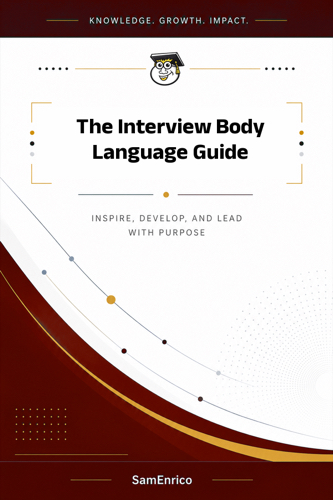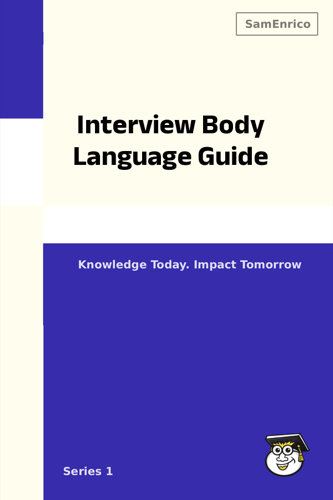
Interview Body Language Guide eBook
Teaches job seekers to convey competence and avoid
Teaches job seekers to convey competence and avoid nervous tells during hiring.
Formats
Free sample
Chapter 1: The Seven-Second Verdict--–- The receptionist’s phone buzzes. You stand, smooth your tie or blazer, and offer a rehearsed smile. The hiring manager appears in the doorway, extends a hand, and says the words every candidate waits for: “Right this way.” In that moment, before you have uttered a single word about your qualifications, before you have mentioned your MBA, your years of experience, or your impressive portfolio of past successes, the interviewer has already formed a durable first impression of you. Not a vague sense. Not a placeholder judgment.
A concrete, sticky, surprisingly accurate prediction of whether you are competent, trustworthy, and worth hiring. The entire process took less time than it takes to blink three times. Seven seconds. That is all the silent interview requires.This is not hyperbole. It is the conclusion of decades of research in social psychology, organizational behavior, and nonverbal communication.
In a landmark study conducted at Princeton University, researchers found that participants who watched one-second video clips of professors teaching could rate the professors’ effectiveness as accurately as students who had spent an entire semester in their classrooms. One second. Extend that to seven seconds—the average length of an initial professional encounter before the first handshake ends—and the brain has already built a scaffold of assumptions about your intelligence, your warmth, and your authority. The interview, in other words, is won or lost before you answer “Tell me about yourself.”This chapter exists to shatter the most dangerous myth in the job-seeking universe: the myth that what you say matters most. It does matter.
But it matters second. The nonverbal channel is faster, more primitive, and more trusted by the human brain than any string of carefully crafted words. By the time you finish reading this chapter, you will understand why your body speaks before you do, how the ancient architecture of your brain sabotages your best intentions, and what the FBI’s most effective interrogation tool can teach you about sitting in a plastic chair across from someone holding a red pen. You will also meet a man who failed fifty-nine interviews—not because he was unqualified, but because his thumb told a story his mouth could not contradict.The Primacy of the Nonverbal Channel Let us begin with a simple experiment you can conduct on yourself. Recall the last time you met someone new in a professional setting—a networking event, a coffee chat, a panel interview.
Without replaying the conversation, focus instead on the first few seconds. What did you notice? Their posture as they walked toward you? The temperature of their handshake? Whether their smile reached their eyes?
Now try to recall the first three sentences they spoke. Chances are, you cannot. The verbal content has faded. The nonverbal impression has not.This is not a flaw in your memory. It is a feature of how the human brain evolved.
The oldest parts of your neural architecture—the parts you share with reptiles and early mammals—are not designed to parse syntax or evaluate the logical coherence of an argument. Those functions belong to the neocortex, the wrinkled outer layer that evolved much later. The ancient brain, sometimes called the limbic system or, more colorfully, the reptilian complex, is designed for one purpose only: survival. It scans for threat. It detects safety.
It categorizes every living creature it encounters as friend, foe, food, or mate. And it does all of this before your conscious, thinking brain has even registered that a decision has been made.When a hiring manager meets you for the first time, their ancient brain is running a silent, high-speed diagnostic on your body. Are your shoulders raised toward your ears? That signals fear—the freeze response preparing for impact. Is your chin tucked down toward your chest?
That signals submission—a lower-status posture that invites dominance. Are your hands visible and relaxed, or are they gripping your portfolio like a shield? Every micro-movement, every tension pattern, every orientation of your torso is being logged and evaluated against a template built from millions of years of evolutionary pressure. The interviewer is not doing this consciously. They are not “reading body language” in the way a detective might study a suspect.
They are simply feeling a sense of comfort or discomfort, safety or threat, trust or suspicion. And that feeling, more than any resume bullet point, will drive their final decision.The FBI’s Comfort/Discomfort Model Joe Navarro spent twenty-five years as an FBI agent specializing in counterintelligence and behavioral analysis. His job, in essence, was to catch spies. Not through torture or trickery, but through observation. Navarro realized early in his career that traditional deception detection—looking for averted eyes, fidgeting, or sweating—was largely useless.
Many truthful people look nervous. Many liars appear calm. The signal, he discovered, was not in any single gesture but in the fundamental orientation of the body toward comfort or discomfort.Navarro’s model, detailed in his book Louder Than Words, is deceptively simple. He argues that the brain’s limbic system produces two categories of nonverbal behavior: comfort behaviors and discomfort behaviors. Comfort behaviors include leaning in, exposing the ventral (front) side of the body, relaxing the shoulders, uncrossing the limbs, and smiling with the eyes.
Discomfort behaviors include leaning away, crossing the arms or ankles, touching the neck or face, compressing the lips, and any form of self-grooming under stress. The key insight is that these behaviors are not arbitrary. They are not cultural. They are universal, hardwired, and involuntary. A child born in Tokyo and a child born in Buenos Aires will both pull their hand away from a hot stove.
They will both raise their shoulders when frightened. They will both, when feeling threatened in a social setting, create barriers between themselves and the source of the threat.In an interview, the hiring manager is not a spy hunter. But their brain is using the same ancient software. They are constantly, unconsciously asking themselves: Does this candidate make me feel comfortable or uncomfortable? Do I feel safe with them?
Do I trust them? The candidate who triggers comfort behaviors in the interviewer—leaning in when the candidate speaks, uncrossing their legs, exposing their palms—has already won half the battle. The candidate who triggers discomfort behaviors—the interviewer turning their torso away, creating a barrier with a coffee cup, touching their neck or collar—has activated the threat response. And once the ancient brain has labeled you a threat, no amount of brilliant verbal answers will fully override that first impression.The Case of the Fifty-Nine Failures Consider the case of Matthew, a graduate of an Ivy League law school with a near-perfect GPA, three published journal articles, and a federal clerkship on his resume. By any objective measure, Matthew was one of the most qualified candidates in his graduating class.
And yet, over the course of eighteen months, he failed fifty-nine consecutive job interviews. Not one offer. Not even a second-round callback from most firms. His classmates, many with weaker credentials, were landing positions at top-tier organizations. Matthew could not get past the first conversation.Desperate and humiliated, he agreed to…
This is the end of the free sample. Get the eBook to keep going. Buy now
About this book
Details
- Author
- Pease Rosaline
- Publisher
- SamEnrico
- Language
- English
- Genre
- Non-Fiction, Self-Help, Career Skills
- Released
- 2026-06-06
- Pages (approx.)
- 149
- Available as
- eBook, Audiobook

Read better in the ZLOADR app
Your eBooks on your phone or tablet. Sign in with your SamEnrico account and start reading.
More by Pease Rosaline
 Persuasive Sponsorship DeckPease Rosaline$11.99
 Sibling Cancer StoryPease Rosaline$11.99
 Manganese Bone Health GuidePease Rosaline$11.99
 NVC for UX DesignersPease Rosaline$11.99
 Interruption BudgetPease Rosaline$11.99
 The Stress and Celiac LinkPease Rosaline$11.99
 Mandala Dream Symbol GuidePease Rosaline$11.99
 Christian Bale MachinistPease Rosaline$11.99
 The Codebreaker's Gambit: Alan Turing's War and LegacyPease Rosaline$11.99
 Timur the Lame: The Bloodstained Conquest of Delhi (1398)Pease Rosaline$11.99
 The Silk and Gold Merchants: How African Traders Built a Global EmpirePease Rosaline$11.99
 The Mineral Guide to NiedermayritePease Rosaline$11.99