
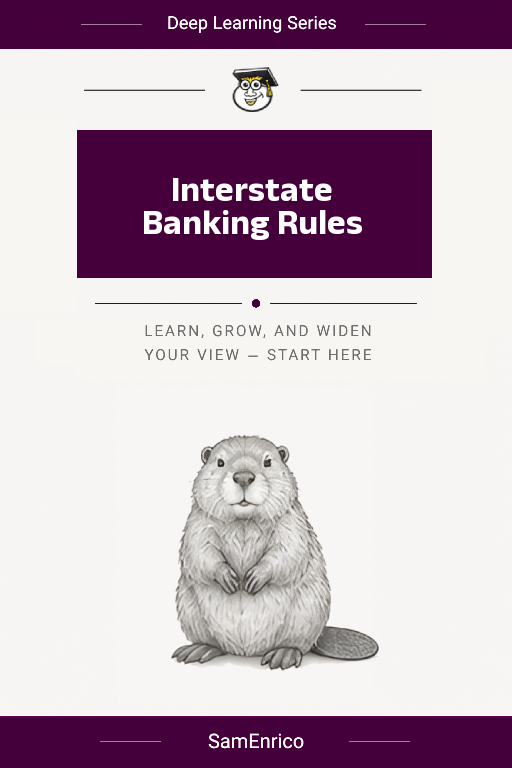
Non-FictionAnnual CheckupFintechBanking
Interstate Banking Rules eBook
Navigate interstate banking regulations for fintec
Navigate interstate banking regulations for fintech including interest rate exportation and branching rules.
Formats
Free sample
Chapter 1: The Fragmented Republic...--The digital loan you just approved on your smartphone traveled through three states, two banks, and one legal loophole before it landed in a borrower's account. That journey took less than three seconds. Understanding where it went and why will take the rest of this book.Every day, millions of financial transactions cross state lines without a single physical document changing hands. An API call routes a loan application from a fintech's servers in Delaware to a bank's underwriting system in South Dakota. The bank approves the loan using its home state's interest rate laws—perhaps 24% APR, perfectly legal in South Dakota, which has no usury cap.
The funds are deposited into a borrower's account in California, where the state constitution caps personal loan interest at 10%. The entire transaction is instantaneous, invisible, and, depending on which lawyer you ask, either perfectly legal or a flagrant violation of California law.This is the fragmented republic of interstate banking. And if you do not understand its rules, you will not survive in it.The One-Thousand-Mile Loan Before we dive into statutes and regulations, consider the story of a single $500 loan—a real transaction, though the names have been changed.Maria, a customer service representative in Bakersfield, California, needed 500tocoveranunexpectedcarrepair.Shehadacreditscoreof620,whichmeantherlocalcreditunionwouldnotapproveher.Shewentonlineandfoundalenderoffering"fastapproval,nohiddenfees."Sheapplied,wasapprovedinfourminutes,andreceived500 to cover an unexpected car repair. She had a credit score of 620, which meant her local credit union would not approve her. She went online and found a lender offering "fast approval, no hidden fees." She applied, was approved in four minutes, and received 500tocoveranunexpectedcarrepair.Shehadacreditscoreof620,whichmeantherlocalcreditunionwouldnotapproveher.Shewentonlineandfoundalenderoffering"fastapproval,nohiddenfees."Sheapplied,wasapprovedinfourminutes,andreceived500 in her bank account the same day.
The APR was 24%.Under California law, the maximum interest rate for a personal loan of that size is 10%. But the lender was not a California lender. The fine print revealed that the loan was originated by a national bank headquartered in Sioux Falls, South Dakota. South Dakota has no usury cap. Under the Marquette doctrine—a 1978 Supreme Court decision we will explore in Chapter 2—that national bank could charge any interest rate permitted by its home state, regardless of where the borrower lived.Maria's loan was legal.
But was it fair? That question has fueled decades of litigation, legislation, and regulatory warfare. And it gets more complicated from here.Six months later, the national bank sold Maria's loan to a debt buyer based in New York. The debt buyer, which was not a bank, attempted to collect the full 24% interest. Under New York law, the maximum interest rate is 16%.
A federal appeals court later ruled that non-bank debt buyers cannot charge rates that exceed the borrower's home state cap. This is the Madden problem, which we will dissect in Chapter 6.Maria's $500 loan—originated by a South Dakota bank, funded to a California resident, and sold to a New York debt buyer—implicated the laws of three states and the federal government. Every participant in that transaction believed they were acting legally. And yet, the debt buyer eventually had to write off the debt and pay a settlement to avoid a class action lawsuit.This is the reality of interstate banking. The rules are fragmented.
The precedents conflict. And the stakes are enormous.The Constitutional Architecture of Fragmentation To understand why interstate banking rules are so fragmented, we must start with the Constitution. The framers did not anticipate digital loans or fintech APIs, but they did anticipate the tension between state and federal authority over commerce. Two clauses in particular shape everything that follows.The Dormant Commerce Clause Article I, Section 8 of the Constitution grants Congress the power "to regulate Commerce with foreign Nations, and among the several States, and with the Indian Tribes." For over two centuries, the Supreme Court has interpreted this clause to contain a negative corollary: when Congress has not acted, states cannot enact laws that unduly burden interstate commerce. This is called the "Dormant Commerce Clause" because it restricts state power even when federal power lies dormant.In the banking context, the Dormant Commerce Clause prevents states from enacting usury caps that discriminate against out-of-state lenders.
A state cannot pass a law that says "in-state banks may charge 15% but out-of-state banks may only charge 10%." That would be facially discriminatory and almost certainly unconstitutional.But the Dormant Commerce Clause does not prevent states from enacting generally applicable usury caps that apply equally to in-state and out-of-state lenders. California's 10% cap applies to all lenders who are "doing business" in California—including out-of-state banks that have a physical presence in the state. The question of what constitutes "doing business" in the digital age is one of the most contested issues in interstate banking law.The Full Faith and Credit Clause Article IV, Section 1 of the Constitution requires each state to respect the "public Acts, Records, and judicial Proceedings" of every other state. This is the Full Faith and Credit Clause, and it creates a powerful tool for interstate banking.If a bank chartered in Delaware makes a loan to a borrower in Texas, and the loan is valid under Delaware law, the Full Faith and Credit Clause generally requires Texas courts to recognize that validity. Texas cannot simply refuse to enforce a Delaware loan because Texas has different usury laws.
However, there is an exception: Texas courts may refuse to enforce a Delaware loan if doing so would violate a "strong public policy" of Texas. And what public policy is stronger than a state's usury cap?This tension—between the Full Faith and Credit Clause's command of interstate respect and the exception for strong state public policies—is at the heart of nearly every interstate banking dispute. The courts have never fully resolved it, which is why litigation continues to flourish.The Tenth Amendment and the Dual Banking System The Tenth Amendment reserves to the states all powers not delegated to the federal government. Banking has never been explicitly delegated to Congress, which means the default assumption is that states regulate banking. And for most of American history, that is exactly what happened.But the Civil War changed everything.
The National Bank Act of 1864 created a system of federally chartered banks that operated alongside state-chartered banks. This was the birth of the "dual banking system"—a uniquely American arrangement in which a bank could choose whether to seek a charter from the federal government or from a state government. Each charter came with different rights, different obligations, and different preemption powers.Today, the dual banking system is the source of both the fintech industry's greatest opportunities and its greatest headaches. Federal charters offer broad preemption but rigorous oversight. State charters offer flexibility but narrower protection from other states' laws.
Choosing between them is one of the most consequential decisions a fintech can make, and we will devote Chapter 3 entirely to that choice.The Digital Disconnect: Why Physical Rules Don't Fit Virtual Transactions The laws governing interstate banking were written in an era of physical branches, paper checks, and face-to-face lending. They assumed that a bank "doing business" in a state would have a building, employees, and customers who walked through the door. They assumed that a loan would be documented…
This is the end of the free sample. Get the eBook to keep going. Buy now
About this book
Details
- Author
- Herring Clarita
- Publisher
- SamEnrico
- Language
- English
- Genre
- Non-Fiction, Annual Checkup, Fintech, Banking
- Released
- 2026-05-30
- Pages (approx.)
- 158
- Available as
- eBook, Audiobook

Read better in the ZLOADR app
Your eBooks on your phone or tablet. Sign in with your SamEnrico account and start reading.
More by Herring Clarita
 Workers Compensation SpecialistsHerring Clarita$11.99
 Metta for Forgiveness Practice GuideHerring Clarita$11.99
 Stress Related Partner Blame GuideHerring Clarita$11.99
 Mindfulness for Beginner ScientistsHerring Clarita$11.99
 Fitness Equipment Starter KitHerring Clarita$11.99
 The Frozen Alchemists: Arctic Secrets in the Age of DiscoveryHerring Clarita$11.99
 Dust to Digital: How the Beat Generation Rewrote the RulesHerring Clarita$11.99
 How to Become a Treating EngineerHerring Clarita$11.99
 Understanding Dennis–fairhurst–Moore SyndromeHerring Clarita$17.99
 Turkish Student Shopping GuideHerring Clarita$12.99
 Portfolio Administration CoordinatorHerring Clarita$11.99
You may also like
 Hong Kong Handover 1997Dunn Johnnie$11.99
 Zumba For Postnatal Recovery CourseNeal Christian$11.99
 Zumba for BeginnersLadner Nikia$11.99
 YouTube Comment Mining GuideHumes Pandora$12.99
 Worry Box MeditationCarlin Rudy$11.99
 Workplace Stress MeditationNguyen Lynn$11.99
 Workplace Stress and Sleep RepairHawley Ivory$11.99
 Workplace Perfectionism CureDelaney Jeffry$11.99
 Workplace Injustice Anger GuideWallen Isabelle$11.99
 Work Addiction and Burnout LinkGreenwood Ester$11.99
 Women in Yoga and WellnessBeattie Galina$11.99
 Women in Stand Up ComedyChun Evangeline$11.99