
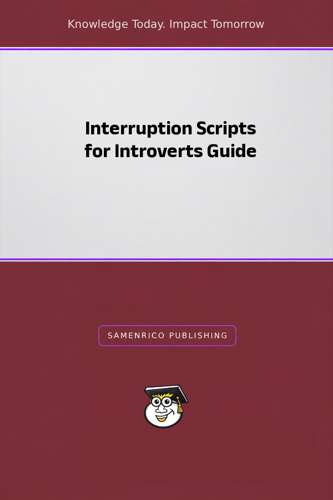
Interruption Scripts for Introverts Guide eBook
Use low energy, polite scripts to decline interrup
by Stowe Junior
Use low energy, polite scripts to decline interruptions without social exhaustion or confrontation.
Formats
Free sample
Chapter 1: The 23-Minute Theft--You are not lazy. You are not antisocial. And you are certainly not bad at your job.You are, however, being robbed. Every single day. By people who like you, respect you, and have no idea what they are costing you.The thief does not wear a mask or carry a weapon.
The thief knocks on your office door, taps you on the shoulder, sends a Slack message that says “quick question,” or walks into your kitchen while you are working from home and says, “Got a second?” The thief is almost always well-intentioned. The thief is often your boss, your colleague, your partner, or your child. And the thief is costing you twenty-three minutes every single time.Twenty-three minutes.That is not a guess. That is not a motivational poster statistic. That is the average time it takes the human brain to fully return to a focused state after an interruption.
The research comes from decades of cognitive psychology studies, most famously by Gloria Mark at the University of California, Irvine, who found that after even a brief disruption—a phone call, a coworker stopping by, a notification—it takes an average of twenty-three minutes and fifteen seconds to regain the same level of cognitive focus you had before the interruption.Let me say that again. Twenty-three minutes.If someone interrupts you for thirty seconds, you do not lose thirty seconds. You lose twenty-three minutes and thirty seconds. The interruption itself is the spark. The refocus period is the fire.And if you are an introvert, the fire burns hotter and longer.The Introvert Tax Most books about productivity and boundaries treat all humans as if they have the same psychological operating system.
They do not. Extroverts and introverts process interruptions fundamentally differently, and pretending otherwise is like giving the same medical advice to someone with a broken leg and someone with a cold.Here is the difference.When an extrovert is interrupted, their brain often experiences a small spike of positive arousal. Social contact, even unexpected contact, can generate dopamine for an extrovert. The interruption might cost them focus, but it may also give them energy. This is not a moral failing on the extrovert’s part and it is not a superiority on the introvert’s part.
It is simply neurology.When an introvert is interrupted, the opposite happens. Unexpected social contact triggers a small but measurable stress response. Cortisol rises. The brain interprets the interruption not as an opportunity but as a demand. Even a thirty-second interruption drains cognitive reserves that took hours to build.
And here is the cruelest part: introverts often need more time than extroverts to rebuild those reserves because focused work for an introvert requires a low-stimulation environment. Once that environment is shattered by an interruption, rebuilding it takes additional effort.I call this the Introvert Tax.The math is brutal. An extrovert who is interrupted for thirty seconds loses roughly twenty-three minutes of refocus time, same as anyone. But an introvert who is interrupted for thirty seconds loses twenty-three minutes of refocus time plus the additional time required to lower their stimulation levels again. For some introverts, that additional time is five minutes.
For others, it is fifteen. For highly sensitive introverts, it can be an hour or more.Let me put this in concrete terms.Imagine you are writing a report. You have been deep in concentration for forty-five minutes. Your prose is flowing. The structure is clear in your mind.
You are in what psychologists call flow state—a condition of complete absorption where time seems to disappear and your best work emerges effortlessly.A coworker appears at your door. “Hey, got a second? Just need a quick answer.”You say yes because you are nice and you do not want to be rude. The conversation lasts forty-five seconds. You answer the question.
The coworker leaves.Now what?Your flow state is gone. The structure you had in your mind has collapsed. The paragraph you were about to write has evaporated. You sit at your desk staring at the screen, trying to remember where you were. You read the last three sentences you wrote.
You delete one of them. You rewrite it. You check your email because it feels easier than finding your way back into the report. Twenty-three minutes pass before you are truly writing again.But you are an introvert, so it is worse than that. Not only have you lost twenty-three minutes of refocus time, but your nervous system is now slightly agitated.
The unexpected social contact has left a residue. You feel a little less safe in your own workspace. You are subconsciously bracing for the next interruption. That bracing costs you cognitive bandwidth even while you work.This is the Introvert Tax. It is real.
It is measurable. And it is not your fault.The Three Lies You Have Been Told Before we go any further, I need you to unlearn three things. These are lies that productivity culture and people-pleasing conditioning have taught you, and they are the reason you are reading this book instead of peacefully finishing your work.Lie Number One: “Multitasking is a skill you should develop.”Multitasking does not exist. What we call multitasking is actually rapid task-switching, and research from Stanford University shows that people who frequently multitask are worse at every cognitive task than people who do one thing at a time. They are slower.
They make more errors. And they have more difficulty filtering irrelevant information. The brain is not a computer that can run multiple programs simultaneously. The brain is a single processor that switches contexts, and each switch costs time and energy. The people who brag about being great multitaskers are not great at multitasking.
They are just less aware of how badly they are performing.Lie Number Two: “Being available makes you valuable.”This lie is seductive because it contains a grain of truth. Yes, being responsive and collaborative is professionally important. But availability without boundaries is not collaboration. It is dissolution. If you are available to everyone all the time, you are not a colleague.
You are a utility. Your value does not come from how quickly you answer Slack messages. Your value comes from the quality of the work you produce when you are not being interrupted. The engineer who writes elegant, bug-free code is more valuable than the engineer who answers every question immediately but produces mediocre work. The writer who finishes the manuscript is more valuable than the writer who replies to every email within five minutes but never publishes anything.Lie Number Three: “Saying no makes you difficult.”This is the most damaging lie of all, especially for introverts who have often been told their whole lives that they are too quiet, too reserved, or too antisocial.
Saying no to an interruption is not saying no to a person. It is saying yes to your own focus. It is saying yes to the project that is due. It is saying yes to the mental health that comes from finishing your work without exhaustion. The person who asks for your time is not owed it simply…
This is the end of the free sample. Get the eBook to keep going. Buy now
About this book
Details
- Author
- Stowe Junior
- Publisher
- SamEnrico
- Language
- English
- Genre
- Non-Fiction, Self-Help, Introvert Communication, Boundaries
- Released
- 2026-06-11
- Pages (approx.)
- 137
- Available as
- eBook, Audiobook

Read better in the ZLOADR app
Your eBooks on your phone or tablet. Sign in with your SamEnrico account and start reading.
More by Stowe Junior
 IBS Dietitian Consultation GuideStowe Junior$11.99
 Aggressive Communication Awareness GuideStowe Junior$11.99
 The Freelance Tax Quarter GuideStowe Junior$11.99
 Scheduling for Night OwlsStowe Junior$11.99
 The Endowment EffectStowe Junior$11.99
 Iliotibial Band Syndrome Stretch GuideStowe Junior$11.99
 Scripting ResearchStowe Junior$11.99
 Alice Walton ArtStowe Junior$11.99
 The Silent Codebreakers: How Women Cracked the Nazis' EnigmaStowe Junior$11.99
 The Moon Shot That Changed Everything: Apollo 11's Hidden TriumphsStowe Junior$11.99
 Into the Frozen Abyss: The Arctic's Hidden Underwater CavesStowe Junior$11.99
 The Complete Guide to the New Me Diet: Hormone BalancingStowe Junior$11.99