
Non-FictionSelf-HelpMorning RitualsSuccess Habits
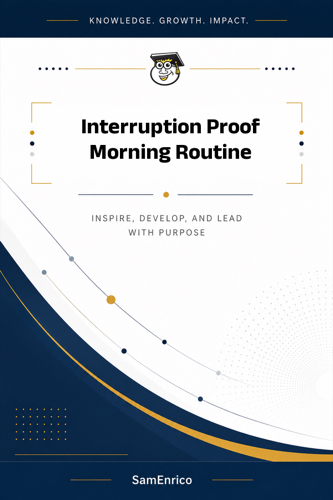
Interruption Proof Morning Routine eBook
Design your first 90 minutes to be inviolable, bui
Design your first 90 minutes to be inviolable, building momentum before the chaos begins.
Formats
Free sample
Chapter 1: The Stolen Hour–- You wake up. Before you open your eyes, your hand reaches for the phone. The screen glows: three emails, two Slack messages, a news alert, and someone liked your post from last night. You have been awake for eleven seconds, and your day already belongs to someone else.This is not a failure of willpower. It is not laziness, lack of discipline, or a character flaw.
It is the predictable result of living in an economy designed to capture your first and best moments. The first hour of your day—what neuroscientists call the “hypnopompic state,” when your brain is most suggestible and least defended—has been colonized. And you are paying the price in ways you cannot see until you step back and measure the damage.Let me show you what the research says. Then let me introduce you to the small group of people who have figured out how to take their mornings back. And finally, let me give you the single most important concept this book will teach you: the Inviolable Block.The Quiet Catastrophe of the Reactive Morning A study from the University of Bristol tracked knowledge workers across three continents.
The researchers found that the average person checks their phone within nine minutes of waking. Within that first hour, they switch tasks an average of twenty-one times. By the time they pour their coffee, they have already responded to demands from five different people—none of whom were themselves.The cost is not just emotional. It is physiological.Cortisol, your body’s primary stress hormone, follows a natural rhythm. It should rise gradually in the morning, helping you wake up and face the day with energy.
But when the first thing you do is react to notifications, cortisol spikes abruptly—50 to 70 percent higher than in people who wait at least thirty minutes before looking at a screen. This spike feels like urgency. It feels like productivity. But it is not. It is a stress response, and it leaves you depleted before you have done a single thing that matters.Decision fatigue compounds the damage.
Every choice you make—what to wear, what to eat, which email to answer first, whether to check Instagram—draws from a finite pool of cognitive resources. Researchers Roy Baumeister and John Tierney demonstrated that each decision reduces the quality of subsequent decisions. By the time you finish choosing between oatmeal and eggs, you have less willpower left for the work that actually moves your life forward.The result is a generation of professionals who are busy but not effective. Who answer emails before they think. Who attend meetings before they create.
Who mistake activity for achievement.The Three Enemies of Your Morning You are not fighting yourself. You are fighting three distinct enemies, each of which has been engineered or evolved to steal your attention.Enemy One: Notifications The first enemy is the most obvious. Notifications are designed by billion-dollar companies to hijack your attention. They exploit a neurological quirk called “intermittent variable reward”—the same mechanism that makes slot machines addictive. You do not know whether the buzz will bring good news, bad news, or nothing at all.
That uncertainty keeps you coming back.Every time you check a notification, your brain releases a small amount of dopamine. Not because the notification is important, but because it might be. Over time, you condition yourself to crave the buzz. Your phone becomes a slot machine in your pocket, and the house always wins.Enemy Two: Other People’s Priorities The second enemy is more insidious because it wears the mask of responsibility. Other people’s priorities arrive in your inbox, your text messages, and your Slack channels disguised as urgent.
But urgency is not the same as importance. Stephen Covey’s urgent-important matrix, decades old but still devastatingly accurate, shows that most of what feels urgent is merely someone else’s anxiety transferred to you.Your coworker’s “quick question” is not quick. It fragments your attention. Your boss’s “thoughts on this?” before you have had coffee is not a genuine request for insight—it is a demand for reaction. Your friend’s meme or your parent’s news article is not connection.
It is distraction dressed up as relationship.The tragedy is that you have been trained to treat all incoming requests as equally valid. Your phone does not distinguish between a genuine emergency and a marketing email. It dings the same. Your brain does the same. And you pay the same price.Enemy Three: Your Own Sleepy Brain The third enemy is the one you cannot blame on anyone else.
Your own sleepy brain defaults to the path of least resistance. When you are groggy, your executive function—the part of your brain that makes deliberate choices—is impaired. You reach for the phone because it is easy. You scroll because it is automatic. You snooze because it is comfortable.This is not a moral failure.
It is biology. The brain’s prefrontal cortex, responsible for willpower and long-term planning, takes longer to wake up than the rest of your brain. For the first fifteen to thirty minutes after waking, you are literally less capable of making good decisions. The path of least resistance is not laziness. It is neurology.But neurology can be outsmarted.
And that is what this book will teach you to do.The Top Performers’ Secret Let me tell you about two people who have figured this out.Sarah is the CEO of a mid-sized technology company. She wakes at six o’clock every morning, including weekends. She does not look at her phone until seven-thirty. For ninety minutes, she works on exactly one thing: the strategic decision that will move her company forward. No email.
No Slack. No news. Just her and the work that only she can do.When I asked her what changed when she started this routine, she said: “I used to get to the office already exhausted. I had answered thirty emails before I walked in the door. I had already fought five small fires.
By nine AM, I felt like I had worked a full day. Now I finish my most important work before anyone else is awake. The fires still come. But they meet someone who has already won.”James is a freelance writer. He works from home, which sounds ideal until you realize that home is full of dishes, laundry, and a partner who also works from home.
James protects six to seven-thirty every morning. He closes his office door. He hangs a sign that says “In session – back at 7:30.” He writes.“Before I did this,” James told me, “I would start my day by checking email. Then I would check Twitter. Then I would get sucked into a ‘quick’ conversation with my partner about dinner.
By the time I actually opened my document, I had already spent my best creative energy on things that didn’t matter. Now I write first. Everything else waits.”Both Sarah and James report producing two to three times more output in their protected ninety minutes than in the next four hours of their day. They…
This is the end of the free sample. Get the eBook to keep going. Buy now
About this book
Details
- Author
- Thrash Aleshia
- Publisher
- SamEnrico
- Language
- English
- Genre
- Non-Fiction, Self-Help, Morning Rituals, Success Habits
- Released
- 2026-06-10
- Pages (approx.)
- 136
- Available as
- eBook, Audiobook

Read better in the ZLOADR app
Your eBooks on your phone or tablet. Sign in with your SamEnrico account and start reading.
More by Thrash Aleshia
 Depreciation of Manufacturing EquipmentThrash Aleshia$11.99
 Campfire Night GuideThrash Aleshia$11.99
 Forgiveness for Past Self GuideThrash Aleshia$11.99
 The 4 7 8 Morning BreathThrash Aleshia$11.99
 Action Verbs For ResumesThrash Aleshia$11.99
 Mixed Use Property InvestingThrash Aleshia$11.99
 B 52 Navigator PilotThrash Aleshia$11.99
 Mark Zuckerberg FacebookThrash Aleshia$11.99
 Feathered Serpent's Descent: Quetzalcoatl’s Exile and ReturnThrash Aleshia$11.99
 The Forgotten Codebreakers of WWII: The Women Who Cracked the AxisThrash Aleshia$11.99
 Soul Train: The Unseen RevolutionThrash Aleshia$11.99
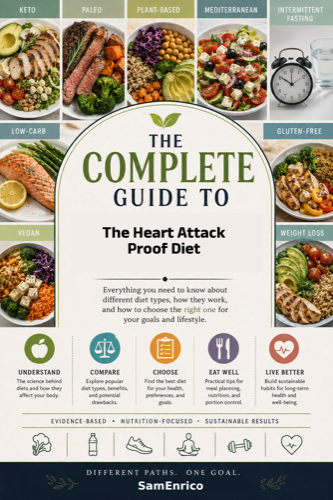 The Complete Guide to the Heart Attack Proof DietThrash Aleshia$11.99
You may also like
 Hong Kong Handover 1997Dunn Johnnie$11.99
 Zumba For Postnatal Recovery CourseNeal Christian$11.99
 Zumba for BeginnersLadner Nikia$11.99
 YouTube Comment Mining GuideHumes Pandora$12.99
 Worry Box MeditationCarlin Rudy$11.99
 Workplace Stress MeditationNguyen Lynn$11.99
 Workplace Stress and Sleep RepairHawley Ivory$11.99
 Workplace Perfectionism CureDelaney Jeffry$11.99
 Workplace Injustice Anger GuideWallen Isabelle$11.99
 Work Addiction and Burnout LinkGreenwood Ester$11.99
 Women in Yoga and WellnessBeattie Galina$11.99
 Women in Stand Up ComedyChun Evangeline$11.99