
Non-FictionSelf-Help / Time Management
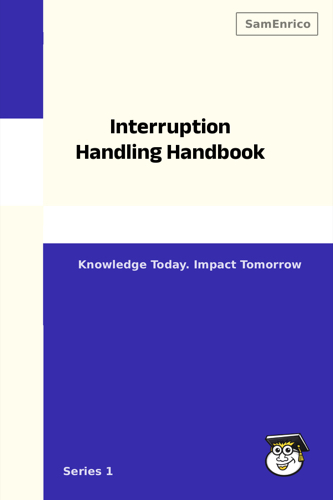
Interruption Handling Handbook eBook
Provides scripts and strategies for managing unexp
Provides scripts and strategies for managing unexpected disruptions at work.
Formats
Free sample
Chapter 1: The Twenty-Minute Theft--–- Sarah, a senior software engineer at a mid-sized tech firm, was exactly forty-three minutes into a complex debugging session when it happened. She had just mapped the final relationship between three interdependent database queries—a breakthrough that had eluded her for two days. Her fingers hovered over the keyboard, ready to implement the fix. Then came the ping.A Slack message from her manager: "Quick question, got a sec?"Sarah sighed, tabbed over, and replied, "Sure, what's up?"The "quick question" was not a question at all. It was a request to review a slide deck for an upcoming client presentation—something that could have been emailed.
Fifteen minutes later, Sarah returned to her debugging session. But she was no longer forty-three minutes in. She was starting over. The mental map she had built was gone. The relationships between the queries had dissolved into a fog.
It took her another twenty-two minutes just to find her place again, and another thirty to rebuild the logic she had already solved.That single "quick question" cost Sarah nearly an hour of productive time. She did not blame her manager. He was not malicious. He was just... unaware.
And Sarah, like most knowledge workers, had never been taught how to defend her attention.This book is the solution Sarah needed.The Myth of the "Quick Question"The modern workplace runs on a dangerous assumption: that brief interruptions cost only the time they consume. A two-minute phone call costs two minutes. A "quick question" costs thirty seconds. A Slack ping costs five seconds to read and dismiss. This assumption is not just wrong—it is catastrophically wrong.
It is the single greatest driver of lost productivity in the knowledge economy, and almost no one is talking about it.Let us name this assumption for what it is: The Myth of the Quick Question.The myth persists because it feels true. When someone interrupts you for thirty seconds, you return to your desk and resume typing. On the surface, nothing appears lost. But beneath the surface—in the neural architecture of your brain—a violent disruption has occurred. Your working memory has been flushed.
Your context has been deleted. Your cognitive momentum has been shattered.The thirty-second interruption does not cost thirty seconds. It costs fifteen to twenty minutes of recovery time, plus the original interruption duration, plus the increased error rate that follows every task switch. This is not opinion. This is peer-reviewed cognitive science.The Science of Attention Residue In 2009, researcher Sophie Leroy published a landmark study that fundamentally changed how we understand task switching.
She gave it an evocative name: Attention Residue.Here is what Attention Residue means in plain language: when you switch from Task A to Task B, your brain does not simply stop thinking about Task A and start thinking about Task B. Instead, a portion of your working memory remains "stuck" on Task A, like a drop of water clinging to a surface after you pour it out. This residue reduces your cognitive capacity for Task B by as much as forty percent.Leroy's research showed that the more incomplete or unresolved Task A is, the more attention residue you carry with you. An unfinished email draft. A half-written report.
A debugging session interrupted mid-logic. These incomplete tasks haunt your working memory, demanding closure even when you have physically moved on.This is why Sarah could not simply resume her debugging session after answering her manager's Slack message. Her brain was still running the debugging logic in the background, competing for mental bandwidth with the slide deck review she had just completed. She was not fully present for either task. She was split between both.The Fifteen to Twenty Minute Rule Attention Residue is the what.
Now let us talk about the how long.Gloria Mark, a professor at the University of California, Irvine, has spent two decades studying how people actually work in digital environments. Her findings are sobering. In her landmark study of knowledge workers, Mark discovered that the average person is interrupted every eleven minutes. Even more striking, after an interruption, it takes an average of twenty-three minutes and fifteen seconds to return to the original task with the same depth of focus.Other studies have narrowed this range. The consensus across cognitive psychology literature is clear: after a brief interruption, cognitive recovery takes between fifteen and twenty minutes.
This is not the time it takes to physically return to your desk. This is the time it takes for your brain to rebuild the context it lost—to reload the mental map, re-establish the logical relationships, and re-enter what psychologists call Flow State.Flow State is the holy grail of productivity. It is the condition of being fully immersed in a task, where time distorts, self-consciousness vanishes, and performance peaks. Flow is fragile. It requires sustained, uninterrupted attention to achieve—typically twenty to thirty minutes of continuous focus.
And it can be shattered by a single ping.Here is the cruel math of interruption:Time to enter Flow State: 20–30 minutes Time to lose Flow State: 1 second (the moment you switch tasks)Time to recover Flow State after a 2-minute interruption: 15–20 minutes The interruption itself is a footnote. The recovery is the story.The Real Cost of "Just One Quick Question"Let us put numbers on this. Assume you are a knowledge worker earning $80,000 per year. Your time, therefore, is worth approximately $40 per hour, or $0.67 per minute.Now assume you receive five "quick questions" in a single day. Each interruption is brief—two minutes, perhaps three.
The total interruption time is fifteen minutes. At $0.67 per minute, that is about $10 worth of time. Not a catastrophe.But that calculation is a lie. It is The Myth of the Quick Question in action.The real calculation must include recovery time. Each two-minute interruption costs fifteen minutes of cognitive recovery.
Five interruptions cost seventy-five minutes of recovery. Add the fifteen minutes of actual interruption time, and you arrive at ninety minutes—one and a half hours—of lost productive time per day.At $40 per hour, five "quick questions" cost your employer **$60 per day**. Over a 240-day work year, that is **$14,400** in lost productivity from a single employee. Now multiply that by a team of ten: $144,000 per year. A department of fifty: $720,000.
A company of five hundred: $7.2 million.These are not hypotheticals. These are the real, measurable costs of a workplace culture that treats interruption as normal.The Hidden Tax of Context Switching Interruptions do not only cost time. They cost quality.Every time you switch tasks, your brain must perform a series of expensive operations. First, it must "unload" the current task from working memory—a process that is never complete, which is why Attention Residue exists. Second, it must load the new task into working memory.
Third, it must re-orient to the new task's goals, rules, and constraints. Fourth, after the interruption, it must reverse the entire process to return to the original task.Each of these operations is error-prone. Studies of medical professionals have found that interruptions during medication administration increase the risk of error by twelve percent. Studies of software developers have…
This is the end of the free sample. Get the eBook to keep going. Buy now
About this book
Details
- Author
- Mullen Suzette
- Publisher
- SamEnrico
- Language
- English
- Genre
- Non-Fiction, Self-Help / Time Management
- Released
- 2026-06-11
- Pages (approx.)
- 122
- Available as
- eBook, Audiobook

Read better in the ZLOADR app
Your eBooks on your phone or tablet. Sign in with your SamEnrico account and start reading.
More by Mullen Suzette
 Teenage Imposter SyndromeMullen Suzette$11.99
 Cocaine Cardiovascular RisksMullen Suzette$11.99
 Voice Actor Superhero LifeMullen Suzette$11.99
 Networking at MeetupsMullen Suzette$11.99
 Pharmacist Medication ErrorMullen Suzette$11.99
 Financial Fights Anger ReductionMullen Suzette$11.99
 Stillbirth Support WorkbookMullen Suzette$11.99
 The Shanghai Kidnapping Plot: The First Ransomware of the Far East (1930s)Mullen Suzette$11.99
 The First Olympic Champion: Koroibos of Elis and the Birth of Athletic ExcellenceMullen Suzette$11.99
 How to Start a Eraser Rubber Business (Beginners Guide)Mullen Suzette$11.99
 How to Produce Moisture MetersMullen Suzette$11.99
 How to Produce Cameras and AccessoriesMullen Suzette$11.99
You may also like
 Hong Kong Handover 1997Dunn Johnnie$11.99
 Zumba For Postnatal Recovery CourseNeal Christian$11.99
 Zumba for BeginnersLadner Nikia$11.99
 YouTube Comment Mining GuideHumes Pandora$12.99
 Worry Box MeditationCarlin Rudy$11.99
 Workplace Stress MeditationNguyen Lynn$11.99
 Workplace Stress and Sleep RepairHawley Ivory$11.99
 Workplace Perfectionism CureDelaney Jeffry$11.99
 Workplace Injustice Anger GuideWallen Isabelle$11.99
 Work Addiction and Burnout LinkGreenwood Ester$11.99
 Women in Yoga and WellnessBeattie Galina$11.99
 Women in Stand Up ComedyChun Evangeline$11.99