
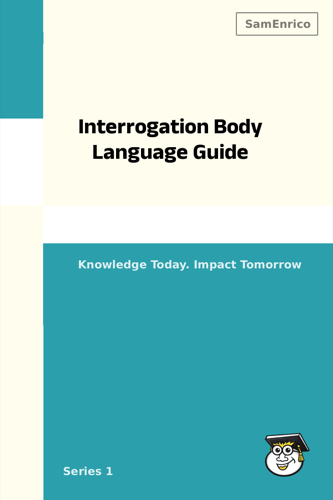
Interrogation Body Language Guide eBook
For investigators: reads deception, stress, and wi
For investigators: reads deception, stress, and willingness to cooperate.
Formats
Free sample
Chapter 1: The Architecture of Deception--–- Every investigator remembers the moment they first realized their gut could lie to them. For some, it comes during a training exercise when a seasoned instructor reveals that the most convincing "tell" they just identified is actually a sign of innocence. For others, it arrives in a courtroom, cross-examined by a defense attorney who produces a transcript showing that the suspect's nervous fidgeting was diagnosed as a benign neurological condition years before the interview. And for the unlucky few, it comes when a confession is played back on video—the confession they worked so hard to obtain—only to realize that every single behavior they interpreted as deception was, in fact, the predictable physiology of terror in an innocent person.This chapter does not begin with a list of lies. It does not open with seven ways to spot a liar or three gestures that guarantee guilt.
Those lists exist, and many of them circulate in law enforcement break rooms and security training seminars. They are seductive in their simplicity, promising that a twitch of the nose or a glance to the left reveals the inner workings of the human soul. But they are also wrong. Not occasionally wrong—structurally, dangerously, ethically wrong. The premise of this entire book is that effective interrogation begins not with knowing what a liar looks like but with understanding what lying actually is: a specific, cognitively demanding act of construction that leaves measurable traces across multiple channels of human behavior.Before an investigator can read body language, they must understand the architecture of deception itself.
This means grasping three foundational truths that will guide every subsequent chapter. First, lying is not the opposite of truth-telling but a distinct cognitive activity that requires significantly more mental resources. Second, the high-stakes environment of an interrogation room produces so much genuine anxiety that innocent people routinely exhibit behaviors that untrained observers mistake for guilt. Third, what most investigators call "gut instinct" is not instinct at all—it is pattern recognition operating below conscious awareness, and without systematic calibration, that pattern recognition is more likely to produce false positives than accurate judgments.This chapter builds the psychological framework upon which all kinesic analysis rests. By the end, the reader will understand why the most successful investigators are not those with the sharpest intuition but those with the most disciplined observation habits.
They will recognize that the difference between a liar and a stressed innocent person is not a single gesture but a pattern of cognitive and emotional behaviors that unfold over time. And they will be prepared to set aside the comfortable certainty of universal "tells" in favor of the harder but more reliable work of baseline comparison and structured analysis.The Hidden Weight of a Lie Consider what happens when someone tells the truth. A truth-teller is asked, "Where were you last Tuesday between seven and nine in the evening?" The truthful person does not need to invent anything. They search their memory, retrieve a sequence of events—perhaps with gaps or minor inaccuracies of timing—and report what they recall. The cognitive process is primarily retrieval, not construction.
The brain activates stored memory traces, and the speaker translates those traces into language with minimal editorial oversight. This is not to say truth-tellers never pause, hesitate, or make errors. Memory is reconstructive, not photographic, and even honest witnesses misremember details. But the underlying cognitive operation is one of access, not invention.The liar faces a radically different task. When asked the same question, the deceptive subject must simultaneously perform at least four distinct cognitive operations.
First, they must invent a plausible alternative narrative that accounts for the relevant time period without revealing their actual activities. This requires constructing a fictional timeline, populating it with believable details, and ensuring internal consistency. Second, they must suppress the true memory, actively inhibiting its retrieval to prevent accidental leakage. This is not passive forgetting but active suppression, a resource-intensive process that draws on the same executive functions needed for complex problem-solving. Third, they must monitor their own emotional state, managing the anxiety, guilt, or fear that accompanies deception.
This emotional labor consumes additional cognitive resources. Fourth, they must observe the interviewer's reactions in real time, adjusting the fabricated story to maintain credibility. A skeptical look, a raised eyebrow, a pointed follow-up question—each requires the liar to recalibrate their narrative on the fly.This is the cognitive load of deception, and it is the single most important concept in behavioral analysis. Research across multiple decades and methodologies consistently demonstrates that lying is cognitively more demanding than truth-telling. Brain imaging studies using functional magnetic resonance imaging (f MRI) show increased activation in the prefrontal cortex, anterior cingulate cortex, and other regions associated with executive function and inhibitory control during deceptive responses compared to truthful ones.
These are the brain's "central executive" regions, responsible for planning, impulse control, working memory, and cognitive flexibility. When a person lies, these regions work harder.Behavioral studies confirm the picture. Liars take longer to respond to questions than truth-tellers, particularly when the questions are unexpected. They make more speech errors, including stutters, word repetitions, and sentence fragments. They provide fewer sensory details about events—fewer descriptions of sounds, smells, physical sensations, or ambient conditions.
Their stories are less coherent, with more contradictions, temporal jumps, and implausible sequences. They use more filler words like "um," "uh," and "like" as their brains buy time to construct the next piece of the narrative. These are not signs of moral failure. They are the observable byproducts of a brain working at full capacity.The practical implication for investigators is profound and often overlooked. The behaviors associated with deception—longer pauses, increased blinking, speech hesitations, reduced detail, inconsistent chronology—are not unique to deception.
They are also produced by other conditions that impose cognitive load: fatigue, illness, intellectual disability, traumatic brain injury, language barriers, anxiety disorders, autism spectrum conditions, and the simple, overwhelming terror of being accused of a crime one did not commit. A suspect who stayed up all night worrying about the interview will show cognitive load signs. A suspect with an undiagnosed learning disability will show cognitive load signs. A suspect who speaks English as a second language will show cognitive load signs. None of these people are necessarily lying.This is why the first step in any interrogation is not accusation but calibration.
The investigator must establish what the subject looks like when thinking is easy before they can interpret what the subject looks like when thinking is hard. A subject who naturally speaks slowly, pauses frequently, and avoids eye contact due to social anxiety will appear "deceptive" under the universal-tell model. But under the cognitive load model, the same subject shows no change from baseline when asked difficult questions—because their baseline already includes those behaviors. The absence of a change is itself meaningful, but only if the investigator knows what the baseline looks like. Without baseline, everything looks like deception.
With baseline, the investigator has a yardstick against which to measure deviation.When Innocent People Look Guilty There is a cruel irony at the heart of interrogation work. The very environment…
This is the end of the free sample. Get the eBook to keep going. Buy now
About this book
Details
- Author
- Davenport Antwan
- Publisher
- SamEnrico
- Language
- English
- Genre
- Non-Fiction, Self-Help, Investigation
- Released
- 2026-06-09
- Pages (approx.)
- 158
- Available as
- eBook, Audiobook

Read better in the ZLOADR app
Your eBooks on your phone or tablet. Sign in with your SamEnrico account and start reading.
More by Davenport Antwan
 HIIT for Weight Loss ResultsDavenport Antwan$11.99
 OCD And Depression ComorbidityDavenport Antwan$11.99
 Reverse Thinking MethodDavenport Antwan$11.99
 Survey Data Sampling with AIDavenport Antwan$11.99
 The Last Queen of Sheba: A Love That Shaped KingdomsDavenport Antwan$11.99
 Silent Saviors: The Unsung Heroes of the Korean War's Mobile Army Surgical HospitalsDavenport Antwan$11.99
 Predoctoral Fellowship Without PubsDavenport Antwan$12.99
 Bulgarian University Master GuideDavenport Antwan$12.99
 Understanding Candidiasis Familial ChronicDavenport Antwan$17.99
 Finance TechnicianDavenport Antwan$11.99
 How to Become a Mix-house TenderDavenport Antwan$11.99
You may also like
 Listening For Detectives GuideGray Allen$11.99
 Private Investigator Stress GuideTavares Noelia$11.99
 Private Investigator StressEpstein Candy$11.99
 Body Language for DetectivesSheffield Lore$11.99
 The Body Language for DetectivesGillette Mee$11.99
 Investigator Case BlockingEpperson Marhta$11.99
 Homicide Detective Stress ReliefHolcomb Cheree$11.99