
Non-FictionStudent's ShortcutWork Experience
Internship Availability eBook
Compare credit-bearing internships, placement year
Compare credit-bearing internships, placement years (UK), and co-op programs (US/Australia).
Formats
Free sample
Chapter 1: The Experience Trap--–- Every year, millions of students graduate with degrees in hand but nothing on their resumes. They have mastered organic chemistry, can recite case law from memory, or have written fifty pages on postcolonial literature—yet they cannot land an entry-level job because the job description asks for “one to two years of experience.” This is the great internship paradox, and it has become the defining frustration of early-career life in the twenty-first century. The logic is maddeningly circular: you need experience to get a job, but you need a job to get experience. Somewhere along the way, the system stopped making sense.The problem is not new, but it has become more acute in the past two decades. As university attendance has expanded globally, degrees have become less distinctive.
A bachelor’s degree is no longer a ticket to the middle class; it is simply the entry fee. Employers, drowning in applications from equally qualified graduates, have raised the bar. They now demand proof that you have already done the job before they will hire you to do the job. This is where internships, placements, and co-ops enter the picture. They are supposed to be the bridge between the classroom and the boardroom.
But here is the catch: not all bridges are built the same. Some are short footbridges that get you partway across the river. Others are massive suspension structures that carry you all the way to the other side. And some, frankly, lead nowhere at all.This book is about those bridges. It is about the three major models of work-integrated learning that have emerged across the English-speaking world: credit-bearing internships in the United States, placement years or sandwich courses in the United Kingdom, and cooperative education programs—co-ops for short—in the United States, Canada, and Australia.
These three models are often used interchangeably by students, parents, and even career advisors, but they are fundamentally different in structure, duration, compensation, academic treatment, and long-term career impact. Choosing the wrong model for your situation can cost you tens of thousands of dollars, delay your graduation unnecessarily, or leave you no better off than when you started. Choosing the right model can launch your career before you even receive your diploma.The central argument of this chapter—and indeed of this entire book—is that students must stop thinking of “internships” as a single category. The word “internship” has become a catch-all term that conceals more than it reveals. A ten-week summer internship at a non-profit is not the same as a six-month co-op rotation at a Fortune 500 company, which is not the same as a year-long placement at a London bank.
These experiences have different application timelines, different legal frameworks, different financial implications, and different outcomes. Treating them as interchangeable is like treating a bicycle, a sedan, and a cargo truck as the same vehicle simply because they all have wheels. You can reach your destination with any of them, but you will not arrive at the same time, with the same cargo, or at the same cost.Before we dive into the specifics of each model—which will occupy the next three chapters in detail—this opening chapter lays the groundwork. It explains why the experience trap exists in the first place, introduces the three pillars of work-integrated learning, and frames the most important decision any student must make: the choice between short-term exploration and deep immersion. This decision will shape not only your undergraduate years but also your first five years in the workforce.
Make it wisely, and you will graduate with a job offer in hand. Make it poorly, and you will join the ranks of graduates sending out two hundred applications with nothing to show for it but automated rejections.Let us begin by understanding how we got here.The Historical Roots of the Experience Trap The idea that young people should gain practical experience before entering the workforce is not new. Apprenticeships have existed for centuries, from medieval guilds training blacksmiths and masons to the modern trade apprenticeships that still produce electricians, plumbers, and carpenters. The apprenticeship model is straightforward: you learn by doing, under the supervision of a master, for a fixed period, after which you become a journeyman and eventually a master yourself. This model works well for trades where skills are tangible, measurable, and transferable.But for white-collar professions—finance, marketing, journalism, law, technology, and the like—the apprenticeship model never really existed.
For most of the twentieth century, a university degree was sufficient. Employers hired graduates directly out of school and trained them on the job. Companies had training programs that lasted months or even years. They invested in their junior employees because they expected those employees to stay for decades. Lifetime employment was the norm, not the exception.That world has disappeared.
Several forces converged to kill it. First, the rise of shareholder capitalism in the 1980s and 1990s pushed companies to prioritize short-term profits over long-term investment. Training programs were expensive and had no immediate payoff, so they were cut. Second, the increasing velocity of the labor market meant that employees no longer stayed at one company for thirty years. Why would a company invest heavily in training someone who might leave in eighteen months?
Third, the credential inflation of higher education meant that degrees became less differentiating. When only ten percent of the population had a bachelor’s degree, that degree was a signal of ability and perseverance. When fifty percent have one, employers need additional signals. That is where experience comes in.The result is a system where employers demand experience but refuse to provide the training that would generate that experience. They have externalized the cost of training onto students themselves.
In economic terms, the burden of human capital investment has shifted from the firm to the individual. You are now expected to arrive on your first day of full-time employment already knowing how to do the job. This is a remarkably efficient system for employers. It is a deeply inefficient and often unjust system for students, particularly those without family wealth or professional connections.This is the experience trap. And the three models of work-integrated learning examined in this book are the most common escape routes.
Each has its own logic, its own history, and its own set of trade-offs.The Three Pillars: A Bird’s-Eye View Before we compare these models in depth, let us define them clearly. The definitions provided here will be expanded in subsequent chapters, but you need a working vocabulary to understand the rest of this chapter.The credit-bearing internship, most common in the United States, is an academic course in which the workplace serves as the laboratory. A student enrolls in an internship course through their university department, pays standard tuition for the credits, and completes a certain number of work hours—typically ten to fifteen per week during a fall or spring semester, or full-time over a ten- to twelve-week summer break. The employer may be a for-profit company, a non-profit organization, a government agency, or a startup. The work may be paid or unpaid, though unpaid internships remain common in fields like media, publishing…
This is the end of the free sample. Get the eBook to keep going. Buy now
About this book
Details
- Author
- Hendricks Perla
- Publisher
- SamEnrico
- Language
- English
- Genre
- Non-Fiction, Student's Shortcut, Work Experience
- Released
- 2026-05-30
- Pages (approx.)
- 147
- Available as
- eBook, Audiobook

Read better in the ZLOADR app
Your eBooks on your phone or tablet. Sign in with your SamEnrico account and start reading.
More by Hendricks Perla
 Uralmash Organized CrimeHendricks Perla$11.99
 Shopping Addiction After Trauma WorkbookHendricks Perla$11.99
 Dream Pregnancy JournalHendricks Perla$11.99
 Food Addiction and Sleep QualityHendricks Perla$11.99
 Candle Gazing MeditationHendricks Perla$11.99
 The Vanishing of the Lost Colony: Roanoke's Last MessageHendricks Perla$11.99
 The Pink Panther Heist: A Gem of a CrimeHendricks Perla$11.99
 Informal Sector DistributionHendricks Perla$12.99
 Understanding Congenital Alopecia X LinkedHendricks Perla$17.99
 Knebelite MiningHendricks Perla$11.99
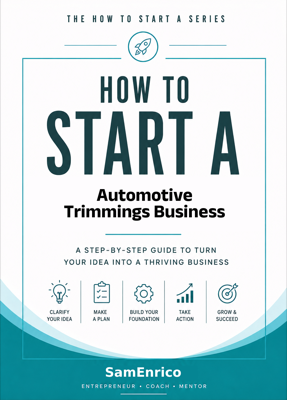 How to Start a Automotive Trimmings Business (Beginners Guide)Hendricks Perla$11.99
You may also like
 Hong Kong Handover 1997Dunn Johnnie$11.99
 Zumba For Postnatal Recovery CourseNeal Christian$11.99
 Zumba for BeginnersLadner Nikia$11.99
 YouTube Comment Mining GuideHumes Pandora$12.99
 Worry Box MeditationCarlin Rudy$11.99
 Workplace Stress MeditationNguyen Lynn$11.99
 Workplace Stress and Sleep RepairHawley Ivory$11.99
 Workplace Perfectionism CureDelaney Jeffry$11.99
 Workplace Injustice Anger GuideWallen Isabelle$11.99
 Work Addiction and Burnout LinkGreenwood Ester$11.99
 Women in Yoga and WellnessBeattie Galina$11.99
 Women in Stand Up ComedyChun Evangeline$11.99