
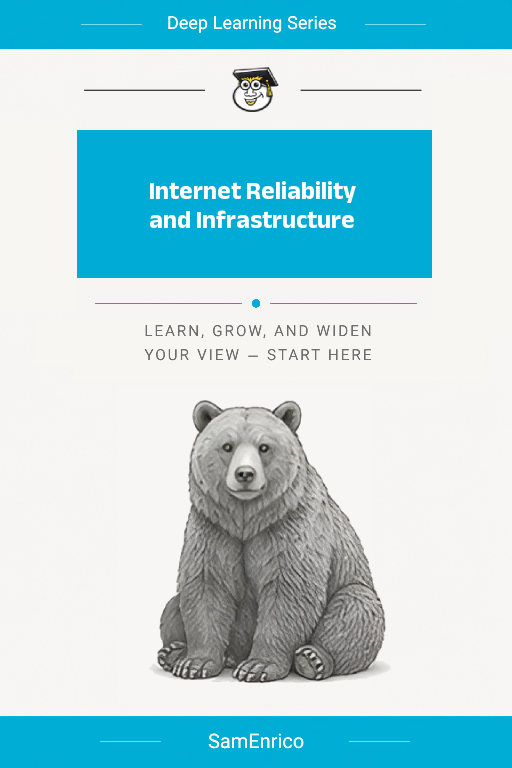
Non-FictionBusiness BriefInfrastructure
Internet Reliability and Infrastructure eBook
Assess connectivity, power stability, and backup o
Assess connectivity, power stability, and backup options for remote workers in each country.
Formats
Free sample
Chapter 1: The Speed Mirage--If you have ever run a speed test from your hotel room in Bangkok, seen “450 Mbps download,” and then proceeded to watch your Zoom call freeze into a pixelated hellscape twelve minutes later, you have already learned the central lesson of this book. Speed is a liar. Speed tells you how fat the pipe is, but it says nothing about whether the water is clean, whether the pressure fluctuates, or whether someone downstream is about to shut off the valve entirely. You do not need a 1 Gbps connection that drops every packet at the worst possible moment. You need a 20 Mbps connection that stays alive.This is not an intuitive truth.
For the past two decades, every internet service provider, every telecom regulator, and every “digital nomad” blog post has trained us to worship one metric: bandwidth. Faster is better. More megabits per second equals more productivity. Except it does not. In the real world, where remote workers sit in beachside cafes in Costa Rica, high-rise apartments in Manila, and converted barns in rural Vermont, the correlation between advertised speed and actual workability is astonishingly weak.
I have witnessed a software engineer push production code from a hut in Burundi using a frayed Ethernet cable and a car battery, while a marketing executive in a glass-walled “innovation hub” in Austin, Texas, could not complete a single client presentation without disconnecting.This chapter exists to tear down the speed cult and replace it with something that actually matters: outcome-based reliability. You will learn why a 1 Gbps fiber line in Zurich is fundamentally different from a 1 Gbps fiber line in Lagos, how to measure the three hidden killers of remote work (jitter, packet loss, and brownouts), and why your next purchase should not be a faster internet plan but a thirty-minute Zoom call with a packet-loss monitor running. By the end of this chapter, you will never ask “What is your internet speed?” again. You will ask, “Can you hold a sixty-minute Zoom call without dropping?” And you will know exactly how to get an honest answer.The Great Deception of Speed Tests Let us begin with an experiment. Open your laptop.
Go to any speed test website — Ookla, Fast.com, Google’s built-in test. Run it three times in a row. Record the results. Now, at the exact same time of day tomorrow, run it three more times. Unless you live in a country with extraordinary grid stability and network engineering (Singapore, Switzerland, South Korea), your numbers will fluctuate wildly.
That is the first clue that something is wrong.The problem with speed tests is that they are optimized to show you the best possible version of your connection. They use large, sequential data transfers that smooth over the very imperfections that kill real-time communication. A speed test measures how fast you can move a massive file from a nearby server. Zoom, on the other hand, sends thousands of tiny packets every second, each one requiring a separate round trip. If your connection drops 2 percent of those packets, the speed test will barely notice.
You will notice when your boss says “You’re frozen again.”Consider two real-world connections. Connection A is a fiber line in Zurich, Switzerland. It advertises 1 Gbps down, 500 Mbps up. In practice, it delivers 940 Mbps with 0.01 percent packet loss and jitter of 2 milliseconds. That connection will handle a Zoom call, a Slack huddle, a Figma file, and a You Tube video simultaneously without breaking a sweat.
Connection B is a fiber line in Lagos, Nigeria. It also advertises 1 Gbps down, 500 Mbps up. But during peak hours, packet loss spikes to 5 percent, jitter jumps to 50 milliseconds, and the connection drops entirely for three seconds every twenty minutes when the local transformer overheats. That connection is useless for real-time work, despite having the same advertised speed as Zurich.The speed test cannot tell the difference. The speed test will happily report 800 Mbps from Lagos and declare your connection “excellent.” Then you will lose your client call for the fourth time that week.This is not a problem of infrastructure investment alone.
Lagos has excellent fiber backbone in many neighborhoods. The problem is that reliability is not a function of peak speed. Reliability is a function of variance. A connection that delivers 500 Mbps with perfect consistency is infinitely more valuable than a connection that delivers 1 Gbps but collapses unpredictably. Variance is the enemy of remote work.
Consistency is the silent hero.Introducing the Volatility Index To move beyond the tyranny of speed, we need a new framework. Let me introduce the Volatility Index — a composite metric that predicts real-world remote work performance far better than any bandwidth number. The Volatility Index combines three measurements, each of which reveals a different failure mode of your connection.First: Latency variance, or jitter. Latency is the time it takes for a packet to travel from your computer to a server and back. Jitter is the variation in that time from packet to packet.
If your latency jumps between 20 milliseconds and 200 milliseconds every few seconds, your Zoom call will stutter, your voice will cut out, and your screen share will become a slideshow. Jitter is the single biggest killer of real-time communication. You can tolerate high latency if it is consistent. You cannot tolerate inconsistent latency.Second: Packet loss. Packets are the envelopes of the internet.
Each one contains a fragment of your voice, your video, or your file. When a packet fails to arrive, your Zoom client has to guess what was lost or request a retransmission. Packet loss above 1 percent makes voice calls difficult. Above 3 percent, they become unusable. Above 5 percent, you might as well be sending smoke signals.
Packet loss is often invisible to speed tests but devastating to real work.Third: Brownout frequency. A brownout is not a complete power outage. It is a drop in voltage below the normal range — for example, from 220 volts down to 180 volts. Brownouts do not turn off your lights, but they do cause your modem, router, and fiber termination point to behave erratically. Some routers reset at 190 volts.
Others can handle down to 170 volts. But all consumer networking gear is sensitive to brownouts. And brownouts are common in countries with overloaded grids: India, Nigeria, Brazil, the Philippines, and parts of South Africa. Chapter 2 will cover power infrastructure in depth, but for now, understand that a brownout is to your internet what a pothole is to your car — not a complete stop, but a jarring disruption that wears everything down.The Volatility Index combines these three measurements into a single score from 0 to 10. A score of 0 means you are essentially plugged into the Matrix: jitter under 5 milliseconds, packet loss under 0.1 percent, and brownouts so rare they are theoretical.
This is Zurich, Singapore, Seoul. A score of 10 means your connection is a chaotic mess: jitter over 100 milliseconds, packet loss over 10 percent, and brownouts several times a day. This is a rural connection in a developing country with overloaded infrastructure and no voltage regulation.Most remote workers fall somewhere in the middle. A beachside Airbnb in Costa Rica might score a 6 — fine for email and asynchronous work, terrible for live…
This is the end of the free sample. Get the eBook to keep going. Buy now
About this book
Details
- Author
- Schmidt Yvonne
- Publisher
- SamEnrico
- Language
- English
- Genre
- Non-Fiction, Business Brief, Infrastructure
- Released
- 2026-05-30
- Pages (approx.)
- 147
- Available as
- eBook, Audiobook

Read better in the ZLOADR app
Your eBooks on your phone or tablet. Sign in with your SamEnrico account and start reading.
More by Schmidt Yvonne
 Alcoholism Harm Reduction GuideSchmidt Yvonne$11.99
 The Caretaker AdultSchmidt Yvonne$11.99
 Dream Alchemy MethodSchmidt Yvonne$11.99
 Anger Master WorkbookSchmidt Yvonne$11.99
 Galileo's Celestial Symphony: The Music of the SpheresSchmidt Yvonne$11.99
 Spurrite MiningSchmidt Yvonne$11.99
 How to Produce Contact CleanerSchmidt Yvonne$11.99
 Ultimate Handbook Guide to Zaria : (Nigeria) Travel GuideSchmidt Yvonne$11.99
You may also like
 Hong Kong Handover 1997Dunn Johnnie$11.99
 Zumba For Postnatal Recovery CourseNeal Christian$11.99
 Zumba for BeginnersLadner Nikia$11.99
 YouTube Comment Mining GuideHumes Pandora$12.99
 Worry Box MeditationCarlin Rudy$11.99
 Workplace Stress MeditationNguyen Lynn$11.99
 Workplace Stress and Sleep RepairHawley Ivory$11.99
 Workplace Perfectionism CureDelaney Jeffry$11.99
 Workplace Injustice Anger GuideWallen Isabelle$11.99
 Work Addiction and Burnout LinkGreenwood Ester$11.99
 Women in Yoga and WellnessBeattie Galina$11.99
 Women in Stand Up ComedyChun Evangeline$11.99