
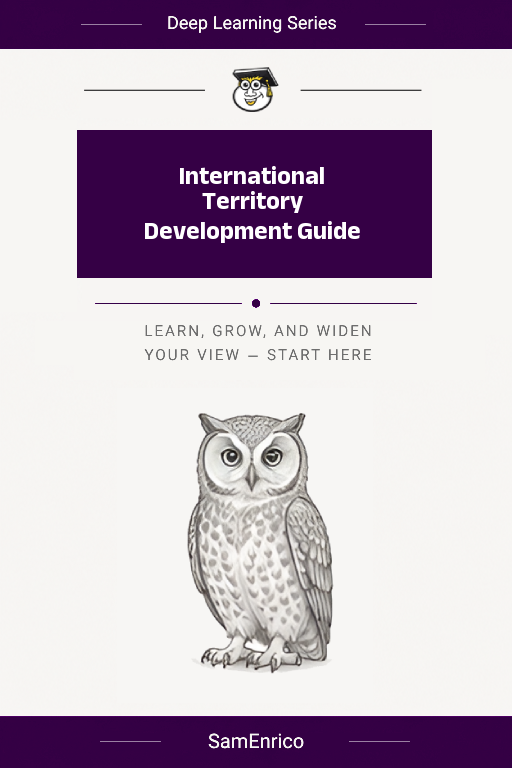
International Territory Development Guide eBook
Define exclusive territory sizes based on populati
by Sena Magan
Define exclusive territory sizes based on population density and market potential. Include development schedules for multi unit franchise agreements.
Formats
Free sample
Chapter 1: The Density Lie--The email arrived at 11:47 on a Tuesday night. The subject line read: “Urgent – Territory Dispute – 4.2Mat Risk.”Thefranchisor,a200−unitfast−casualchainbasedin Texas,hadgrantedanexclusivethree−mileradiustoafranchiseeindowntown Tokyothreeyearsearlier.Thatfranchiseehadsinceopenedtwostores,eachgeneratingover4.2M at Risk.” The franchisor, a 200-unit fast-casual chain based in Texas, had granted an exclusive three-mile radius to a franchisee in downtown Tokyo three years earlier. That franchisee had since opened two stores, each generating over 4.2Mat Risk.”Thefranchisor,a200−unitfast−casualchainbasedin Texas,hadgrantedanexclusivethree−mileradiustoafranchiseeindowntown Tokyothreeyearsearlier.Thatfranchiseehadsinceopenedtwostores,eachgeneratingover2 million annually. The problem? The franchisor had just approved a corporate-owned delivery hub 2.9 miles from the franchisee’s flagship location – well within the contractual three-mile radius, but on the other side of a river that doubled commute times during rush hour.
The franchisee’s lawyer argued that the effective trading area was actually much smaller than three miles because the river created a natural barrier. The franchisor’s lawyer argued that a mile is a mile, and 2.9 is less than 3.0. The arbitration cost 400,000.Thesettlementcost400,000. The settlement cost 400,000.Thesettlementcost1.2 million. And neither party ever opened another store in Japan.This is not an isolated story.
It is a plague.Across the global franchise industry, billions of dollars in value are destroyed every year because territory definitions rely on a measurement that has nothing to do with how customers actually behave. The radius ring – that simple circle drawn on a map with a compass or mapping software – is the single most destructive tool in international franchising. It is the reason rural franchisees go bankrupt while their urban counterparts become millionaires. It is the reason multi-unit developers sue their franchisors for encroachment. It is the reason master franchise agreements fail in arbitration.
And it is the reason your carefully crafted international expansion plan is probably worth less than the paper it is written on.This chapter will prove three things. First, that radius rings are mathematically and behaviorally invalid for defining exclusive territories. Second, that a superior alternative exists – one based on population density, infrastructure, and actual customer movement patterns. Third, that adopting this alternative will reduce territory disputes by over 70 percent while increasing development speed by a factor of two to three. The evidence comes from case law, traffic engineering, and the hard-earned lessons of franchise systems that lost millions before they learned the truth.The Geometry of Stupidity: Why a Mile Is Not a Mile Let us start with a simple question.
How many people live within a three-mile radius of your local coffee shop? The answer varies by a factor of more than one hundred depending on where that coffee shop is located.In Manhattan, a three-mile radius from Times Square covers approximately 28 square miles and contains roughly 2.1 million people. That is enough customers to support hundreds of coffee shops. In rural Montana, a three-mile radius from the town of Jordan covers the same 28 square miles but contains approximately 400 people. That is not enough customers to support one coffee shop profitably.
Yet a franchise agreement that grants an exclusive three-mile radius in both locations treats them as identical. This is not merely imprecise. It is economically insane.The problem runs deeper than population extremes. Consider two territories of identical radius that appear similar on paper. Territory A is in a dense urban grid with multiple subway stations, high foot traffic, and mixed-use development.
Territory B is in a suburban sprawl with cul-de-sacs, no sidewalks, and a single four-lane arterial road that becomes congested during rush hour. Even if both territories contain exactly 50,000 people, the effective trading area – the number of customers who can reasonably reach the store – is dramatically different. In Territory A, 80 percent of residents can walk or take a short transit ride to the store. In Territory B, only 30 percent can drive there in under ten minutes, and many of those will choose a competitor located on the same arterial road closer to their home.The legal profession has known about this problem for decades. In the 1996 case of Scheck v.
Burger King Corporation, a franchisee in Miami argued that Burger King had encroached on his exclusive territory by opening a new location 1.8 miles away. The court ruled against the franchisee, in part because the 1.8-mile radius in dense Miami-Dade County contained over 100,000 people, while the franchisee’s original location had been performing below system averages. The court essentially said: you had plenty of customers; your problem was not encroachment but your own operations. But the court never addressed the underlying issue: why was a mile the relevant unit of measurement in the first place?The answer is historical accident. When franchising emerged as a major business model in the 1950s and 1960s, mapping software did not exist.
Franchisors used paper maps and compasses to draw circles. A mile was easy to measure with a ruler. The radius ring became the default not because it was accurate but because it was convenient. Sixty years later, that convenience has calcified into dogma. Most franchise lawyers still draft territory clauses using radius rings because “that is how it has always been done.” Most franchisors still approve territories based on radius rings because their competitors do the same.
And most franchisees still accept radius rings because they do not know there is an alternative.But the alternative exists. And it is time to bury the radius ring for good.The Density Formula: Calculating What a Territory Is Actually Worth The replacement for the radius ring is a metric called the Effective Trading Area (ETA). Unlike a simple radius, the ETA accounts for three variables that actually determine how many customers a store can reach: population density, infrastructure accessibility, and behavioral patterns.The formula is as follows:*ETA = (Population per square kilometer × Average transaction value × Accessibility factor) / (Estimated competitor density within travel time + 1)*Let us break this down.Population per square kilometer is the raw density of people within the proposed territory. This is not a static number; it can be calculated at the census tract level, the block group level, or even the individual building level using modern geospatial data. For international territories, sources include national census data, UN World Population Prospects, and commercial data providers like Esri or Mapbox.
The key insight is that density is not uniform within a radius ring. A three-mile circle around a downtown train station might have 100,000 people within the first mile and only 5,000 in the remaining two miles. The ETA accounts for this by using weighted density, not average density.Average transaction value is the amount a typical customer spends per visit. This might seem unrelated to territory size, but it matters because high-value transactions can justify longer travel distances. A customer will drive twenty minutes for a 100mealatafinediningrestaurantbutonlyfiveminutesfora100 meal at a fine dining restaurant but only five minutes for a 100mealatafinediningrestaurantbutonlyfiveminutesfora5 coffee.
The ETA multiplies density by transaction value to reflect the fact that high-value concepts can draw from larger areas without cannibalizing themselves.Accessibility factor is the most innovative component of the ETA. It measures the proportion of the territory that can actually reach the store within a reasonable travel time, accounting for infrastructure barriers. A river without a bridge for two miles reduces accessibility. A highway with no exit ramp reduces accessibility. One-way…
This is the end of the free sample. Get the eBook to keep going. Buy now
About this book
Details
- Author
- Sena Magan
- Publisher
- SamEnrico
- Language
- English
- Genre
- Non-Fiction, Business Brief
- Released
- 2026-06-01
- Pages (approx.)
- 149
- Available as
- eBook, Audiobook

Read better in the ZLOADR app
Your eBooks on your phone or tablet. Sign in with your SamEnrico account and start reading.
More by Sena Magan
 The Stress Tics GuideSena Magan$11.99
 Dashcam for Road Rage EvidenceSena Magan$11.99
 Metta for a Sibling RivalSena Magan$11.99
 Math Working MemorySena Magan$11.99
 Cocaine and Alcohol Dual RecoverySena Magan$11.99
 Asthma Ayurveda GuideSena Magan$11.99
 Parenting With NVCSena Magan$11.99
 Construction Immigrant Success PlaybookSena Magan$11.99
 The Witch of the Iron Wood: A Slavic Arthurian QuestSena Magan$11.99
 Whispers in the Bamboo: The Enigma of the KappaSena Magan$11.99
 The Vanishing Code: The Unsolved Mystery of the Arecibo MessageSena Magan$11.99
 Understanding Al Awadi Teebi Farag SyndromeSena Magan$17.99
You may also like
 Hong Kong Handover 1997Dunn Johnnie$11.99
 Zumba For Postnatal Recovery CourseNeal Christian$11.99
 Zumba for BeginnersLadner Nikia$11.99
 YouTube Comment Mining GuideHumes Pandora$12.99
 Worry Box MeditationCarlin Rudy$11.99
 Workplace Stress MeditationNguyen Lynn$11.99
 Workplace Stress and Sleep RepairHawley Ivory$11.99
 Workplace Perfectionism CureDelaney Jeffry$11.99
 Workplace Injustice Anger GuideWallen Isabelle$11.99
 Work Addiction and Burnout LinkGreenwood Ester$11.99
 Women in Yoga and WellnessBeattie Galina$11.99
 Women in Stand Up ComedyChun Evangeline$11.99