
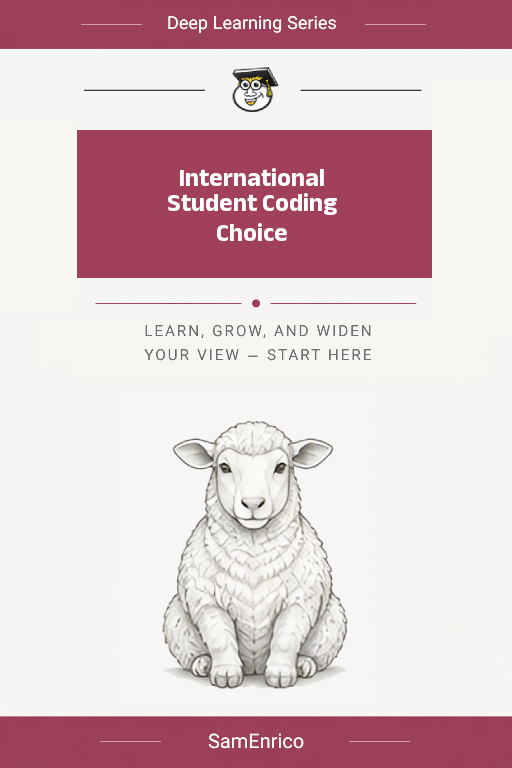
Non-FictionCareer EducationInternational Guide
International Student Coding Choice eBook
Navigate bootcamp vs degree as an international st
Navigate bootcamp vs degree as an international student. Visa implications, work permits, and immigration pathways.
Formats
Free sample
Chapter 1: The $500,000 Mistake...--–- The email arrived at 9:47 AM on a Tuesday. Rahul read it three times, each time hoping the words would rearrange themselves into something less catastrophic. "Notice of Intent to Deny – Status Violation." His F-1 visa, his OPT work authorization, his job offer from a Fortune 500 tech company—all of it hung by a thread he hadn't even known existed. The cause? A coding bootcamp he had attended for three months, which had promised him a shortcut to Silicon Valley but had instead delivered a legal nightmare.
He had chosen speed over stability, a bootcamp certificate over a university degree, and now he was 90 days away from deportation. His $150,000 starting salary, his American Dream, his parents' life savings—evaporating because of a single, unforced error.This is not a book about coding. It is a book about survival.Every year, over 300,000 international students arrive in the United States to study computer science, software engineering, and related fields. They come from Mumbai, Shanghai, Lagos, São Paulo, and a hundred other cities, each carrying the same dream: build a career in the world's most dynamic tech economy. Most of them are brilliant coders.
Many have perfect GPAs. Some have already built impressive portfolios. Yet the vast majority will make one of two catastrophic mistakes within their first twelve months—mistakes that will permanently foreclose immigration pathways they didn't even know existed.This book exists because the existing literature has failed you.The best-selling books on coding careers—Cracking the Coding Interview, The Pragmatic Programmer, Clean Code—are written for domestic students. They assume you have an unconditional right to work in the United States. They assume your only challenge is passing technical interviews.
They assume that choosing between a bootcamp and a degree is a purely economic calculation about return on investment.They are wrong. Dangerously wrong.For the international student, the choice between a bootcamp and a degree is not primarily about money. It is not primarily about time. It is primarily about status maintenance—a legal concept that will determine whether you spend your twenties building a career in San Francisco or watching from your parents' living room in a country you left behind.This chapter introduces the foundational framework for everything that follows. By the time you finish reading it, you will understand: why "status" matters more than salary, how a 60-day window can determine your entire future, why most coding bootcamps are legally inaccessible to international students, and why the word "immigration" belongs at the center of every career decision you make.The Brutal Math of International Tech Careers Let us begin with a number that will haunt you for the next decade: $500,000.That is the approximate lifetime earnings differential—over ten years—between an international student who successfully navigates the US immigration system and one who does not.
According to the National Foundation for American Policy, skilled tech workers in the United States earn approximately 300% more than their counterparts in India, 250% more than in China, and 400% more than in Brazil. These are not modest differences. These are generational wealth differentials. These are the stakes.Yet the path to capturing that differential is littered with legal landmines that domestic students never encounter.Consider two students: Priya and Miguel. Both are exceptional programmers.
Both graduate from the same university. Both receive identical job offers from the same FAANG company. Priya is a US citizen. Miguel is an international student on an F-1 visa. Priya's path is straightforward: accept the offer, start working, file taxes, live her life.
Miguel's path is a labyrinth of forms, deadlines, and government lotteries. He needs OPT authorization, then STEM extension, then H-1B sponsorship, then PERM certification, then I-140 approval, then green card allocation. Each step has its own rules, its own deadlines, its own failure modes. Missing one form by one day can invalidate the entire chain.This is the reality that the best-selling coding books refuse to acknowledge.The central argument of this book—and the theme that will recur through every chapter—is that for international students, legal strategy precedes technical strategy. You cannot code your way out of a visa violation.
You cannot optimize your way around a missed deadline. You cannot brute-force your way through a government lottery. The immigration system is indifferent to your Leet Code score, your Git Hub contributions, or your startup's valuation. It cares only about one thing: whether you have maintained lawful status.The Architecture of Your Legal Life: F-1, I-20, and SEVISBefore we can discuss bootcamps, degrees, or immigration pathways, we must understand the three pillars of your legal existence in the United States as a student.The F-1 Visa: Your Key to the Country The F-1 visa is not permission to work. It is not permission to stay indefinitely.
It is permission to study at an accredited US educational institution. That distinction matters more than any other in this book.The F-1 visa carries a critical legal doctrine known as "duration of status" (D/S). Unlike tourist visas (B-1/B-2), which have fixed expiration dates, your F-1 status lasts as long as you are a full-time student making "normal progress" toward your degree. Stop attending classes? Status violated.
Drop below full-time enrollment without authorization? Status violated. Work without permission? Status violated. Each of these violations triggers a cascade of consequences that can include termination of SEVIS record, accrual of unlawful presence, and eventual deportation.Consider the practical implication: you could have an F-1 visa stamped in your passport that is valid for five years, yet lose your legal status in the United States within five weeks if you stop attending classes.
The visa is your entry document. Status is your permission to remain. They are not the same thing.The I-20: Your Most Important Document The Form I-20, "Certificate of Eligibility for Nonimmigrant Student Status," is issued by your university's International Student Office. It serves three functions: (1) it certifies that you have been admitted to a full-time course of study, (2) it certifies that you have demonstrated sufficient financial resources, and (3) it authorizes the issuance of your F-1 visa at a US consulate abroad.Most students treat the I-20 as administrative paperwork—something to be filed away and forgotten. This is a catastrophic error.
Your I-20 contains your SEVIS ID number, your program start and end dates, your authorized level of study, and—crucially—the "remarks" section where any work authorization (CPT, OPT) is recorded. You will need your I-20 for every subsequent immigration application: OPT, STEM extension, H-1B, and eventually your green card. Lose your I-20? You cannot work. Misplace the version with your OPT endorsement?
You cannot board an international flight and re-enter the country.Action item: Make three copies of every I-20 you ever receive. One physical copy in a fireproof safe. One digital copy in encrypted cloud storage. One copy with a trusted family member in your home country. This is not paranoia.
This is survival.SEVIS: The System That Knows Everything About You The Student and Exchange Visitor Information System (SEVIS) is the Department of Homeland Security's database tracking every international student in the United States. Every time you enroll in classes, change…
This is the end of the free sample. Get the eBook to keep going. Buy now
About this book
Details
- Author
- Stacy Maryellen
- Publisher
- SamEnrico
- Language
- English
- Genre
- Non-Fiction, Career Education, International Guide
- Released
- 2026-06-01
- Pages (approx.)
- 154
- Available as
- eBook, Audiobook

Read better in the ZLOADR app
Your eBooks on your phone or tablet. Sign in with your SamEnrico account and start reading.
More by Stacy Maryellen
 Affirmations For PatienceStacy Maryellen$11.99
 Underwater Archaeology TechniquesStacy Maryellen$11.99
 Walking Meditation in SummerStacy Maryellen$11.99
 The Assertiveness Self Compassion LinkStacy Maryellen$11.99
 Software and SaaS Inflation PricingStacy Maryellen$12.99
 Understanding Ophthalmoplegia Ataxia HypoacusisStacy Maryellen$17.99
 IOT Solutions SpecialistStacy Maryellen$11.99
 How to Become a Shake Backboard NotcherStacy Maryellen$11.99
You may also like
 Hong Kong Handover 1997Dunn Johnnie$11.99
 Zumba For Postnatal Recovery CourseNeal Christian$11.99
 Zumba for BeginnersLadner Nikia$11.99
 YouTube Comment Mining GuideHumes Pandora$12.99
 Worry Box MeditationCarlin Rudy$11.99
 Workplace Stress MeditationNguyen Lynn$11.99
 Workplace Stress and Sleep RepairHawley Ivory$11.99
 Workplace Perfectionism CureDelaney Jeffry$11.99
 Workplace Injustice Anger GuideWallen Isabelle$11.99
 Work Addiction and Burnout LinkGreenwood Ester$11.99
 Women in Yoga and WellnessBeattie Galina$11.99
 Women in Stand Up ComedyChun Evangeline$11.99