
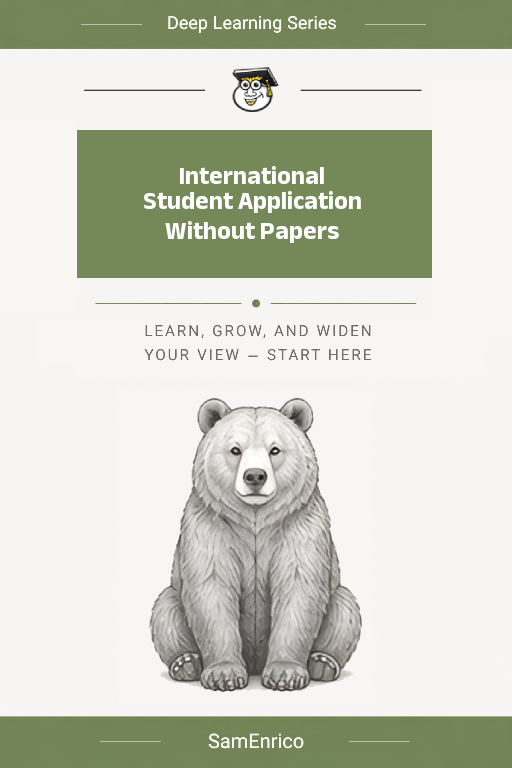
Non-FictionStudent's ShortcutInternational
International Student Application Without Papers eBook
Navigate visa and credential evaluation for PhD ap
Navigate visa and credential evaluation for PhD applications when your home country has different publication norms.
Formats
Free sample
Chapter 1: The Mirror Lies--You are reading this book because somewhere along the way, you looked at your academic profile and saw a stranger staring back. The grades that should have been impressive translated into something mediocre. The thesis that won awards at your home university looks, on paper, like a lonely document with no citations. The publications that don't exist feel like a weight around your neck, even though no one in your country expected you to publish before a Ph D. You have been told, directly or indirectly, that you are not enough.
That you are behind. That you do not belong in the same applicant pool as the shiny, polished candidates from elite Western universities.The mirror is lying to you.This chapter dismantles the single most destructive myth in international graduate admissions: the existence of a "standard applicant." That idealized candidate—the one with the 3.8 GPA, three first-author publications, a pristine educational trajectory, and a research proposal that reads like a funded grant—is not a real person. It is a construct. It is a marketing image created by test-prep companies, admissions consultants, and the anxious imaginations of applicants who have never sat on an admissions committee.More importantly, that construct was never designed for you. It was designed for a very specific, very narrow subset of applicants from well-resourced universities in countries where undergraduate research is funded, where faculty publish three papers a year, and where the entire system is aligned with American academic norms.
You are not from that system. That does not make you deficient. It makes you different. And different, as you will learn throughout this book, is an asset you have never been taught to leverage.The goal of this chapter—and this book—is to give you a new mirror. One that reflects your actual strengths, your actual trajectory, and your actual potential.
Before we can fix your application, we have to fix the story you are telling yourself about who you are allowed to be.The Invention of the Perfect Applicant Let us begin with a confession: admissions committees do not believe in the perfect applicant either. In fact, the faculty members who read your file are deeply skeptical of candidates who appear too polished. They have seen too many students from expensive consulting firms who write beautiful statements but cannot think independently. They have admitted too many "perfect on paper" candidates who crumbled in their first year because they had never faced academic failure.The myth of the standard applicant persists not because committees demand it, but because it has been profitable to sell. A quick search for "Ph D application consulting" returns thousands of results, each promising to help you "stand out" by conforming to a template.
These services charge thousands of dollars to mold you into an imagined ideal that does not exist. They prey on your fear of being different.Here is what actual admissions data reveals about the "standard applicant":At research-intensive universities in the United States, the median GPA of admitted international Ph D students varies dramatically by field and by country of origin. In engineering, the median may be 3.7 on a 4.0 scale. In humanities, it may be 3.4. In fields like mathematics or theoretical physics, admissions committees openly state that GPA is the least important factor after a certain threshold.
The obsession with a specific number is largely arbitrary.Similarly, the expectation of publications is wildly inconsistent. Among funded STEM applicants to top ten US programs, approximately thirty-eight percent have a peer-reviewed publication. That means sixty-two percent do not. In the humanities, the figure drops to around twelve percent. In the social sciences, approximately eighteen percent.
For applicants from countries where undergraduate research is not funded or where journals do not accept submissions from students, the figure is likely below ten percent.Read that again. The majority of successful Ph D applicants do not have publications. The majority. The anxiety you feel about your lack of papers is not rooted in the reality of admissions. It is rooted in a myth amplified by the small number of hyper-competitive fields and the echo chamber of online forums where only the most anxious applicants congregate.A Critical Distinction You Must Understand Before we go any further, we need to clarify something essential.
Throughout this book, you will encounter the phrase "no papers." This phrase is deliberately ambiguous because it captures multiple realities that all lead to the same feeling of inadequacy. However, the strategies you need depend entirely on which type of "no papers" describes your situation.Type One: Documented with Unusual Credentials You have a valid passport and legal immigration status. You have a degree from an accredited institution. But your transcript uses a grading scale that baffles American evaluators. Perhaps you graduated from a French university using the 0-20 scale, where a 14 is excellent and an 18 is nearly impossible.
Perhaps you are from India, where a "First Class" degree with sixty percent may represent top performance in a system with severe grade deflation. Perhaps your university uses narrative evaluations instead of letter grades.You have the papers. They just look wrong to people who do not understand your system.Type Two: Undocumented or Precarious Status You lack legal immigration status in the country where you hope to study. You may have entered on a tourist visa and overstayed. You may have been brought to the United States as a child and aged out of protections.
You have educational credentials, but your legal status creates barriers that documented applicants do not face. This book will address your situation with specific strategies, but you should also seek legal counsel from organizations specializing in undocumented student support.Type Three: Refugees, Asylees, and Stateless Persons You fled conflict or persecution. Your university may no longer exist. Your transcripts may have been destroyed, or you may have no way to request official copies from a closed institution. You may hold a UNHCR card or have been granted asylum.
Your situation is distinct from undocumented status because you have legal recognition and pathways to work authorization. This book will treat your case separately.Type Four: Non-Traditional Educational Backgrounds You do not have a bachelor's degree. Perhaps you are self-taught in a technical field. Perhaps you left university early but built a professional portfolio. Perhaps your credentials are from non-accredited institutions or from systems that the United States does not recognize.
You are applying to programs that explicitly accept "equivalent experience" or to professional doctorates that value work history over degrees.These four types are not the same. A refugee with a UNHCR card and destroyed transcripts requires different strategies than a documented international student with unusual grading scales. A self-taught programmer applying to a Ph D in computer science requires different strategies than an undocumented student with perfect transcripts but no legal status.At the end of this chapter, you will find the "Which 'No Papers' Are You?" flow chart. Complete it before moving on. The chapters that follow are organized around your specific situation.
If you ignore this distinction, you will waste time on strategies that do not apply to you.The Psychology of Perceived Barriers Here is something no…
This is the end of the free sample. Get the eBook to keep going. Buy now
About this book
Details
- Author
- Braxton Curtis
- Publisher
- SamEnrico
- Language
- English
- Genre
- Non-Fiction, Student's Shortcut, International
- Released
- 2026-06-01
- Pages (approx.)
- 158
- Available as
- eBook, Audiobook

Read better in the ZLOADR app
Your eBooks on your phone or tablet. Sign in with your SamEnrico account and start reading.
More by Braxton Curtis
 Affirmation Journal for MenBraxton Curtis$11.99
 Drug Dependency and PregnancyBraxton Curtis$11.99
 Loving Kindness for WorkplacesBraxton Curtis$11.99
 Blink Rate as Stress IndicatorBraxton Curtis$11.99
 Moldovan Labor MigrantBraxton Curtis$11.99
 The Nobel Economics FoundersBraxton Curtis$11.99
 Ken Griffin CitadelBraxton Curtis$11.99
 Anapanasati for Tai ChiBraxton Curtis$11.99
 The Underground Poets: How a D.C. Collective Redefined Spoken WordBraxton Curtis$11.99
 Tiamat's Cosmic Forge: The Babylonian Birth of Chaos and OrderBraxton Curtis$11.99
 Minimalist Influencer Comparison TrapBraxton Curtis$12.99
 How to Start a Plates Made of Plastic (tableware) Business (Beginners Guide)Braxton Curtis$11.99
You may also like
 Hong Kong Handover 1997Dunn Johnnie$11.99
 Zumba For Postnatal Recovery CourseNeal Christian$11.99
 Zumba for BeginnersLadner Nikia$11.99
 YouTube Comment Mining GuideHumes Pandora$12.99
 Worry Box MeditationCarlin Rudy$11.99
 Workplace Stress MeditationNguyen Lynn$11.99
 Workplace Stress and Sleep RepairHawley Ivory$11.99
 Workplace Perfectionism CureDelaney Jeffry$11.99
 Workplace Injustice Anger GuideWallen Isabelle$11.99
 Work Addiction and Burnout LinkGreenwood Ester$11.99
 Women in Yoga and WellnessBeattie Galina$11.99
 Women in Stand Up ComedyChun Evangeline$11.99