
Non-FictionAI OperatorKnowledge Management
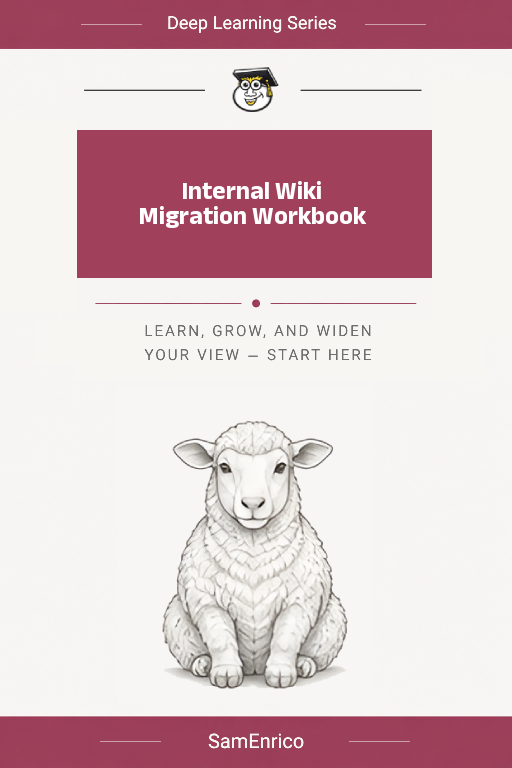
Internal Wiki Migration Workbook eBook
Use AI to restructure, deduplicate, and update leg
Use AI to restructure, deduplicate, and update legacy documentation when moving between Confluence, Notion, or SharePoint without losing institutional knowledge.
Formats
Free sample
Chapter 1: The Chaos Currency--Quiet disasters don't scream. They don't trigger dashboards, page on-call engineers, or send urgent Slack notifications. Instead, they unfold in the background—one broken link at a time, one outdated screenshot, one contradictory policy. By the time anyone notices, the damage is already measured in seven figures.Consider the engineer at a mid-sized fintech company who spent eleven hours tracking down a database credential that existed in exactly one place: a Confluence page written by a contractor who had left the company two years earlier. The page was titled "Temp - DO NOT USE - OLD." It was, in fact, the only correct version.
Eleven hours. One credential. No overtime logged. No incident report filed. Just productivity that vanished into the void of a rotting wiki.This is the chaos currency: the invisible tax your organization pays every day in lost time, duplicated effort, and quiet frustration.
It doesn't appear on your profit and loss statement. It doesn't trigger an audit. But it flows out of your company as surely as payroll—thousands, often millions, of dollars each year, spent not on building products or serving customers, but on searching for information that should have been findable.Most organizations respond to this crisis by buying a new wiki. They migrate every page from Confluence to Notion, or from Share Point to Confluence, or from a chaotic mess in one tool to an equally chaotic mess in another. The interface is prettier.
The search bar is faster. The problem is identical. This is the lift-and-shift fallacy—the mistaken belief that the tool causes the chaos, rather than merely housing it.This chapter will show you why that fallacy is so expensive. You'll learn the five specific symptoms of wiki rot that survive any migration that doesn't explicitly address them. You'll calculate exactly how much your own documentation chaos is costing your organization.
And you'll complete a self-assessment that gives you a baseline score—a Rot Severity Index—that will guide your decisions throughout the rest of this workbook. By the time you finish this chapter, you'll know whether you need a minor cleanup, a major restructuring, or a full emergency evacuation of your knowledge base. More importantly, you'll understand why skipping this diagnosis is the single most expensive mistake you can make.The Lift-and-Shift Fallacy Let me tell you about a company I'll call Fin Scale. They were a financial technology firm with four hundred employees, fourteen years of history, and a Confluence instance that contained forty-three thousand pages. Their employees complained constantly about not being able to find anything.
The VP of Operations, under pressure from the CEO to "fix documentation," purchased an enterprise Notion license for ninety thousand dollars per year. She then hired a migration consulting firm for another two hundred thirty thousand dollars to move every single Confluence page into Notion.Four months later, on launch day, the Notion workspace contained forty-three thousand pages. Exactly the same pages. Exactly the same broken links. Exactly the same contradictory instructions about the same outdated processes.
The only difference was that the pages now lived in a database instead of a hierarchy. The VP resigned six weeks after launch.This is the lift-and-shift fallacy. It is the belief that moving content from one container to another will somehow improve the content itself. It never does. Confluence, Notion, Share Point, Google Sites, Dropbox Paper—every modern wiki platform is capable of hosting well-structured, accurate, findable documentation.
And every modern wiki platform is equally capable of hosting chaos. The tool is never the problem. The problem is what you put into it.The lift-and-shift fallacy persists for two reasons. First, it feels safe. Keeping everything is emotionally easier than deleting something that might, someday, in some hypothetical scenario, prove useful.
Corporate culture is pathologically loss-averse. The question "What if we need this later?" paralyzes decision-making. Leaders choose to keep everything because no one wants to be the person who deleted the page that the CEO references in an all-hands meeting.Second, most organizations have no systematic way to evaluate documentation quality. They cannot distinguish between a critical security policy that must be preserved and a meeting note from a canceled project that should have been deleted three years ago. Both are just pages.
Both have titles, authors, and last-edit dates. When everything looks the same, deleting anything feels risky.This workbook exists to eliminate that risk. Over the next eleven chapters, you'll learn a repeatable, AI-assisted method for evaluating every page in your wiki before you move it. But the first step is not technical. The first step is learning to see the five symptoms of wiki rot for what they are: expensive, measurable, and fixable.Symptom One: Orphaned Pages An orphaned page is any page in your wiki that has no inbound links and no outbound links.
It exists in isolation. No other page points to it, and it points to no other page. Orphaned pages are the digital equivalent of a filing cabinet drawer labeled "Miscellaneous" that no one has opened in five years.Orphaned pages happen for many reasons. Someone created a draft and never published it properly. A project was canceled, but the documentation remained.
An employee left, and their personal wiki space was never integrated into the main knowledge base. A page was moved, but the links that used to point to it were never updated. The specific cause matters less than the consequence: orphaned pages are undiscoverable. No matter how accurate or valuable their content, no one will ever find them through normal navigation.The danger of orphaned pages is not just that they waste storage space. It's that they create shadow knowledge.
Your official onboarding guide might point to a broken process, while the correct process lives on an orphaned page that someone wrote two years ago and never linked. The people who know about the orphaned page share its URL directly with new team members. The rest of the organization continues using the broken process. Over time, orphaned pages become tribal knowledge—necessary for getting work done, but completely invisible to anyone outside the inner circle.How to spot orphaned pages: In Confluence, use the "Page Information" view to see inbound links. In Share Point, use the "Site Pages" library with the "Inbound Links" column.
In Notion, the backlinks feature shows you what points to a page. For each page with zero inbound links, ask yourself: Is this page discoverable through the main navigation or search? If the answer is no, you've found an orphan.In Chapter 2, you'll learn how to use AI to detect orphaned pages across your entire wiki in minutes instead of days. For now, simply understand that orphaned pages are not harmless clutter. They are a symptom of a broken information architecture, and they will survive any migration that does not explicitly address them.Symptom Two: Conflicting Versions Conflicting versions occur when two or more pages give contradictory instructions, definitions, or procedures for the same topic.
This is the most dangerous symptom of wiki rot because it directly causes operational failures.Imagine a simple example. Page A, titled "Employee PTO Request," states: "Submit requests at least two weeks…
This is the end of the free sample. Get the eBook to keep going. Buy now
About this book
Details
- Author
- Thigpen Gaynelle
- Publisher
- SamEnrico
- Language
- English
- Genre
- Non-Fiction, AI Operator, Knowledge Management
- Released
- 2026-05-29
- Pages (approx.)
- 125
- Available as
- eBook, Audiobook

Read better in the ZLOADR app
Your eBooks on your phone or tablet. Sign in with your SamEnrico account and start reading.
More by Thigpen Gaynelle
 Couples Counseling In Poor CommunitiesThigpen Gaynelle$11.99
 Road Work Sign Patience GuideThigpen Gaynelle$11.99
 Italian Mastermind Escape TaleThigpen Gaynelle$11.99
 Blitzing Through Adversity PlaybookThigpen Gaynelle$11.99
 Mentorship for Imposter SyndromeThigpen Gaynelle$11.99
 Saddam HusseinThigpen Gaynelle$11.99
 FCPA Statute of Limitations CasesThigpen Gaynelle$11.99
 Weighted Blanket RLS TestThigpen Gaynelle$11.99
 Roth IRA Estate GuideThigpen Gaynelle$11.99
 Tangaroa's Lament: The Drowning of HinaThigpen Gaynelle$11.99
 The Last Empress: The Rise and Fall of the House of AhnThigpen Gaynelle$11.99
 The Day the Sky Spoke: The 1977 Soviet UFO Encounter That Shook the Cold WarThigpen Gaynelle$11.99
You may also like
 Hong Kong Handover 1997Dunn Johnnie$11.99
 Zumba For Postnatal Recovery CourseNeal Christian$11.99
 Zumba for BeginnersLadner Nikia$11.99
 YouTube Comment Mining GuideHumes Pandora$12.99
 Worry Box MeditationCarlin Rudy$11.99
 Workplace Stress MeditationNguyen Lynn$11.99
 Workplace Stress and Sleep RepairHawley Ivory$11.99
 Workplace Perfectionism CureDelaney Jeffry$11.99
 Workplace Injustice Anger GuideWallen Isabelle$11.99
 Work Addiction and Burnout LinkGreenwood Ester$11.99
 Women in Yoga and WellnessBeattie Galina$11.99
 Women in Stand Up ComedyChun Evangeline$11.99