
Non-FictionInformativeEducational
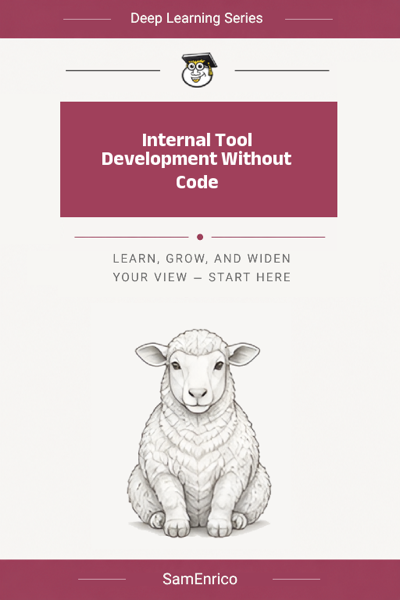
Internal Tool Development Without Code eBook
A Coursebook on Internal Tool Development Without
by Covert Yi
A Coursebook on Internal Tool Development Without Code
Formats
Free sample
Chapter 1: The Queue is Burning...--–- Every organization has a secret graveyard where productivity goes to die. It is not the breakroom, the email inbox, or the endless video call. It is the IT development queue.You have felt its pull. You need a simple tool—an approval form for time-off requests, a tracker for IT assets, a vendor onboarding portal. Nothing complex.
Ten screens, five email notifications, one approval chain. Your team of twelve people spends four hours a week manually stitching together spreadsheets, email chains, and Slack messages to accomplish what a $20 app could do. You submit a ticket to IT. And then you wait.Three weeks pass. You follow up.
“It’s in the backlog.” Two more months. You escalate to your manager. They escalate to the IT director. The response is always the same: “We’re resource-constrained. All developer capacity is allocated to customer-facing projects for the next quarter.”So you do what everyone does.
You open Excel. You build a shared spreadsheet with seven columns, conditional formatting highlights, and a column called “Status” where people type “Pending,” “Approved,” or “Waiting for Janet.” You email the spreadsheet around. Someone saves a local copy. Now you have version conflicts. Someone deletes a row by accident.
You have no audit trail. Someone approves a request they should not have because the approval column was accidentally left editable. You have chaos.And then IT finds out about your spreadsheet. They call it “Shadow IT.” They tell you it is a security risk. They demand you stop using it immediately.
But they do not offer a replacement. So you rename the file to “Team_Operations_Tracker_FINAL_v3.xlsx” and keep using it anyway.This is not a failure of people. It is a failure of process. And it is the single largest drag on internal productivity in the modern enterprise.The Great Bottleneck The traditional software development model was built for a world where every application required months of planning, specialized coding skills, and expensive infrastructure. In that world, the IT queue made sense.
Prioritization was necessary because building anything required a team of six engineers for three months.That world no longer exists.Cloud computing eliminated infrastructure delays. No-code and low-code platforms eliminated coding as a prerequisite. But the organizational process—submit a ticket, wait for triage, wait for requirements gathering, wait for design, wait for development, wait for testing, wait for deployment—remains frozen in 1998.Consider the math. A typical internal tool request, such as an expense approval workflow or a vacation tracker, requires approximately 10 to 20 hours of development time on a modern no-code platform. A professional developer familiar with the platform could build it in two to three days.
A trained citizen developer—someone from the business side with two weeks of training—could build it in five days.Yet the average IT queue time for such a request, according to industry surveys, ranges from three to six months. That is not a development constraint. That is a prioritization and queuing constraint. The work itself is trivial. The waiting is the problem.The cost of that waiting is staggering.
A manual email approval chain involving five people, each spending five minutes per request, at an average loaded salary of 50perhour,costs50 per hour, costs 50perhour,costs2.08 per approval. For 500 requests per month, that is over $12,000 annually in pure labor waste—not counting errors, delays, lost visibility, and employee frustration. Automating that workflow reduces the labor cost to near zero. The tool pays for itself in the first month.But the hidden cost is larger. Every hour an employee spends manually reconciling spreadsheets, chasing approvals via email, or hunting for the latest version of a document is an hour they are not spending on strategic work.
The cumulative effect across an organization of 500 employees is measured in hundreds of thousands of dollars annually. This is the tax of manual process. And it is entirely avoidable.The Rational Rebellion Let us name what is actually happening. When business users build their own solutions in Excel, Access, Google Sheets, or Airtable, they are not being rebellious. They are being rational.They have a problem.
Their problem is urgent. The official channel cannot solve it in an acceptable timeframe. They solve it themselves using the tools available to them. That is not shadow IT. That is daylight productivity operating in the absence of legitimate support.The term “shadow IT” carries a moral judgment.
It implies secrecy, risk-taking, and a disregard for governance. But in the vast majority of cases, the spreadsheet that IT discovers was not hidden. It was sitting on a shared drive with the name “Department_Processes_FINAL.xlsx.” Everyone knew about it. No one had a better option.The proper response to this dynamic is not to punish the behavior. It is to recognize that the behavior is a signal of a broken system.
When employees build their own tools, they are telling you that your formal processes are too slow, too rigid, or both.The solution is not to ban citizen development. It is to enable it safely.The Fusion Team Model This book introduces a new operating model: the Fusion Team.A Fusion Team is a collaborative unit composed of business-domain experts (who understand the problem) and IT professionals (who understand security, integration, and scalability). The business experts build the tool using no-code platforms. The IT professionals provide governance guardrails, integration connectors, and production support. Neither group works in isolation.
Both groups share responsibility for the outcome.The model works like this:Phase 0 – Guardrails (IT-led, before any building): IT establishes the boundaries. Which no-code platforms are approved? What data can be stored where? Which external systems can be connected? What are the compliance requirements for audit trails?
This is not bureaucracy. This is a safety fence that enables freedom within boundaries.Phase 1 – Build (Business-led, within guardrails): A business user—an operations manager, a team lead, a project coordinator—builds the prototype using an approved no-code platform. They work from a process map (Chapter 3). They design the data schema (Chapter 4). They build the forms and workflows (Chapters 5 and 6).
IT is available for consultation but does not control the builder.Phase 2 – Review (IT-led, after prototype): The business user submits the completed prototype to IT for formal review. IT checks for security vulnerabilities, compliance gaps, and integration risks. This review typically takes two to five days, not three months.Phase 3 – Production (IT-led): IT provisions the production environment with proper access controls, backups, and monitoring. The business user maintains ongoing logic changes.Phase 4 – Support (Shared): Business maintains the business logic (approval rules, form fields, workflow changes). IT maintains the infrastructure (uptime, disaster recovery, user access provisioning).This model eliminates the “throw it over the wall” failure mode.
Business does not build in secret. IT does not reject tools they did not design. Ownership is shared. Accountability is clear.The Economic Case for Citizen Development The numbers are too compelling to ignore. A typical internal tool built on a no-code platform costs between zero and 500permonthinplatformsubscriptionfees.Thesametool,ifbuiltbyatraditionaldevelopmentteam,wouldcost500 per month in platform subscription fees.
The same tool, if built by a traditional development team, would cost 500permonthinplatformsubscriptionfees.Thesametool,ifbuiltbyatraditionaldevelopmentteam,wouldcost20,000 to $80,000 in internal labor. The return…
This is the end of the free sample. Get the eBook to keep going. Buy now
About this book
Details
- Author
- Covert Yi
- Publisher
- SamEnrico
- Language
- English
- Genre
- Non-Fiction, Informative, Educational
- Released
- 2026-05-09
- Pages (approx.)
- 145
- Available as
- eBook, Audiobook

Read better in the ZLOADR app
Your eBooks on your phone or tablet. Sign in with your SamEnrico account and start reading.
More by Covert Yi
 Myostatin Inhibition NaturallyCovert Yi$11.99
 Lactose Intolerance And Acne GuideCovert Yi$11.99
 Children's Recurring DreamsCovert Yi$11.99
 Transcendental Meditation for VeteransCovert Yi$11.99
 MBSR For FibromyalgiaCovert Yi$11.99
 Postpartum Mood Disorders GuideCovert Yi$11.99
 Arthritis Water ExerciseCovert Yi$11.99
 Press Secretary Stress GuideCovert Yi$11.99
 Bipolar Hypomania GuideCovert Yi$11.99
 The Alchemists of the Nile: Secrets of the Black FireCovert Yi$11.99
 The Trial of the First AI: A Legal Turning Point in 2045Covert Yi$11.99
 The Ballot That Broke the Internet: How a Single Vote Changed HistoryCovert Yi$11.99
You may also like
 Hong Kong Handover 1997Dunn Johnnie$11.99
 Zumba For Postnatal Recovery CourseNeal Christian$11.99
 Zumba for BeginnersLadner Nikia$11.99
 YouTube Comment Mining GuideHumes Pandora$12.99
 Worry Box MeditationCarlin Rudy$11.99
 Workplace Stress MeditationNguyen Lynn$11.99
 Workplace Stress and Sleep RepairHawley Ivory$11.99
 Workplace Perfectionism CureDelaney Jeffry$11.99
 Workplace Injustice Anger GuideWallen Isabelle$11.99
 Work Addiction and Burnout LinkGreenwood Ester$11.99
 Women in Yoga and WellnessBeattie Galina$11.99
 Women in Stand Up ComedyChun Evangeline$11.99