
Non-FictionProfessional's Cheat SheetCorporate Writing
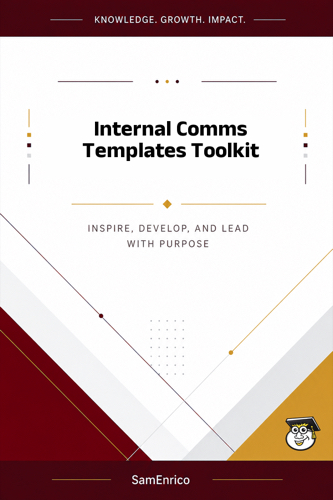
Internal Comms Templates Toolkit eBook
Use ready to fill templates for announcements, new
Use ready to fill templates for announcements, newsletters, and leadership updates.
Formats
Free sample
Chapter 1: The Parking Email...--It was a Tuesday afternoon, and I had just spent eleven hours writing a single email about a parking policy change.Not a merger. Not a layoff. Not a security breach. A parking policy. Specifically, whether employees in Building 4 could park in the overflow lot during a construction project.
The email went through nine rounds of edits. Three different VPs weighed in. Legal asked for two disclaimers. HR wanted to add "empathy language." The CEO's chief of staff requested that the subject line be changed three times. And when the email finally sent at 4:47 PM on a Friday, the only response was a single reply from an employee in accounting: "Wait, what does this mean for me?"I closed my laptop, looked at the clock, and realized something that would change my entire career: I had just wasted a full day on something that changed exactly zero behaviors.That parking email was opened by 82 percent of employees.
By every vanity metric, it was a success. But the only person who actually changed where they parked was me—I started taking the bus out of sheer exhaustion. The rest of the organization did exactly what they had always done: parked wherever they wanted, ignored the policy, and waited for someone to enforce it. No one was enforcing it.That was the moment I stopped being an order-taker and started being a strategic adviser.This book is the toolkit I wish I had that day. It is not a book about communication theory.
It is not a collection of abstract principles about "authenticity" or "transparency" that sound good in a boardroom but fall apart when you have fifteen minutes to write an update about a server outage. This is a book of templates. Fill-in-the-blank, ready-to-use, battle-tested templates for the actual work of internal communication: the announcements, the newsletters, the leadership updates, the crisis messages, the policy reminders, and the thousand other pieces of writing that land in your inbox every week.But before you touch a single template, we need to talk about why you are writing in the first place.The Order-Taker Trap Most internal communicators start their careers as order-takers. Someone—usually a leader, a legal partner, or an HR business partner—says, "We need to send a communication about X." And the internal communicator says, "How long should it be?" and "Who is the audience?" and "When do you need it by?" and then goes off to write.This is the order-taker trap. It feels productive.
You are busy. You are checking boxes. You are sending emails. But you are not driving results. You are simply executing tasks.
And when you are an order-taker, you are infinitely replaceable. Anyone with basic writing skills can take an order and turn it into an email. A chatbot can do it. In fact, by the time you read this book, AI will almost certainly be able to write a competent first draft of most internal communications.What AI cannot do—and what the order-taker never learns to do—is answer the question that comes before the writing: Why are we communicating at all?The strategic internal communicator starts with a different set of questions. Not "How long should it be?" but "What behavior are we trying to change?" Not "Who is the audience?" but "What does that audience currently believe, and what do we need them to believe instead?" Not "When do you need it by?" but "What is the cost of sending this message at the wrong time—or not sending it at all?"This chapter is about making that shift.
It is about moving from output to outcome. It is about building a planning discipline that ensures every template you use from this book is aimed at a measurable business objective. Because a template without a strategy is just a fancy way to waste time faster.The Output vs. Outcome Distinction Here is the single most important concept in this entire book: Output is the message you send. Outcome is the change in employee behavior that results.An output is measurable.
You can count it. "We sent three emails this week." "The newsletter had a 72 percent open rate." "Four hundred employees clicked the link." These are outputs. They feel good. They fill dashboards. They justify your existence to managers who do not understand internal communication.An outcome is harder to measure, but it is the only thing that actually matters.
"After we sent the email, 85 percent of employees completed the safety training." "After the leadership update, voluntary turnover in the affected department dropped by 40 percent." "After the policy announcement, compliance errors decreased by 62 percent."Notice something about those outcomes? They are not communication metrics. They are business metrics. Safety training completion. Turnover.
Compliance errors. These are the metrics that the CEO cares about. These are the metrics that get internal communication a seat at the table.The parking email I spent eleven hours on had excellent outputs. High open rate. Respectable click-through rate.
Positive sentiment scores in the follow-up survey. But the outcome? Zero. No one changed their behavior. The construction project started.
The overflow lot was repaved. And employees kept parking in the closed lot because no one had given them a reason to stop.What went wrong? I never asked the outcome question before I started writing. If I had, I would have realized that an email was the wrong channel entirely. What we needed was not a message but a system: physical barriers, towing warnings, enforcement from security.
Communication alone cannot solve a problem that requires structural change. By asking the outcome question first, I would have saved eleven hours and recommended a different solution entirely.The Communication Plan Canvas To help you avoid my parking email mistake, this chapter provides the first template in this book: The Communication Plan Canvas. It is a one-page, fill-in-the-blank tool that forces you to answer the outcome question before you write a single word.The Canvas has seven sections. Let me walk you through each one.Section 1: Business Objective What business metric are you trying to move? Be specific.
Do not write "improve communication" or "increase engagement." Write "increase safety training completion from 67 percent to 90 percent within 30 days" or "reduce benefits-related HR tickets by 25 percent before open enrollment" or "improve e NPS among deskless workers by 10 points this quarter."If you cannot name a specific, measurable business objective, stop. Do not write the communication. Go back to the person who made the request and ask: "What business problem are we trying to solve?" If they cannot answer, the communication is not necessary.Section 2: Target Audience Which specific segment of employees needs to change their behavior? Do not write "all employees." Write "warehouse staff on the night shift" or "sales representatives in the EMEA region" or "new hires in their first 90 days." Use the personas you will build in Chapter 2. The more specific you are, the better your communication will be.Section 3: Current State vs.
Desired State What does the audience currently believe, feel, or do? What do you need them to believe, feel, or do instead? This is the gap your communication will close.For the parking…
This is the end of the free sample. Get the eBook to keep going. Buy now
About this book
Details
- Author
- Hogue Margarett
- Publisher
- SamEnrico
- Language
- English
- Genre
- Non-Fiction, Professional's Cheat Sheet, Corporate Writing
- Released
- 2026-06-07
- Pages (approx.)
- 148
- Available as
- eBook, Audiobook

Read better in the ZLOADR app
Your eBooks on your phone or tablet. Sign in with your SamEnrico account and start reading.
More by Hogue Margarett
 Social Media And Senior Self EsteemHogue Margarett$11.99
 Loving Kindness For CodependencyHogue Margarett$11.99
 The Problem Gambler WorkbookHogue Margarett$11.99
 The Breath Awareness for AthletesHogue Margarett$11.99
 The Timbuktu Taste of Numbers: Feasting on the Genius of Africa's Mathematical MastersHogue Margarett$11.99
 Understanding Sommer–young–wee–frye SyndromeHogue Margarett$17.99
 Currency Hedging PricingHogue Margarett$12.99
 Quote Writing for HAROHogue Margarett$12.99
 Terrestrial Qualified Environmental ProfessionalHogue Margarett$11.99
 How to Start a Acid Dye Business (Beginners Guide)Hogue Margarett$11.99
You may also like
 Hong Kong Handover 1997Dunn Johnnie$11.99
 Zumba For Postnatal Recovery CourseNeal Christian$11.99
 Zumba for BeginnersLadner Nikia$11.99
 YouTube Comment Mining GuideHumes Pandora$12.99
 Worry Box MeditationCarlin Rudy$11.99
 Workplace Stress MeditationNguyen Lynn$11.99
 Workplace Stress and Sleep RepairHawley Ivory$11.99
 Workplace Perfectionism CureDelaney Jeffry$11.99
 Workplace Injustice Anger GuideWallen Isabelle$11.99
 Work Addiction and Burnout LinkGreenwood Ester$11.99
 Women in Yoga and WellnessBeattie Galina$11.99
 Women in Stand Up ComedyChun Evangeline$11.99