
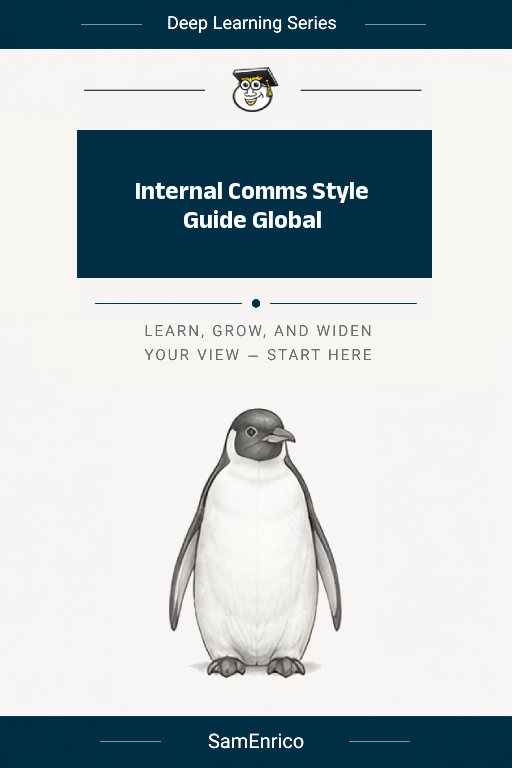
Internal Comms Style Guide Global eBook
Create global writing style guide covering tone vo
Create global writing style guide covering tone voice and formatting for internal messages across all regions and languages.
Formats
Free sample
Chapter 1: The Global Mess Trap--–- It began, as these things often do, with a single email. The kind of email that lands in your inbox at 4:47 PM on a Thursday, when you are already mentally composing your weekend grocery list. The subject line read: "Update." That was the first warning sign, though no one recognized it at the time. Inside, the message announced a new cross-functional initiative to "leverage synergies across global workstreams" and asked recipients to "circle back by EOD with their bandwidth for a deep dive."Within six hours, that one email had generated forty-seven follow-up messages, three confused replies from non-native English speakers asking for clarification, two frustrated responses from native speakers mocking the jargon, and one formal complaint to HR from a German team member who had spent twenty minutes trying to determine whether "circle back" meant reply, call, or physically return to a previous location.This is not an exaggeration. This is Tuesday.The Hidden Cost of Inconsistent Communication Every day, inside thousands of global companies, employees waste millions of hours decoding messages that should have been clear.
They puzzle over idioms that make no sense in their cultural context. They miss deadlines because a date format meant something different to the person who wrote it. They feel excluded, confused, or irritated—not because the information was unimportant, but because the way it was delivered created unnecessary friction.Let us name this problem. Let us call it the Global Mess Trap.The Global Mess Trap is what happens when well-intentioned communicators assume that what works in their home office, in their language, with their cultural assumptions, will work everywhere else. It is the gap between what you meant to say and what your colleague in Singapore, São Paulo, or Stuttgart actually understood.
And that gap is expensive.Consider the following real examples, collected from internal communications audits across Fortune 500 companies:A US-based manager wrote to her team in India, "Let's touch base offline." The Indian team members, unfamiliar with the idiom, spent thirty minutes searching for an offline server or database named "Base." They found nothing. They did not ask for clarification because they did not want to seem incompetent. The work stalled for an entire day.A British headquarters sent a message to its Polish office stating that a decision had been "tabled." In British English, "table" means to bring forward for discussion. In American English—which the Polish team had learned—"table" means to postpone. The Polish team believed the decision was delayed.
The British team believed it was being actively discussed. Two weeks passed before anyone noticed the misalignment.A German office received a cheerful announcement from its American parent company: "We're thrilled to announce a restructuring that will affect approximately 15 percent of roles. Let's celebrate our exciting new chapter!" The German employees were not thrilled. They were confused, then angry. The mismatch between the serious content and the exclamatory, positive tone felt dishonest.
Trust eroded.These are not edge cases. They are daily friction points.The Cost of Confusion, Quantified Let us put numbers on this problem. A 2019 study by the International Association of Business Communicators found that employees in global organizations spend an average of 2.1 hours per week decoding unclear messages—figuring out what the sender actually meant, asking for clarification, correcting misunderstandings, or redoing work that was done incorrectly because instructions were ambiguous.For a company with 10,000 employees, that is 21,000 hours per week. At a conservative average loaded cost of 50perhour,thatisover50 per hour, that is over 50perhour,thatisover1 million per week. Over $50 million per year.
Wasted.And that is just the direct cost. The indirect costs are harder to measure but arguably larger: disengagement, turnover, missed opportunities, slow decision-making, and the quiet exhaustion of employees who have learned to mentally translate every message from "corporate-ese" into human language before they can act on it.One global technology company we studied had an internal wiki with over 200 entries defining acronyms and jargon terms. Two hundred. Employees spent an average of fifteen minutes per day looking up terms or guessing at meanings. The company eliminated 80 percent of those terms through a plain language initiative and saw employee satisfaction scores rise by 12 percent in six months.
The only cost was the discipline to write differently.Why Most Style Guides Fail Globally At this point, you might be thinking: "We already have a style guide. Our communications team maintains it. It lives on the intranet. People can reference it whenever they want."And yet, your people are still writing "circle back" and "low-hanging fruit" and "let's unpack that." They are still using ambiguous date formats. They are still sending messages that confuse and frustrate colleagues in other regions.Here is why most style guides fail globally.First, they are designed for native speakers.
Most traditional style guides—AP, Chicago, even the much-loved Elements of Style—were written by and for people who grew up speaking English in an English-dominant culture. They assume a shared understanding of idioms, cultural references, and rhetorical conventions that simply does not exist in a global workplace. When the guide says "use active voice," that is useful. When it says "avoid clichés," it does not tell you which clichés are actively harmful across cultures.Second, they focus on correctness rather than clarity. Traditional style guides care deeply about whether you should use "that" or "which," whether you can split an infinitive, whether a preposition is something you should end a sentence with.
These debates matter for published literature and legal documents. For internal communication—where the goal is action, understanding, and connection—they are mostly distractions. Your German colleague does not care about your Oxford comma. She cares about whether she knows what to do by Friday.Third, they treat all situations the same. A style guide that gives identical rules for a Slack message, a CEO email, and a safety policy is not a guide—it is a cage.
Different channels, different audiences, and different stakes require different approaches. A contraction that is perfectly fine in a quick Teams message can undermine authority in a legal notice. An emoji that builds camaraderie in a US-based channel can cause offense in the Middle East.Fourth, and most critically, traditional style guides assume uniformity is the goal. They say: "Here is how we write. Everyone must write this way." But in a global organization, uniformity is impossible and undesirable.
A German office that uses the formal "Sie" will never adopt the casual, first-name-basis tone of a Silicon Valley startup. A Japanese team that values indirect, context-rich communication will never embrace the blunt, direct style favored in the Netherlands. And they should not have to.Consistency is not uniformity.That sentence is the central argument of this entire book. You can repeat it to yourself when the pressure to standardize becomes overwhelming. Consistency means that your brand voice is recognizable, your core rules are followed, and your messages are clear.
Uniformity means that everyone writes exactly the same way, regardless of culture, context, or channel. Uniformity is a trap. Consistency is the goal.Brand Voice Versus Tone: A Critical Distinction Before we go any further, we need…
This is the end of the free sample. Get the eBook to keep going. Buy now
About this book
Details
- Author
- Hillman Zetta
- Publisher
- SamEnrico
- Language
- English
- Genre
- Non-Fiction, Professional's Cheat Sheet, Style Guide, Writing Standards
- Released
- 2026-06-01
- Pages (approx.)
- 145
- Available as
- eBook, Audiobook

Read better in the ZLOADR app
Your eBooks on your phone or tablet. Sign in with your SamEnrico account and start reading.
More by Hillman Zetta
 Navigating Custody DisputesHillman Zetta$11.99
 Etsy Digital Planner Income Tax GuideHillman Zetta$11.99
 Segmentation Overlay HandbookHillman Zetta$11.99
 Sleep Memory Improvement PlanHillman Zetta$11.99
 Attention Residue Reduction ProtocolHillman Zetta$11.99
 The Olmec Skywatchers: Cosmic Origins in Ancient MesoamericaHillman Zetta$11.99
 The Algorithm King: How a Math Genius Built a $100B EmpireHillman Zetta$11.99
 Recovery Coach Board RoleHillman Zetta$12.99
 Understanding CholelithiasisHillman Zetta$17.99
 Lead Quality Assurance AnalystHillman Zetta$11.99
 Ultimate Handbook Guide to Philadelphia : (United States) Travel GuideHillman Zetta$11.99