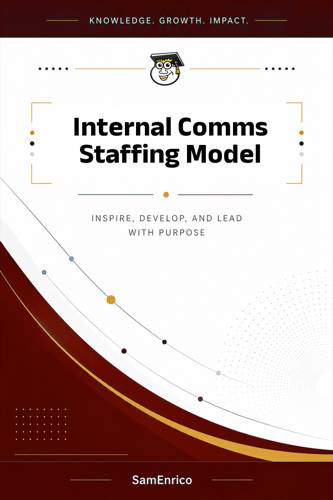
Internal Comms Staffing Model eBook
Calculate headcount needs based on employee popula
Calculate headcount needs based on employee population.
Formats
Free sample
Chapter 1: The Fracture Zone--–- The first time Melissa realized her company was broken, she was standing in a Costco parking lot at 7:45 on a Tuesday morning. A warehouse associate named Darrell had pulled her aside after a town hall—if you could call a crowded break room with a crackling laptop speaker a "town hall." Darrell wasn't angry. He was confused. "Corporate said we're getting a bonus structure change," he said, squinting at his phone. "My supervisor said it's a pay cut.
The regional manager said it's 'complicated.' And the CEO's video said we should be 'excited about the future.' Which one is it, Melissa? Because I've got a kid starting college, and I can't afford 'complicated.'"Melissa didn't have an answer. She was the head of people operations, not internal communications—because the company didn't have internal communications. At eighty-seven employees, they hadn't needed it. At one hundred forty-two employees, the cracks were showing.
At one hundred eighty-three employees, Darrell was standing in a parking lot, and Melissa was lying awake at 2:00 AM wondering why the same question about healthcare enrollment had been asked seventeen times in the last month.This book is for everyone who has been Melissa. For the chief of staff who inherited comms because no one else would do it. For the HR director who spends 40 percent of their week writing emails that no one reads. For the founder who thinks "culture is just what happens when we're all in the same room"—except now you have three offices and a remote team in six time zones. And most of all, this book is for the internal communications leader who knows they need a bigger team but can't find the words, the data, or the courage to ask for it.The problem is not that you are bad at your job.
The problem is that you are trying to solve a structural problem with individual effort. And that never works.The Dunbar Problem: Why 150 Changes Everything Let us start with an anthropologist you have probably heard of and a number you have definitely seen misused. Robin Dunbar, a British anthropologist, proposed that there is a cognitive limit to the number of stable social relationships a human can maintain. That number is approximately 150. Dunbar was not studying corporations.
He was studying neocortex sizes in primates and extrapolating to human social structures, from Neolithic villages to military units. But here is what he actually found: groups larger than 150 require formal rules, written communication, and hierarchical structures to function. Below 150, informal social bonds and gossip are sufficient for coordination. Above 150, gossip becomes rumor. Trust becomes transactional.
And information stops flowing unless someone is paid to move it.That someone is you.The Fracture Zone is the range—roughly 100 to 200 employees—where informal communication breaks down and formal internal communications becomes a necessity, not a luxury. Below 100, a founder or CEO can theoretically talk to everyone. They can remember names. They can walk the floor, send a Slack message to the whole company, and reasonably assume that important news will travel through the grapevine. The grapevine works when everyone knows everyone.
But at 120 employees, the grapevine fractures. At 150, it disintegrates. At 200, you are no longer a village. You are a small city, and cities do not run on gossip.One of the most dangerous myths in scaling organizations is the belief that "we'll just communicate better." This is the corporate equivalent of telling a sinking ship that it should try floating harder. The problem is not communication quality; it is communication structure.
You cannot whisper across a football stadium. You need a public address system. That public address system is your internal communications function. And if you do not build it intentionally, you will build it accidentally through shadow channels, frustrated managers, and the slow erosion of trust.The Three Fracture Symptoms: How to Know You Are Already There Before we talk about solutions, let us name the disease. Most leaders do not realize they have an IC staffing problem until they are deep in the Red Zone.
The symptoms are subtle at first, then blindingly obvious in retrospect. Here are the three fracture symptoms that every understaffed IC function exhibits.Symptom One: Fragmented Culture Different departments develop conflicting narratives about the same company news. The engineering team hears one thing from their VP. The sales team hears another from their regional director. The customer support team learns about the product launch from a Reddit thread.
When Melissa finally investigated why Darrell was so confused, she discovered that the bonus change had been communicated in three different ways: a dense PDF from finance, a two-minute video from the CEO, and a verbal summary from frontline managers who had each interpreted it differently. None of these matched. The company had not lied. It had simply failed to coordinate. And in the absence of a single source of truth, every employee became their own anthropologist, piecing together reality from fragments.Symptom Two: Leadership Distrust When information arrives late, inconsistently, or not at all, employees stop assuming good intentions.
They assume secrecy. They assume manipulation. They assume that leadership is hiding something because if leadership had good news, surely they would share it clearly and quickly. The data on this is stark. In organizations without a dedicated IC function, employee trust in leadership drops by an average of 23 percentage points between 100 and 300 employees.
That is not because leaders become less trustworthy. It is because the communication infrastructure cannot support the trust that used to be built through informal proximity. Employees do not distrust the message. They distrust the silence around the message.Symptom Three: Information Hoarding Middle managers are not villains. They are survivalists.
When corporate communication is inconsistent or nonexistent, managers learn that they gain power and security by being the ones who "translate" news for their teams. They become gatekeepers. They decide what to share, what to summarize, and what to bury. This is not malice; it is rational behavior in an information-scarce environment. But the consequence is devastating: frontline employees hear a filtered, interpreted, and often distorted version of corporate news.
And corporate leaders have no idea what is actually being said because they are not in those manager meetings. The result is a communication black hole where strategy goes in and confusion comes out.If you recognize even one of these symptoms in your organization, you are already in the Fracture Zone. If you recognize all three, you are in the Red Zone, and you need to hire someone yesterday.The $100 Million Mistake: A Case Study in Understaffing Let me tell you about a company that did everything else right and still nearly collapsed because of one blind spot. I will call them Swift Cloud. They were a Saa S startup in the logistics space, growing like a weed: from 50 employees to 300 in eighteen months.
They had a brilliant product, a charismatic founder, and a culture that everyone described as "electric." They also had zero internal communications staff. Not one person whose job description included "make sure everyone knows what is happening."At 50 employees, the founder sent a weekly email. People read it. People…
This is the end of the free sample. Get the eBook to keep going. Buy now
About this book
Details
- Author
- Malcolm Misti
- Publisher
- SamEnrico
- Language
- English
- Genre
- Non-Fiction, Professional's Cheat Sheet, Staffing
- Released
- 2026-06-08
- Pages (approx.)
- 145
- Available as
- eBook, Audiobook

Read better in the ZLOADR app
Your eBooks on your phone or tablet. Sign in with your SamEnrico account and start reading.
More by Malcolm Misti
 Workaholism in Project ManagementMalcolm Misti$11.99
 Anger for LibrariansMalcolm Misti$11.99
 Lactose Intolerance in InfantsMalcolm Misti$11.99
 The Habit Cue Optimization GuideMalcolm Misti$11.99
 Ghosts of the Hindu Kush: The Soviet-Afghan War's Forgotten FrontMalcolm Misti$11.99
 Cooperative Digital TransformationMalcolm Misti$12.99
 Conflict Resolution Micro BreaksMalcolm Misti$12.99
 How to Become a Lead-burner ApprenticeMalcolm Misti$11.99
 Understanding Squamous Cell CarcinomaMalcolm Misti$17.99
 Beauty Salon ManagerMalcolm Misti$11.99