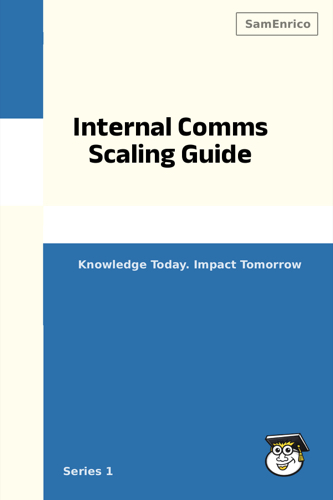
Internal Comms Scaling Guide eBook
Avoid info silos with better async tools.
Avoid info silos with better async tools.
Formats
Free sample
Chapter 1: The 150-Person Death Spiral--–- It begins with a feeling, not a fact. You wake up one Tuesday—probably a Tuesday, because Mondays are too obvious—and something has changed. Your company, which six months ago felt like a nimble family of brilliant misfits, now feels like a slow, confused bureaucracy. The CEO is suddenly in back-to-back meetings. The engineering manager is chasing down "alignment" that everyone assumed was obvious.
Your cross-functional project, the one that launched in three weeks last year, is now in its eighth week with no end in sight.No one sent a memo. No one drew a red line on a chart. But the air is different.This is the 150-Person Death Spiral. It is not a failure of talent, effort, or culture. It is a failure of communication architecture.
And until you name it, measure it, and rebuild against it, your organization will continue to add headcount while subtracting intelligence.The Startup Lie: Why Small Teams Fool Everyone Every founder has a creation story. It usually sounds like this: "We were five people in a garage. We didn't have processes or policies. We just talked. And somehow, we shipped faster than companies fifty times our size."This story is true.
And it is a trap.Small teams—let's define "small" as up to about twenty people—possess a superpower that no process can replicate. It is called ambient awareness. You overhear the designer complaining about a font choice. You see the engineer's Slack status go from "active" to "away" and know she's debugging a production issue. You catch the tail end of a conversation between sales and product and realize, without anyone telling you, that a key feature request is about to derail the roadmap.This ambient awareness is not magic.
It is the result of physical and digital proximity coupled with a low enough headcount that your brain can maintain stable mental models of every other person. You know what Sarah knows. You know what Mike cares about. You know that when David says "we should revisit this," he means "I'm worried but don't want to be the bad guy."Robin Dunbar, the British anthropologist, quantified this limit in the 1990s. His research on primates and human social groups suggested that the human brain can comfortably maintain stable, meaningful relationships with about 150 people.
Below that threshold, you can rely on informal, implicit, socially-coordinated communication. Above that threshold, your brain simply cannot hold all the necessary context.For startup founders, Dunbar's Number feels like an accusation. They built something beautiful below 150, and now that they are scaling, they assume they can simply "do more of what worked." More all-hands meetings. More Slack channels. More "quick syncs" to keep everyone aligned.This is the startup lie: that small-team communication patterns are infinitely scalable.
They are not. They are the opposite of scalable. They are the communication equivalent of a hand-built wooden canoe—perfect for a quiet river, a disaster for an ocean crossing.The Breaking Point: When Tribal Knowledge Becomes a Liability Every organization crosses a threshold where the informal system breaks. Based on case studies from over two hundred scaling companies, that threshold consistently falls between 100 and 200 employees. The precise number depends on three variables:Task interdependence.
How often do teams need to coordinate? The more interdependence, the lower the threshold.Physical distribution. Are people in the same room? The more distributed, the lower the threshold.Turnover rate. How often do people leave?
The higher the turnover, the lower the threshold.But the symptoms are universal. Listen for these phrases. They are the early warning signs of the 150-Person Death Spiral."I thought everyone knew that."This phrase signals a knowledge silo. Information existed in someone's head or in a private conversation, but it was never made explicit and shared. The person who said it genuinely believed they were being transparent.
They were not. They were relying on ambient awareness that no longer exists."Why didn't you ask me sooner?"This phrase signals a context silo. The person being asked has information, but they are frustrated because they expected the asker to already know something. The missing element is not raw data—it is the "why" that would have prompted the question earlier."Let's schedule a quick sync to align."This phrase signals a channel silo. Someone is about to convert an asynchronous problem into a synchronous meeting because they cannot find the information in any written form.
The "quick sync" is not collaboration. It is a search engine failure disguised as a calendar invite."Who made that decision? I wasn't in that room."This phrase signals a decision silo. A choice was made, but the decision logic was never captured. The organization now has two groups operating under different assumptions about what was actually decided.
This is not a disagreement. It is a fork in reality."Why am I on this email? I don't care about this."This phrase signals an audience silo. Information was broadcast to everyone because it was easier than segmenting. The recipients have learned to ignore most communication because most communication is irrelevant.
This is not laziness. It is rational filtering in an information-flooded environment.When you hear these phrases weekly, you are not in a culture problem. You are in an architecture problem. The informal system that worked at fifty people is now actively harming the organization at one hundred fifty.The Curse of the 150-Person Company: A Case Study Consider the fictional but archetypal company Nexa Dynamics. At fifty people, Nexa was a marvel.
The CEO held weekly all-hands where she knew every name. The product manager sat next to engineering and could turn a hallway comment into a shipped feature in days. The head of sales walked over to the customer success team to resolve escalations personally.At one hundred fifty people, Nexa moved to a larger office. The CEO now had direct reports she barely knew. The product manager was pulled into six hours of meetings daily.
The head of sales sent emails that went unanswered.The leadership team did what most leaders do: they added process. They created a weekly "cross-functional alignment meeting" with forty attendees. They mandated that every decision be reviewed by a new "operations committee." They hired an internal comms manager to send a weekly newsletter.None of it worked. The alignment meeting became a status read where people scrolled Slack while waiting for their turn. The operations committee became a bottleneck that approved nothing and blocked everything.
The newsletter had a 9% open rate.Here is what Nexa's leadership missed. The problem was not too little process. The problem was the wrong kind of process. They were trying to formalize the informal—to take the spontaneous, high-context, ambient communication of a fifty-person company and codify it into meetings and emails.What they needed was to replace the informal with the asynchronous—to build a system where context was written, decisions were logged, and information was searchable rather than whispered.Nexa eventually failed. Not because their product was bad or their market was small, but because they could not coordinate faster than their own complexity grew.
They drowned in sync.A Taxonomy of Silos: The Five Ways Information Dies Before we can fix the problem, we need…
This is the end of the free sample. Get the eBook to keep going. Buy now
About this book
Details
- Author
- Leone Sherley
- Publisher
- SamEnrico
- Language
- English
- Genre
- Non-Fiction, Business Brief, Internal Communication
- Released
- 2026-06-07
- Pages (approx.)
- 148
- Available as
- eBook, Audiobook

Read better in the ZLOADR app
Your eBooks on your phone or tablet. Sign in with your SamEnrico account and start reading.
More by Leone Sherley
 Anger And Child OCD SymptomsLeone Sherley$11.99
 Task Switching Cost ReductionLeone Sherley$11.99
 Cultural Anger Trigger GuideLeone Sherley$11.99
 Gilgamesh's Shadow: The Untold Mentor of the Wild ManLeone Sherley$11.99
 The Silk Road's Shadow: How a Tech Whiz Cracked the Dark Web's Drug EmpireLeone Sherley$11.99
 Residential SurveyorLeone Sherley$11.99
 Climate Policy And Advocacy HandbookLeone Sherley$12.99
 Synthetic Identity Fraud DetectionLeone Sherley$12.99
 Understanding Hyperlipoproteinemia Type VLeone Sherley$17.99
 How to Become a ChemistLeone Sherley$11.99