
Non-FictionProfessional's Cheat SheetRisk Management
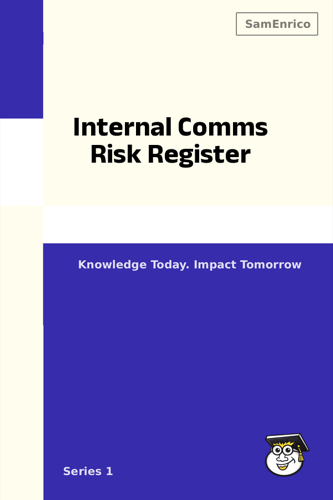
Internal Comms Risk Register eBook
Track potential messaging risks and mitigation pla
by Yu Jackelyn
Track potential messaging risks and mitigation plans.
Formats
Free sample
Chapter 1: The Four Killers...--The email arrived at 2:17 AM on a Tuesday. It was marked “High Importance” and sent from the CEO’s account to all 3,400 employees of a publicly traded manufacturing company. The subject line read: “Immediate Restructuring – Effective Tomorrow.”The body contained four sentences. The first thanked everyone for their service. The second announced that “a significant reduction in force” would begin at 9 AM.
The third instructed employees to check their personal email for individual status. The fourth said HR would host a town hall at 11 AM “to answer questions.”There was just one problem. The CEO had not written the email. He was asleep. His account had been compromised by a phishing attack twelve hours earlier when an assistant clicked a link in a message that appeared to come from IT support.By 3 AM, the company’s internal Slack channels were on fire.
By 4 AM, screenshots of the email had leaked to Reddit. By 6 AM, the local news was calling. By 8 AM, the stock had dropped 7 percent. By 9 AM, when the real CEO arrived at the office, three hundred employees had already updated their Linked In profiles to “open for work.”The fake layoff announcement was corrected by 10 AM. The account was locked by 10:15.
An apology went out at 11. None of it mattered. The damage was done. The company spent the next six months trying to rebuild trust. Turnover increased 40 percent that quarter.
Two senior executives resigned. A class-action lawsuit from employees who said they suffered emotional distress was filed and eventually settled for seven figures.The forensic investigation later revealed something even more disturbing. The compromised CEO account had sent the fake message at 2:17 AM. But the first internal whisper about a layoff had appeared in a private Slack channel at 1:55 AM – twenty-two minutes earlier. Someone had seen something suspicious and instead of reporting it, they had speculated.
That speculation became a rumor. The rumor became a fact. The fact became a crisis.And not one person had thought to check whether the CEO was actually awake.The Blind Spot That Costs Billions Let me tell you what is not happening in most organizations. Every quarter, the finance team updates the financial risk register with currency fluctuations, interest rate changes, and credit defaults. Every quarter, the IT team updates the cybersecurity risk register with new vulnerabilities, patch schedules, and penetration test results.
Every quarter, the legal team updates the compliance risk register with regulatory changes, pending litigation, and contract exposures.These registers are thick documents. They are taken seriously. They are reviewed by boards and auditors and executives who demand to know exactly how much risk the company is carrying in each category.Now let me tell you what is happening in almost every organization. The internal communications team – if one exists – is tracking nothing systematically. At best, there is a mental checklist of “things that could go wrong with the all-hands meeting.” At worst, there is a shared folder of post-crisis after-action reports that no one has opened since the last crisis.
At the typical company, there is no risk register for messaging. There is no quarterly review of communication vulnerabilities. There is no scoring system for the likelihood that a Slack message will be misinterpreted or that a rumor will outrun the truth.This is not a minor oversight. This is a systemic vulnerability that has destroyed billions of dollars in market value, ended careers, landed executives in regulatory crosshairs, and turned functional workplaces into battlefields of rumor and resentment.Consider the following pattern, repeated across industries and continents. A company announces a “strategic realignment.” The announcement is carefully worded by lawyers and communications professionals.
It says nothing about layoffs. It uses phrases like “optimizing our workforce” and “aligning resources with strategic priorities.” The CEO delivers the message in a recorded video that took four takes to get right. The internal comms team pats itself on the back for a smooth rollout.Twenty-four hours later, the grapevine has translated “strategic realignment” into “mass layoffs starting next week.” The translation happened not because employees are malicious or stupid. It happened because the official message lacked specificity, so employees filled the gaps with their own fears. And because the company has no system for detecting the gap between what was said and what was heard, no one realizes the problem until the rumor has already caused damage.This book is about closing that gap.
It is about building a systematic, repeatable framework for identifying, scoring, and mitigating the specific risks that arise when human beings communicate with other human beings inside organizations. I call this framework the Internal Communications Risk Register.But before we build the framework, we have to understand the enemy. And the enemy has four faces.The Four Killers Every messaging failure that has ever brought down a company, triggered a regulatory fine, or destroyed employee trust can be traced to one of four root causes. I call them the Four Killers. They are not abstract concepts.
They are specific, measurable, and – most importantly – preventable.Killer One is what I call the Technical and Channel Killer. This is the failure of the infrastructure itself. A phishing email compromises an executive account. A misconfigured distribution list sends a sensitive message to the wrong audience. A lack of end-to-end encryption exposes confidential discussions to a platform provider who can be subpoenaed.
A terminated employee’s active account sends a goodbye message to the entire company. These are failures of hardware, software, and access controls. They are the easiest to understand and, in many ways, the easiest to fix. Yet most companies have never audited their internal communication channels for these vulnerabilities. They do not know which of their tools have end-to-end encryption.
They do not know who has admin rights to lock a compromised account at 2 AM. They do not know how long their data is retained or who can export it.Killer Two is the Human and Behavioral Killer. This is the failure of individual judgment, usually driven by good intentions. The helpful employee who pastes a confidential merger document into Chat GPT to “summarize it for me,” not realizing that the input is being used to train the model. The exhausted manager who emails a sensitive file to their personal Gmail account so they can work from home, bypassing the VPN.
The disgruntled system administrator who downloads thousands of files the night before their last day. These are failures of people acting rationally within the incentives they have been given. The helpful employee is not trying to leak trade secrets. They are trying to do their job faster. The problem is that the secure path is too slow, so they take the fast path.
The solution is not more training or more rules. The solution is making the secure path the easiest path.Killer Three is the Cultural and Silence Killer. This is the most insidious of the four because it is invisible. It is the organization that has systematically trained its employees not to bring bad news upward. It is the frontline worker who notices a safety risk but does not report it because the last three people who raised concerns were labeled…
This is the end of the free sample. Get the eBook to keep going. Buy now
About this book
Details
- Author
- Yu Jackelyn
- Publisher
- SamEnrico
- Language
- English
- Genre
- Non-Fiction, Professional's Cheat Sheet, Risk Management
- Released
- 2026-06-10
- Pages (approx.)
- 151
- Available as
- eBook, Audiobook

Read better in the ZLOADR app
Your eBooks on your phone or tablet. Sign in with your SamEnrico account and start reading.
More by Yu Jackelyn
 Anger for ChefsYu Jackelyn$11.99
 Mindfulness for WorkaholicsYu Jackelyn$11.99
 The AgTech Investment OutlookYu Jackelyn$11.99
 The Stoneworkers' Secret: How Medieval Masons Built Cathedrals for the BirdsYu Jackelyn$11.99
 Understanding Spondyloepiphyseal Dysplasia Nephrotic SyndromeYu Jackelyn$17.99
 Humming and Vibration BreaksYu Jackelyn$12.99
 Multi Stakeholder CooperativeYu Jackelyn$12.99
 Arrowroot HarvestingYu Jackelyn$11.99
 How to Become a Contract AdministratorYu Jackelyn$11.99
You may also like
 Hong Kong Handover 1997Dunn Johnnie$11.99
 Zumba For Postnatal Recovery CourseNeal Christian$11.99
 Zumba for BeginnersLadner Nikia$11.99
 YouTube Comment Mining GuideHumes Pandora$12.99
 Worry Box MeditationCarlin Rudy$11.99
 Workplace Stress MeditationNguyen Lynn$11.99
 Workplace Stress and Sleep RepairHawley Ivory$11.99
 Workplace Perfectionism CureDelaney Jeffry$11.99
 Workplace Injustice Anger GuideWallen Isabelle$11.99
 Work Addiction and Burnout LinkGreenwood Ester$11.99
 Women in Yoga and WellnessBeattie Galina$11.99
 Women in Stand Up ComedyChun Evangeline$11.99