
Non-FictionProfessional's Cheat SheetProcurement
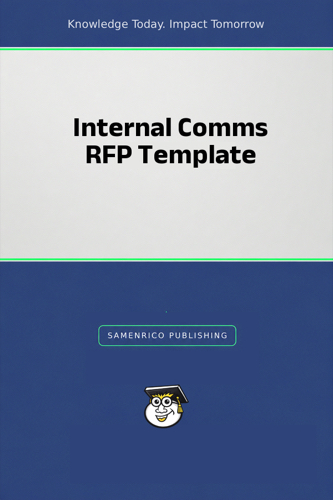
Internal Comms RFP Template eBook
Request proposals from vendors for platform or age
Request proposals from vendors for platform or agency services.
Formats
Free sample
Chapter 1: The $47,000 Mistake...--–- The email arrived at 9:47 AM on a Tuesday. Priya, the Internal Communications Director for a 4,000-person retail chain, had spent six months evaluating employee communication platforms. She had sat through seventeen demos. She had filled out thirty-two vendor scorecards. She had finally secured $47,000 in budget for a sleek, AI-powered intranet with sentiment analysis, chatbots, and personalized news feeds.
The platform launched with a company-wide celebration. Six months later, Priya pulled the usage report. Twelve percent adoption. Among her deskless warehouse and store employees? Zero point seven percent.
Her CFO sent a one-line email: "Please explain." Priya had no good answer. She had bought features. She had not diagnosed her problem.This chapter exists to ensure you never become Priya. Before you write a single word of your RFP, before you invite a single vendor to a demo, before you even open a budget spreadsheet, you must first answer three deceptively simple questions: What is actually broken? Why did it break?
And what kind of solution would fix it? Most IC professionals skip these questions entirely. They chase "must-haves" like chat, mobile apps, and analytics dashboards without ever asking whether those features address the root cause of their communication failures. The result is what this book calls the $47,000 Mistake: buying a solution to a problem you do not have.This chapter provides three diagnostic tools to prevent that mistake. First, the Internal Comms Maturity Matrix, which scores your organization from Firefighting (Level 1) to Strategic Predictor (Level 4).
Second, the Gap Analysis Worksheet, which uses real data to identify whether your failure is channel, message, timing, or trust. Third, a Decision Tree that helps you determine whether you need an agency (strategy help), a platform (execution help), or a hybrid model. By the end of this chapter, you will have a one-page Diagnostic Report that becomes the introduction to your RFP. More importantly, you will know what you are actually trying to solve.The Four Vendor Traps (A Note Before You Begin)This book assumes you have been burned before. Every chapter is designed to protect you from what we call the Four Vendor Traps.
Trap #1 is Overpromising: vendors will tell you their platform can do everything, but they will not ask whether you need everything. This chapter is your defense against Trap #1. The remaining traps appear throughout the book: Hiding Costs (Chapter 4), Locking You In (Chapter 10), and Vanishing Post-Sale (Chapter 11). You do not need to memorize them now. Just know that skipping the diagnostic audit is how Trap #1 gets you.
Priya fell for Trap #1. You will not.The Internal Comms Maturity Matrix: Where Do You Stand?Most IC professionals cannot describe their organization's communication maturity because they have never been asked to. They know their open rates, their engagement scores, their Town Hall attendance. But they do not have a framework for understanding whether those numbers reflect a systemic problem or a tactical one. The Internal Comms Maturity Matrix changes that.Level 1: Firefighting At Level 1, internal communication is reactive, inconsistent, and channel-driven.
Emails go out whenever someone remembers to write them. Town Halls are scheduled without employee input. There is no measurement beyond "did we send it?" Crisis communication consists of panic. The defining characteristic of Level 1 is that nobody owns the strategy. There might be a Comms person, but that person is overwhelmed by requests from every department.
Decisions about tools are made by whoever shouts loudest. If this sounds familiar, your problem is not a lack of features. Your problem is the absence of a communication function.Typical symptoms: Open rates vary wildly from 5% to 60% with no pattern. Employees report learning about important news from external sources. Managers complain they never know what to say.
The Comms team describes their work as "putting out fires."Level 2: Channel-Focused At Level 2, the organization has established channels. There is a weekly email newsletter. There is an intranet. There might be a Slack channel for announcements. But each channel operates independently, and nobody has mapped which channel works for which audience.
The defining characteristic of Level 2 is activity without insight. You are doing a lot of communication, but you cannot say whether any of it lands. Deskless workers are systematically excluded because all channels assume desktop access. When something fails, the response is to add another channel.Typical symptoms: Open rates are stable but low (20-30%). Employees say they receive "too much email" but also "never know what is important." The intranet gets clicks but no engagement.
The Comms team spends most of their time formatting and distributing, not strategizing.Level 3: Audience-Aware At Level 3, the organization segments its audience. Different messages go to different roles, locations, or departments. There is some personalization. The Comms team can tell you who opened what. But measurement is still focused on outputs (opens, clicks) rather than outcomes (retention, behavior change).
The defining characteristic of Level 3 is that you know who is listening, but you do not know whether they understand or act. You can identify a problem (the warehouse team is not reading safety updates), but you cannot diagnose why (is it channel, message, timing, or trust?).Typical symptoms: Segmented open rates show clear gaps between deskbound and deskless workers. Employee surveys say "communication is fine" but operational metrics (safety incidents, turnover, compliance) say otherwise. The Comms team asks for a new platform because "the current one doesn't have good analytics."Level 4: Strategic Predictor At Level 4, communication is integrated with business outcomes. You can predict which messages will resonate with which audiences.
You measure information retention, behavior change, and business impact. The defining characteristic of Level 4 is that you fix problems before they happen. When a new policy is announced, you already know which segments will struggle and have targeted campaigns ready. Your measurement tells you not just what happened, but why. Very few organizations reach Level 4.
That is fine. But you cannot buy your way to Level 4 with a platform. You have to build the strategic capability first.Typical symptoms: Open rates vary by design (high for urgent messages, lower for reference messages). Employees can correctly answer quiz questions about recent announcements. Operational metrics improve after communication campaigns.
The Comms team spends most of their time on strategy, not production.How to Score Your Organization The chapter includes a printable worksheet with twelve diagnostic statements. For each statement, rate your organization from 1 (strongly disagree) to 5 (strongly agree). Examples include: "We have a documented internal comms strategy that is reviewed quarterly," "We can measure whether employees retain information after a campaign," and "Deskless workers have channels that work for their context." Add your scores. A total below 20 points to Level 1. Twenty to 29 points to Level 2.
Thirty to 39 points to Level 3. Forty to 60 points to Level 4. Most readers will land in Level 2 or 3. That is fine. What matters is that you now have a baseline.The Gap Analysis Worksheet: Diagnosing Why You Are Stuck Maturity scores tell you where you are.
The Gap Analysis Worksheet tells you why you are stuck. This is where most RFPs go wrong. IC professionals see a low open rate or poor engagement and assume they need a new platform. But a platform cannot fix a message problem. It…
This is the end of the free sample. Get the eBook to keep going. Buy now
About this book
Details
- Author
- Arthur Eugena
- Publisher
- SamEnrico
- Language
- English
- Genre
- Non-Fiction, Professional's Cheat Sheet, Procurement
- Released
- 2026-06-11
- Pages (approx.)
- 155
- Available as
- eBook, Audiobook

Read better in the ZLOADR app
Your eBooks on your phone or tablet. Sign in with your SamEnrico account and start reading.
More by Arthur Eugena
 Senior Self Esteem For MenArthur Eugena$11.99
 The Behavioral Addiction and DivorceArthur Eugena$11.99
 Hope Legacy GuideArthur Eugena$11.99
 The Signal Privacy Comparison GuideArthur Eugena$11.99
 Charitable Remainder TrustArthur Eugena$12.99
 Byzantium Inc.: The Silk Road Empire of JustinianArthur Eugena$11.99
 Warehouse LeadArthur Eugena$11.99
 Understanding Spinal Muscular Atrophy Type I With Congenital Bone FracturesArthur Eugena$17.99Charitable Remainder TrustArthur Eugena$12.99
 Retail Climate InsuranceArthur Eugena$12.99
 10 Ways to Use Dark Chocolate (Recipe Book)Arthur Eugena$11.99
You may also like
 Hong Kong Handover 1997Dunn Johnnie$11.99
 Zumba For Postnatal Recovery CourseNeal Christian$11.99
 Zumba for BeginnersLadner Nikia$11.99
 YouTube Comment Mining GuideHumes Pandora$12.99
 Worry Box MeditationCarlin Rudy$11.99
 Workplace Stress MeditationNguyen Lynn$11.99
 Workplace Stress and Sleep RepairHawley Ivory$11.99
 Workplace Perfectionism CureDelaney Jeffry$11.99
 Workplace Injustice Anger GuideWallen Isabelle$11.99
 Work Addiction and Burnout LinkGreenwood Ester$11.99
 Women in Yoga and WellnessBeattie Galina$11.99
 Women in Stand Up ComedyChun Evangeline$11.99