
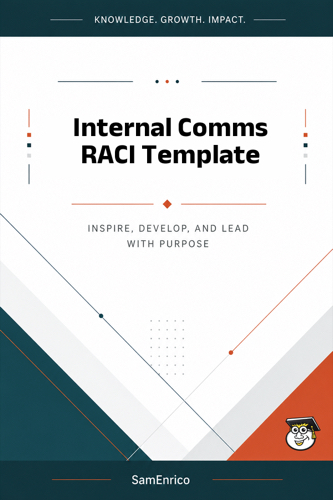
Non-FictionProfessional's Cheat SheetGovernance
Internal Comms RACI Template eBook
Define roles and approvals for messaging across de
Define roles and approvals for messaging across departments.
Formats
Free sample
Chapter 1: The Approval Trap--–- Sarah stared at her inbox for the seventeenth time that hour. Forty-seven emails. Twenty-three people copied. Three separate threads about the same all-hands announcement. The CEO had requested a “quick review” at 9 AM.
It was now 4 PM. The message still hadn’t gone out. Legal wanted to change the word “exciting” to “noteworthy.” Marketing wanted to add a hashtag. IT wanted to confirm the Zoom link for the third time. HR wanted to know if the message implicitly promised new benefits.
And the CEO’s chief of staff had just replied all with “Can we hop on a quick call to align?” Sarah closed her laptop, pressed her palms against her eyes, and whispered something unprintable.She was not alone.Across the country, in companies of every size and industry, internal communications professionals were living the same nightmare. A simple announcement that should take thirty minutes to write and ten minutes to approve was taking three days. Or five days. Or, in one horrifying case that Sarah had heard about at a conference, eleven days for a two-paragraph update about the office microwave being repaired.This was the Approval Trap.And it was costing organizations millions.The Anatomy of a Broken System Let us begin with a simple question: Why does internal communications approval take so long?The intuitive answer is “too many stakeholders.” But that is not quite right. The correct answer is “no clear owner.” When ten people have the power to say no, but no single person has the power to say yes, you do not have an approval process.
You have a hostage situation.Consider what happens when a standard internal announcement—let us say a reminder about the annual benefits enrollment deadline—enters a typical approval chain.The communications specialist writes a draft. Following policy, they send it to their manager. The manager, wanting to be thorough, forwards it to the head of HR. The head of HR, mindful of legal exposure, sends it to employment counsel. Employment counsel, who bills by the hour and has no sense of urgency about a benefits reminder, puts it in a queue.
Three days later, legal replies with seventeen comments, most of which are stylistic preferences disguised as compliance requirements. The head of HR reviews the legal comments, adds five of their own, and sends it back to the communications manager. The communications manager forwards it to the specialist. The specialist makes changes. The specialist’s manager reviews again.
The manager forwards to HR. HR forwards to legal. Legal replies with four new comments because the specialist used “you” instead of “employees.”And somewhere in this infinite loop, the benefits enrollment deadline passes.This is not an exaggeration. This is a verbatim account from a Fortune 500 company that hired me to diagnose their internal comms delays. When I mapped their actual approval workflow for a routine HR message, I found an average of 2.3 iterations per message and a median time-to-approval of 94 hours.
For a message that took 45 minutes to write.The Approval Trap has three distinct characteristics, and once you learn to see them, you will spot them everywhere.Characteristic One: The Expanding Circle The first sign of the Approval Trap is that the number of reviewers grows over time, never shrinks. Someone starts by sending a draft to three people. One of those three says, “This looks good, but let me loop in Legal to be safe.” Legal says, “Thanks, I’ll review after Finance weighs in.” Finance says, “We should probably get IT’s perspective on the terminology.” And suddenly a message that began with three reviewers now has seventeen.This expansion feels prudent. It feels like covering your bases. In reality, it is the opposite of prudent.
Every additional reviewer adds not just their own review time but also the coordination time required to reconcile their feedback with everyone else’s. The relationship is not linear. It is exponential.Characteristic Two: The Ghost Reader The second sign of the Approval Trap is the presence of “friendly ghosts”—people who are copied on the draft, who have the authority to object, but who never actually respond until the last possible moment. They do not reply to the first email. They do not reply to the follow-up.
They do not reply to the “gentle reminder.” But the moment someone says, “We’re going to send this at 2 PM if there are no objections,” the ghost materializes with seven paragraphs of changes.Why? Because the ghost is not malicious. The ghost is simply operating without a timebox. When there is no deadline for feedback, feedback has an infinite half-life. The ghost will review the message exactly when the cost of not reviewing exceeds the cost of reviewing—which is usually about thirty seconds before the message is scheduled to go out.Characteristic Three: The Consensus Mirage The third and most dangerous sign of the Approval Trap is the belief that consensus is possible or even desirable.
Teams trapped in this cycle genuinely believe that if they just get everyone in a room, or on one more call, or into one more document, they will eventually arrive at a version that satisfies every stakeholder perfectly.This is a mirage.Consensus is not a destination. It is a delay mechanism disguised as collaboration. Every time you ask for “alignment,” you are implicitly giving every stakeholder a veto. And when everyone has a veto, no one has accountability.The Real Cost of Chaos Let us talk about money, because money focuses the mind.Earlier I mentioned a financial model showing that a 500-person company loses approximately $200,000 annually in salaried time just waiting for approvals. That figure comes from a simple calculation, and I want to walk you through it because most communications professionals have never been asked to quantify the cost of their approval delays.
Once you see the math, you will never look at a fourteen-email thread the same way again.Here is the model.Assume a 500-person company where the average fully-loaded cost per employee (salary, benefits, overhead, office space) is $120,000 per year. That is $60 per hour, assuming 2,000 working hours annually. Now consider the internal comms function specifically. A typical mid-sized company might have three people dedicated to internal communications, each earning approximately $80,000 to $100,000 plus benefits. But the cost of approval delays is not limited to the comms team.
It includes every stakeholder who touches the message.In the companies I have studied, the average internal message that requires approval passes through 4.2 stakeholders before publication. Each stakeholder spends an average of 22 minutes reviewing and commenting. Each message goes through an average of 1.8 revision cycles. And the average company in this study published 47 internal messages per week—everything from all-hands announcements to policy updates to newsletter items.Let us do the multiplication.22 minutes per stakeholder × 4.2 stakeholders = 92.4 minutes of review time per message.92.4 minutes × 1.8 revision cycles = 166.3 minutes of total stakeholder time per message.166.3 minutes × 47 messages per week = 7,816 minutes of stakeholder time per week.7,816 minutes ÷ 60 = 130.3 hours of stakeholder time per week.130.3 hours × $60 per hour = $7,818 per week…
This is the end of the free sample. Get the eBook to keep going. Buy now
About this book
Details
- Author
- Crockett Bulah
- Publisher
- SamEnrico
- Language
- English
- Genre
- Non-Fiction, Professional's Cheat Sheet, Governance
- Released
- 2026-06-07
- Pages (approx.)
- 133
- Available as
- eBook, Audiobook

Read better in the ZLOADR app
Your eBooks on your phone or tablet. Sign in with your SamEnrico account and start reading.
More by Crockett Bulah
 Forgiving Your Body WorkbookCrockett Bulah$11.99
 Loving Kindness For ManiaCrockett Bulah$11.99
 The Online Casino Addiction GuideCrockett Bulah$11.99
 The Listening for Interviewers GuideCrockett Bulah$11.99
 Neanderthal Echoes: The Forgotten DNA That Shapes Us TodayCrockett Bulah$11.99
 How to Start a Civil Defence Administration Business (Beginners Guide)Crockett Bulah$11.99
 Freelancer HARO Press GuideCrockett Bulah$12.99
 Export Pricing Inflation GuideCrockett Bulah$12.99
 Understanding Spastic Paraplegia Facial Cutaneous LesionsCrockett Bulah$17.99
 Train CollectingCrockett Bulah$11.99
You may also like
 Hong Kong Handover 1997Dunn Johnnie$11.99
 Zumba For Postnatal Recovery CourseNeal Christian$11.99
 Zumba for BeginnersLadner Nikia$11.99
 YouTube Comment Mining GuideHumes Pandora$12.99
 Worry Box MeditationCarlin Rudy$11.99
 Workplace Stress MeditationNguyen Lynn$11.99
 Workplace Stress and Sleep RepairHawley Ivory$11.99
 Workplace Perfectionism CureDelaney Jeffry$11.99
 Workplace Injustice Anger GuideWallen Isabelle$11.99
 Work Addiction and Burnout LinkGreenwood Ester$11.99
 Women in Yoga and WellnessBeattie Galina$11.99
 Women in Stand Up ComedyChun Evangeline$11.99