
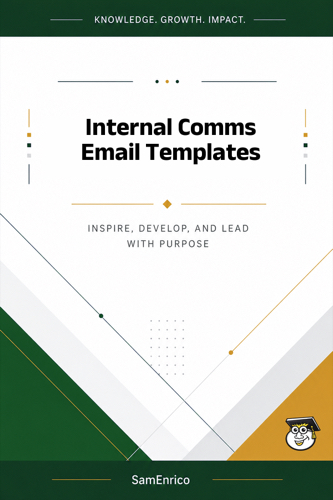
Non-FictionProfessional's Cheat SheetEmail
Internal Comms Email Templates eBook
Use proven subject lines and body copy for common
Use proven subject lines and body copy for common announcements.
Formats
Free sample
Chapter 1: The Invisible Cost...--Every internal email you have ever sent that was ignored has already cost you something. You just haven't been counting.The math is brutal but simple. Take the average salary of everyone on your team. Multiply it by the number of hours they spend each week confused, waiting, or duplicating work because an email was unclear or never opened. Then multiply that by fifty-two weeks.
That number is not a rounding error. That number is your invisible payroll. You are paying people to be confused.The problem is not that your team is lazy or that they hate reading. The problem is that internal communication has no consequences in most organizations. If a marketing email to customers has a low open rate, someone gets fired.
If an internal email about a policy change has a low open rate, no one notices. The silence is invisible. The cost is invisible. The frustration builds invisibly. And then one day, someone misses a deadline, a compliance issue slips through, or a good employee quits because they felt out of the loop.
Everyone asks, "How did this happen?" The answer is always the same: it started with an email that no one read.This book exists to make the invisible visible. Before we get to a single template, before we write a single subject line, we need to understand what we are fighting against. The enemy is not your team's attention span. The enemy is not the volume of email. The enemy is a specific pattern of bad writing that has become so normalized in corporate culture that most people don't even see it anymore.We call it the Gray Blob.The Gray Blob: An Autopsy The Gray Blob is any email that begins with a soft, meaningless opening sentence designed to cushion the reader from anything resembling actual information.
You have received thousands of Gray Blobs. You have probably sent hundreds yourself.Here is a Gray Blob. Read it and notice what you feel:"Hi team, I hope this message finds you well. I wanted to reach out today to provide a quick update on some items that are in progress. As you may know, we have been working on a few initiatives lately, and I think it would be helpful to share where things stand.
Please see below for more details. As always, thank you for your hard work and dedication. Best, [Manager Name]"What did you feel? Nothing? Annoyance?
A vague sense that someone has just asked for your time without giving you a reason to care? That is the Gray Blob in action. It is not malicious. It is not even wrong, exactly. It is just empty.
It is calories without nutrition. It is the written equivalent of elevator music.The Gray Blob has three defining characteristics.First, it buries the lead. The most important information is never in the first sentence. Sometimes it is not even in the first paragraph. The writer has been trained to "warm up" the reader, to provide context before delivering news.
But in an internal email, the reader does not need to be warmed up. They need to know, within three seconds, whether this email matters to them.Second, the Gray Blob uses passive voice as a shield. "Mistakes were made" instead of "I made a mistake." "It was decided" instead of "We decided." "The deadline has been moved" instead of "We moved the deadline." Passive voice feels professional, but what it actually signals is avoidance. Readers notice this. They may not be able to name it, but they feel it.
They feel that the writer is hiding something or avoiding accountability. Trust erodes in millimeters.Third, the Gray Blob has no clear call to action. It ends with something like "Let me know if you have any questions" or "Thanks for your understanding." These phrases are not calls to action. They are invitations to do nothing. And employees, being efficient creatures who receive dozens of emails per day, will always choose nothing when nothing is clearly required.The Gray Blob is not a failure of grammar or vocabulary.
It is a failure of courage. It is the result of writers who are afraid to be direct, afraid to ask for what they need, afraid that stating the news plainly will seem rude or abrupt. So they soften. They pad. They produce beige paragraphs of nothing.
And their teams learn, over time, to ignore them.The Three Second Window Neuroscience has something to tell us about internal email, and it is not comforting. The human brain, when faced with a stream of incoming information, makes a rapid binary decision about each item: relevant or irrelevant. This decision happens in approximately three seconds. Three seconds is the time it takes to read a subject line and the first few words of a preview pane.If your email does not signal relevance within three seconds, it is irrelevant. Permanently.
The reader will not come back to it later. They will not "save it for when they have more time." They will archive it, delete it, or mark it as read and forget it. The email will become digital noise, taking up space in an inbox that no one ever cleans.This is not a failure of discipline on the reader's part. It is a feature of how attention works in a high-information environment. Your employees are not lazy.
They are overwhelmed. They have been trained by years of Gray Blobs to treat all internal emails as low priority until proven otherwise. You are not competing with other emails for their attention. You are competing with their learned helplessness.The only way to win that competition is to prove, in the subject line and the first sentence, that you respect their time. That you have something specific to say.
That you are not sending a Gray Blob.Consider two subject lines for the same email about a software update. The first is a Gray Blob: "IT Update" The second is specific and action-oriented: "Action required by Friday: Update your Salesforce password" Which one gets opened? The second one, every time. Not because it is more exciting, but because it answers the two questions every employee asks about every email: Do I need to do something? and By when?The first subject line answers neither question.
The second answers both in under ten words.The Three C's: A Framework for Escape This book is built on a framework that we call the Three C's. Every email you send, regardless of topic or audience, should be evaluated against these three standards. If an email fails any of the three, do not send it. Rewrite it until it passes.Clarity: The First Sentence Rule Clarity means that the most important information appears in the first two sentences. Not the third sentence.
Not the second paragraph. The first two sentences. This is called the inverted pyramid structure, borrowed from journalism. A news article puts the conclusion first because the editor knows that readers may stop reading at any moment. The same is true of internal email.
Your reader may be interrupted by a phone call, a colleague, or another email. If they only read the first…
This is the end of the free sample. Get the eBook to keep going. Buy now
About this book
Details
- Author
- Mireles Jewel
- Publisher
- SamEnrico
- Language
- English
- Genre
- Non-Fiction, Professional's Cheat Sheet, Email
- Released
- 2026-06-10
- Pages (approx.)
- 146
- Available as
- eBook, Audiobook

Read better in the ZLOADR app
Your eBooks on your phone or tablet. Sign in with your SamEnrico account and start reading.
More by Mireles Jewel
 Mindfulness For Senior Self EsteemMireles Jewel$11.99
 Senior Flexibility Stretch GuideMireles Jewel$11.99
 The Inflammation and Depression LinkMireles Jewel$11.99
 Innovation Legacy GuideMireles Jewel$11.99Innovation Legacy GuideMireles Jewel$11.99
 The Vanishing Highwayman: Britain's Most Audacious Prison BreakMireles Jewel$11.99
 Wedding ManagerMireles Jewel$11.99
 Anti Clintock Rule ChangesMireles Jewel$12.99
 Climate Insurance Claims GuideMireles Jewel$12.99
 10 Ways to Use Dandelion (Recipe Book)Mireles Jewel$11.99
You may also like
 Hong Kong Handover 1997Dunn Johnnie$11.99
 Zumba For Postnatal Recovery CourseNeal Christian$11.99
 Zumba for BeginnersLadner Nikia$11.99
 YouTube Comment Mining GuideHumes Pandora$12.99
 Worry Box MeditationCarlin Rudy$11.99
 Workplace Stress MeditationNguyen Lynn$11.99
 Workplace Stress and Sleep RepairHawley Ivory$11.99
 Workplace Perfectionism CureDelaney Jeffry$11.99
 Workplace Injustice Anger GuideWallen Isabelle$11.99
 Work Addiction and Burnout LinkGreenwood Ester$11.99
 Women in Yoga and WellnessBeattie Galina$11.99
 Women in Stand Up ComedyChun Evangeline$11.99