
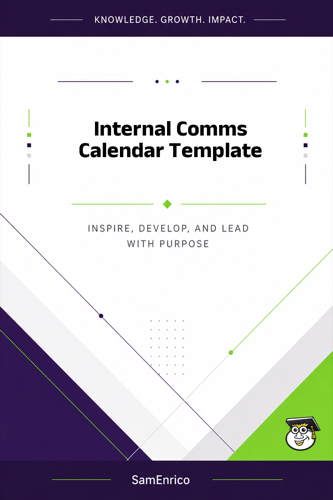
Non-FictionProfessional's Cheat SheetPlanning
Internal Comms Calendar Template eBook
Plan yearly communications with timing for holiday
by Woods Dawn
Plan yearly communications with timing for holidays and regional events.
Formats
Free sample
Chapter 1: The Calendar Trap--Every internal communications team I have ever met—from startups with twenty employees to global enterprises with two hundred thousand—suffers from the same silent affliction. They are drowning in requests, buried in Slack notifications, and working evenings and weekends to send messages that most employees will never read. And when I ask them what tool would fix their problems, almost all of them say the same thing: "We need a better calendar."They are wrong.The calendar is not the problem. The way you think about the calendar is the problem. Most IC professionals treat their calendar as a passive log—a neutral record of "things we need to send." They fill it with requests as they arrive, color-code by department, and call it a day.
Then they wonder why employees have stopped listening, why leadership doesn't trust them, and why they have no time for strategic work.This chapter will show you a different path. It will reveal why ad-hoc communication is quietly destroying your credibility, introduce the single most powerful concept in strategic internal communications, and give you a three-question filter that will cut fifty percent of your "urgent" requests before they ever reach your inbox. By the end of this chapter, you will never look at a calendar the same way again.The True Cost of Being a News Broadcaster Let me tell you about Maria. Maria runs internal communications for a mid-sized financial services firm with three thousand employees across twelve offices. When we first met, she was exhausted.
Her team of four people was sending an average of forty-seven communications per week—emails, Slack messages, intranet posts, CEO videos, and digital signage updates. They were working ten-hour days and often answering emails at midnight.Maria thought she was doing everything right. She had a beautiful spreadsheet calendar with color-coded tabs for each department. She had a weekly editorial meeting. She had a "request form" that stakeholders were supposed to use.
And yet, her employee engagement survey results were dismal. Only twenty-two percent of employees agreed with the statement "I receive the information I need to do my job effectively." Thirty-one percent agreed with "Leadership communicates clearly." The CEO was frustrated. The CHRO was demanding answers. And Maria was one bad quarter away from outsourcing her team to an agency.What Maria didn't realize was that she had fallen into the News Broadcaster Trap. She was treating her team like a wire service—receiving inputs from stakeholders, packaging them into messages, and broadcasting them to employees.
She was fast, responsive, and always available. She thought these were strengths. They were not.The News Broadcaster Trap has three predictable costs, and they are devastating.The first cost is information overload. When you send everything, employees learn to ignore everything. The human brain has a limited capacity for processing new information.
Psychologists call this "cognitive load." When you exceed it, the brain simply shuts down and stops paying attention. Maria was sending an average of seven messages per employee per day. That is not communication. That is noise. And employees had learned to treat her channel the same way they treat email from an online retailer they once bought a gift for: delete, archive, or mark as read without looking.The second cost is employee confusion.
When every message is marked "urgent," no message is urgent. Maria's team had a habit of labeling everything as "important" because they wanted to ensure it was read. The result was that when a genuinely urgent message appeared—a security breach, a payroll error, a facility closure—employees did not recognize it as different from the forty-six other messages they received that week. Confusion is not a failure of writing. It is a failure of filtering.The third cost, and the most insidious, is channel fatigue.
Employees do not hate your communications. They hate the feeling of being bombarded by irrelevant information from channels they cannot escape. Maria's company used Slack for instant messaging, and her team had made it a practice to post every announcement in the #general channel. Employees started muting the channel. Then they started muting Slack entirely.
The channel that was supposed to be for urgent, company-wide updates became a ghost town—not because the technology failed, but because the discipline failed.Maria is not alone. I have seen this pattern in healthcare, technology, manufacturing, retail, and government. The symptoms are always the same: a hardworking IC team, a beautiful calendar, and an employee base that has learned to tune them out. The cause is almost always the same as well: the team is acting as a news broadcaster rather than a strategic filter.The Strategic Filter: Your New Operating System If the News Broadcaster is the disease, the Strategic Filter is the cure. A Strategic Filter is not a tool or a template.
It is a mindset and a discipline. It is the practice of treating every incoming communication request as something that must earn its place on your calendar, rather than something that automatically deserves a slot.Think of it this way. A news broadcaster asks: "What has happened that we should tell people about?" A strategic filter asks: "What needs to happen in the minds and behaviors of our employees, and what communication will actually cause that change?"The difference is subtle but profound. The news broadcaster is reactive. The strategic filter is proactive.
The news broadcaster measures success by sends and opens. The strategic filter measures success by understanding and behavior change. The news broadcaster is exhausted by Friday. The strategic filter has time for strategic work because they are not drowning in noise they created themselves.Becoming a strategic filter requires a fundamental shift in how you relate to your calendar. Your calendar is not a to-do list.
It is a strategic weapon. It is the single most powerful tool you have for shaping what employees pay attention to, what they remember, and what they do. Every slot on your calendar is an investment of attention. And attention, unlike email volume, is a finite resource.When you internalize this truth, everything changes. You stop asking "Can we send this?" and start asking "Should we send this?" You stop accepting every stakeholder request as a mandate and start treating each request as a negotiation.
You stop filling empty slots because they are empty and start leaving them empty because silence is often more strategic than noise.The Drumbeat: Creating Predictable, Trusted Rhythms The most powerful tool in the strategic filter's arsenal is what I call The Drumbeat. A Drumbeat is a predictable, trusted rhythm of communication that employees can set their watches by. It is the opposite of ad-hoc, reactive, or surprise messaging. It is the foundation upon which all strategic communication is built.Let me give you examples of Drumbeats that work.A technology company I worked with implemented a simple Drumbeat: the CEO video drops every Tuesday at 10 AM Eastern Time, and it is never longer than three minutes. Employees began scheduling their Tuesday mornings around this video.
They would watch it with their teams, discuss it in their standups, and ask questions in a dedicated Slack channel…
This is the end of the free sample. Get the eBook to keep going. Buy now
About this book
Details
- Author
- Woods Dawn
- Publisher
- SamEnrico
- Language
- English
- Genre
- Non-Fiction, Professional's Cheat Sheet, Planning
- Released
- 2026-06-09
- Pages (approx.)
- 147
- Available as
- eBook, Audiobook

Read better in the ZLOADR app
Your eBooks on your phone or tablet. Sign in with your SamEnrico account and start reading.
More by Woods Dawn
 The Senior Worthiness WorkbookWoods Dawn$11.99
 The Active Listening for ManagersWoods Dawn$11.99
 The Gaming Cue Exposure GuideWoods Dawn$11.99
 Loving Kindness For Eating DisordersWoods Dawn$11.99
 Frozen Echoes of the Lost Franklin ExpeditionWoods Dawn$11.99
 How to Start a Banner-making BusinessWoods Dawn$11.99
 Understanding Spastic AWoods Dawn$17.99
 Tire RotationWoods Dawn$11.99
 Price Lag Strategy GuideWoods Dawn$12.99
 Multiple HARO Accounts StrategyWoods Dawn$12.99
You may also like
 Hong Kong Handover 1997Dunn Johnnie$11.99
 Zumba For Postnatal Recovery CourseNeal Christian$11.99
 Zumba for BeginnersLadner Nikia$11.99
 YouTube Comment Mining GuideHumes Pandora$12.99
 Worry Box MeditationCarlin Rudy$11.99
 Workplace Stress MeditationNguyen Lynn$11.99
 Workplace Stress and Sleep RepairHawley Ivory$11.99
 Workplace Perfectionism CureDelaney Jeffry$11.99
 Workplace Injustice Anger GuideWallen Isabelle$11.99
 Work Addiction and Burnout LinkGreenwood Ester$11.99
 Women in Yoga and WellnessBeattie Galina$11.99
 Women in Stand Up ComedyChun Evangeline$11.99