
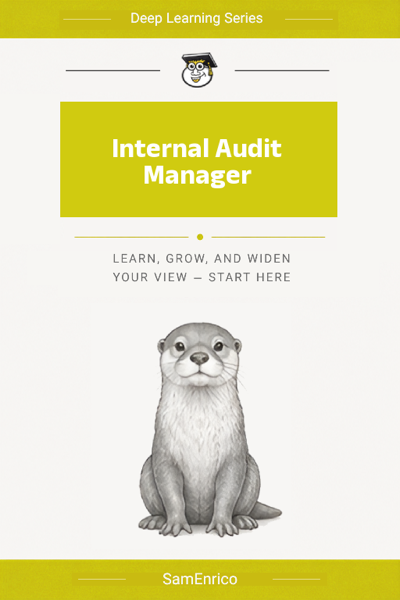
Non-FictionInformativeEducational
Internal Audit Manager eBook
A Coursebook on Internal Audit Manager
A Coursebook on Internal Audit Manager
Formats
Free sample
Chapter 1: The Suit Nobody Trusted--The first time someone refused to make eye contact with you during an exit conference, you told yourself it was just their personality. The second time, you blamed the awkwardness of Zoom. But by the fifth time a process owner leaned back in their chair, crossed their arms, and answered every question with one-word sentences, you knew the truth: they didn’t trust you. Not your team. Not your findings.
Not the hours you’d poured into testing their controls. And the worst part? You couldn’t blame them. Because until that moment, you had been running your internal audit function like a compliance enforcement agency—checking boxes, issuing reports, and wondering why no one seemed grateful for your “help.”If that scene stings with recognition, this chapter is your turning point.The modern internal audit manager faces a crisis that has nothing to do with technical competence and everything to do with perceived value. According to the Institute of Internal Auditors’ 2023 Global Internal Audit Survey, only 42 percent of audit committee members believe their internal audit function delivers strategic insight beyond regulatory compliance.
Fifty-eight percent see internal audit as a cost center—necessary, perhaps, but not essential. That number should terrify you. Because when leadership views your function as a toll booth rather than a navigation system, you lose budget battles, you lose headcount arguments, and you lose the ability to influence before disasters happen.This chapter will rewire how you think about your role. We will trace the seventy-year evolution of internal auditing from clerical error-checker to risk-based assurance provider to—if you do the work—strategic partner. You will learn the difference between independence and objectivity, why your Audit Charter is either your shield or your coffin, and how to navigate the ethical minefields that sink careers.
Most importantly, you will confront a question that most audit managers never ask aloud: Does anyone in your organization actually want you here?By the end of this chapter, you will have a concrete framework for earning credibility—not through louder reports or more aggressive findings, but through the quiet, relentless work of aligning your audit plan with what keeps the CEO awake at night. Let us begin.The Historical Trap: From Clerk to Cop To understand why internal audit managers struggle for relevance, you must first understand how the profession lost its way.In the 1950s and 1960s, internal auditing was largely a clerical function. Teams of accountants manually traced transactions, verified mathematical accuracy, and searched for fraud through brute-force sampling. The typical audit manager rose through the ranks because they could spot a transposition error from across the room. Their value was undeniable but narrow: they prevented small leaks from becoming large holes.The corporate scandals of the 1970s—Penn Central Railroad’s bankruptcy, Equity Funding’s insurance fraud—began to shift expectations.
Boards realized that clerical accuracy did not equal organizational integrity. The Treadway Commission’s 1987 report and the subsequent creation of the Committee of Sponsoring Organizations (COSO) framework pushed internal audit toward risk assessment. By the 1990s, the profession had adopted the language of “risk-based auditing,” and the Institute of Internal Auditors (IIA) codified its International Professional Practices Framework (IPPF).Then came Enron, World Com, Tyco, and the Sarbanes-Oxley Act of 2002.Overnight, internal audit became mandatory for public companies. Section 404 required management and external auditors to certify internal controls over financial reporting. Internal audit functions exploded in size and budget.
Suddenly, audit managers had resources, mandates, and board-level reporting lines. It felt like victory.But victory came with a hidden cost.In the rush to satisfy SOX compliance, internal audit became synonymous with control testing. The profession trained a generation of auditors to ask, “Does this control exist?” rather than, “Is this control the right one?” Audit plans filled with cyclical testing of the same processes year after year. Managers measured success by how many findings they issued—as if counting problems proved value. Process owners learned to dread the audit team not because the team was unfair, but because the team was irrelevant.
They received reports documenting what they already knew, recommending fixes they had already approved, and consuming time they could have spent on actual business problems.You inherited this legacy. The “gotcha” auditor. The compliance cop. The person who shows up, asks for documents, and leaves behind a report that no one reads.The good news is that you also inherited the authority to change it. The IIA’s new Global Internal Audit Standards, released in 2024, explicitly emphasize agility, strategic alignment, and stakeholder value over rote compliance.
The profession is begging for managers who understand that auditing is not an end in itself but a means to organizational effectiveness. Your job is to answer that call.Independence vs. Objectivity: The Two Pillars of Trust Before you can become a strategic partner, you must understand the twin foundations upon which all audit credibility rests. These are not academic distinctions; they are practical constraints that will shape every decision you make.Independence refers to your organizational reporting lines. The IIA Standards require that the chief audit executive (CAE) report functionally to the board, audit committee, or equivalent governing body, and administratively to the CEO.
This means no one in operations can fire you, cut your budget, or kill your findings without board visibility. Independence is structural. It is written into your Audit Charter. It is the reason you can audit the CFO’s department without immediately losing your job.Objectivity, by contrast, is individual and situational. It requires every auditor on your team to make impartial judgments free from conflicts of interest, bias, or undue influence.
Objectivity is tested every time a friendly process owner buys you lunch, every time a powerful executive suggests you “reconsider” a finding, every time you review the work of a colleague you mentored.Here is the distinction that most managers miss: Independence is easier to maintain than objectivity. You can have perfect structural independence—a flawless Audit Charter, a supportive board, no reporting lines to operations—and still lose objectivity because you want to be liked, because you fear retaliation, or because you have convinced yourself that a small compromise today will lead to a larger victory tomorrow.The manager’s job is to protect both.The Two-Question Test for Impaired Objectivity Before you assign any auditor to any engagement, ask yourself these two questions:Does this auditor have a financial, familial, or reputational interest in the outcome of this audit?Would a reasonable observer, knowing all the facts, question this auditor’s ability to judge impartially?If the answer to either question is yes, reassign the engagement. Do not pass go. Do not convince yourself that “it will probably be fine.” Objectivity impairments have a way of surfacing during investigations, depositions, or board presentations—never at convenient moments.Real-World Example A mid-sized technology company assigned a senior auditor to review the procurement department. The auditor’s spouse worked in that department—in a different role, with no direct reporting line to the auditee.
The manager considered the risk low and proceeded. Six months later, the audit found evidence of purchasing card misuse by the spouse’s…
This is the end of the free sample. Get the eBook to keep going. Buy now
About this book
Details
- Author
- Coronado Sharleen
- Publisher
- SamEnrico
- Language
- English
- Genre
- Non-Fiction, Informative, Educational
- Released
- 2026-06-02
- Pages (approx.)
- 151
- Available as
- eBook, Audiobook

Read better in the ZLOADR app
Your eBooks on your phone or tablet. Sign in with your SamEnrico account and start reading.
More by Coronado Sharleen
 Creative Professional EQ GuideCoronado Sharleen$11.99
 Restaurant Empire Immigrant StoryCoronado Sharleen$11.99
 The Julia Roberts? No, Julia ChildCoronado Sharleen$11.99
 Stress Dizziness Vertigo GuideCoronado Sharleen$11.99
 The Sepoy Mutiny: India's Flames of RebellionCoronado Sharleen$11.99
 Learn to Play the Double BassCoronado Sharleen$11.99
 AI for IT Asset ManagementCoronado Sharleen$12.99
 How to Become a Liquid-fertilizer ServicerCoronado Sharleen$11.99
You may also like
 Hong Kong Handover 1997Dunn Johnnie$11.99
 Zumba For Postnatal Recovery CourseNeal Christian$11.99
 Zumba for BeginnersLadner Nikia$11.99
 YouTube Comment Mining GuideHumes Pandora$12.99
 Worry Box MeditationCarlin Rudy$11.99
 Workplace Stress MeditationNguyen Lynn$11.99
 Workplace Stress and Sleep RepairHawley Ivory$11.99
 Workplace Perfectionism CureDelaney Jeffry$11.99
 Workplace Injustice Anger GuideWallen Isabelle$11.99
 Work Addiction and Burnout LinkGreenwood Ester$11.99
 Women in Yoga and WellnessBeattie Galina$11.99
 Women in Stand Up ComedyChun Evangeline$11.99