
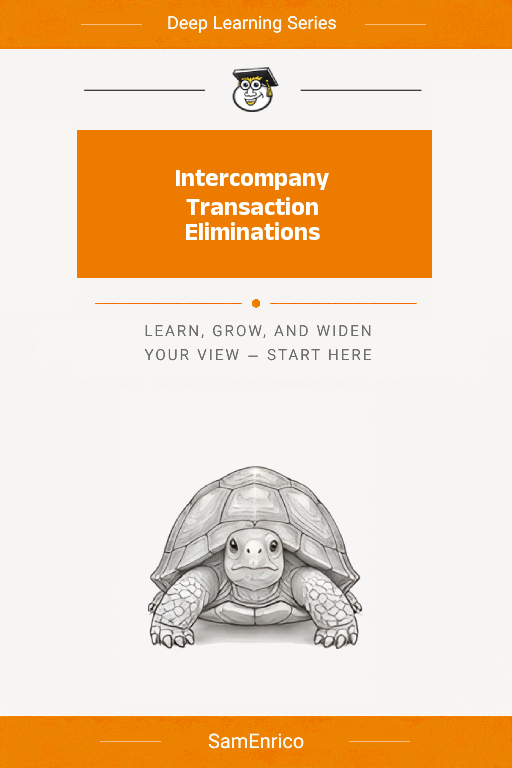
Non-FictionBusiness BriefConsolidation
Intercompany Transaction Eliminations
Automatically match and eliminate intercompany loa
by Donovan Cruz
Automatically match and eliminate intercompany loans, sales, and expenses across multiple small business entities using AI-driven reconciliation rules.
Formats
About this book
Free sample
Chapter 1: The 40% Heist--It was 11:47 PM on the last Friday of the quarter, and Sarah Chen, the controller of a modest seven-entity holding company, had just discovered that her consolidated financial statements showed a glaring 480,000discrepancythatnoonecouldexplain.Theintercompanyloansbetweenthreesubsidiarieshadbeenbookedintwodifferentcurrencies,theinterestaccrualswerecalculatedusingconflictingrates,andsomewhereinthechaos,a480,000 discrepancy that no one could explain. The intercompany loans between three subsidiaries had been booked in two different currencies, the interest accruals were calculated using conflicting rates, and somewhere in the chaos, a 480,000discrepancythatnoonecouldexplain.Theintercompanyloansbetweenthreesubsidiarieshadbeenbookedintwodifferentcurrencies,theinterestaccrualswerecalculatedusingconflictingrates,andsomewhereinthechaos,a120,000 intercompany sale had been recorded twice—once as revenue and once as an asset. Her team had worked sixteen-hour days for two weeks. The auditors were arriving Monday morning. And Sarah was quietly calculating how many more quarters she could survive this before her family forgot what she looked like.Sarah's story is not exceptional.
It is, in fact, painfully ordinary across thousands of multi-entity small and medium businesses. The problem that kept her awake at 11:47 PM—the problem of intercompany transaction eliminations—is one of the most underestimated drains on finance team productivity, the most common source of consolidation errors, and arguably the last great manual frontier in accounting. This chapter will show you why.The Hidden Cost of Growth When your business operates as a single legal entity, consolidation is straightforward. You close the books, run financial statements, and you are done. But growth changes everything.
You add a holding company. You spin off a real estate subsidiary to own your facilities. You create a separate entity for a new product line to manage risk. You acquire a competitor but keep their legal structure intact. Before you know it, you are managing a web of intercompany relationships that would challenge a much larger enterprise.Here is what happens to the accounting close process when you move from one entity to multiple entities.
It does not scale linearly—it scales exponentially. With one entity, intercompany eliminations do not exist. With two entities, you have two directions of potential transactions (A to B, B to A). With three entities, you have six possible transaction pairs. With four entities, twelve pairs.
With five entities, twenty pairs. Every new entity you add does not just add its own transactions—it creates new relationship…
This is the end of the free sample. Get the eBook to keep going. Buy now
Contents
- Chapter 1
- Chapter 2
- Chapter 3
- Chapter 4
- Chapter 5
- Chapter 6
- Chapter 7
- Chapter 8
- Chapter 9
- Chapter 10
- Chapter 11
- Chapter 12
Details
- Author
- Donovan Cruz
- Publisher
- SamEnrico
- Language
- English
- Genre
- Non-Fiction, Business Brief, Consolidation
- Released
- 2026-06-01
- Pages (approx.)
- 160
- Available as
- eBook, Audiobook

Read better in the ZLOADR app
Your eBooks on your phone or tablet. Sign in with your SamEnrico account and start reading.
More by Donovan Cruz
 Ginger Gut Motility GuideDonovan Cruz$11.99
 The Biotech Talent CorridorDonovan Cruz$11.99
 Honoring Hunger Intuitive Eating GuideDonovan Cruz$11.99
 Weekly Review for Journalists ManualDonovan Cruz$11.99
 Elizabeth I Piracy Encouragement Against SpainDonovan Cruz$11.99
 The Last Unknown: Magellan’s Legacy in the 21st CenturyDonovan Cruz$11.99
 Whispers in the Pines: The Vanishing of the Crystal Lake CampersDonovan Cruz$11.99
 Operating Agreement for Foreign OwnersDonovan Cruz$12.99
 Understanding Benzodiazepine OverdoseDonovan Cruz$17.99
 Ocean ViewsDonovan Cruz$11.99
 How to Start a Cyclamates Business (Beginners Guide)Donovan Cruz$11.99
You may also like
 Hong Kong Handover 1997Dunn Johnnie$11.99
 Zumba For Postnatal Recovery CourseNeal Christian$11.99
 Zumba for BeginnersLadner Nikia$11.99
 YouTube Comment Mining GuideHumes Pandora$12.99
 Worry Box MeditationCarlin Rudy$11.99
 Workplace Stress MeditationNguyen Lynn$11.99
 Workplace Stress and Sleep RepairHawley Ivory$11.99
 Workplace Perfectionism CureDelaney Jeffry$11.99
 Workplace Injustice Anger GuideWallen Isabelle$11.99
 Work Addiction and Burnout LinkGreenwood Ester$11.99
 Women in Yoga and WellnessBeattie Galina$11.99
 Women in Stand Up ComedyChun Evangeline$11.99