
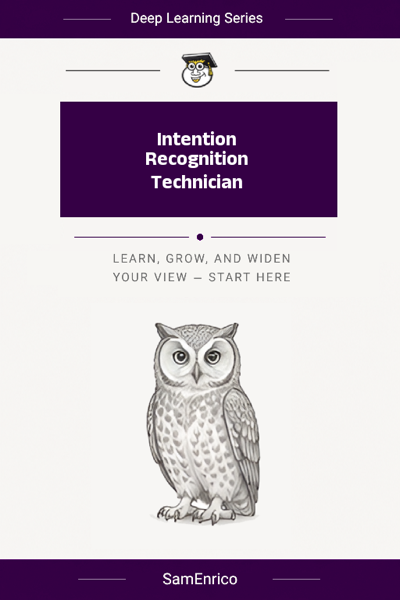
Non-FictionInformativeEducational
Intention Recognition Technician eBook
A Coursebook on Intention Recognition Technician
by Dodd Keven
A Coursebook on Intention Recognition Technician
Formats
Free sample
Chapter 1: The Prediction Shadow--–- Every morning at 7:23 AM, without fail, your phone knows you are about to open your email before your finger touches the screen. Your car knows you are about to change lanes three seconds before you signal. Your thermostat knows you are about to walk through the front door based on the acceleration pattern of your phone in your pocket. You are surrounded by machines that are guessing what you will do next—and most of the time, they are right.This is not magic. This is not mind-reading.
This is intention recognition, and it is the single most important technology you have never heard of.Intention recognition is the science and engineering of inferring what a person means to do from observable signals: the angle of their gaze, the cadence of their speech, the trajectory of their hand, the hesitation before a keystroke. It is the difference between a robot that waits for you to give a command and a robot that hands you a tool because it saw you look at it. It is the difference between a smart home that responds to voice prompts and a smart home that turns on the lights because it detected the characteristic gait of you walking down the hallway at midnight.This book is a coursebook for becoming an Intention Recognition Technician—a professional who designs, builds, calibrates, and ethically deploys systems that infer human goals from behavioral evidence. You will learn to move from raw sensor data to probabilistic predictions, from ambiguous signals to actionable outputs, and from technical accuracy to human trust.But before you can build such a system, you must understand what an intention actually is. And that question—deceptively simple—has occupied philosophers, psychologists, and computer scientists for decades.
In this chapter, we dismantle the common misconception that "intention" is a single, monolithic thing. We will discover that human action is driven by at least two fundamentally different kinds of intention, that the transition between them is a region of rapid change rather than a sharp line, and that the technician's job is not to read minds but to assign probabilities. By the end of this chapter, you will have the conceptual vocabulary that underpins every subsequent chapter in this book.The Two Faces of Intention Consider two scenarios.Scenario A: You are walking across your living room to get a glass of water. You do not think about lifting your left foot, then your right, then balancing your weight, then extending your arm. Your body simply does it.
The movement feels automatic, effortless, almost invisible to your conscious awareness. If someone asked you, "Did you intend to take that step?" you would say yes—but you did not deliberate about it. The intention was there, but it was not something you chose in the moment.Scenario B: You are standing in your kitchen, trying to decide whether to make coffee or tea. You weigh the options: coffee gives you a faster caffeine hit, but tea is gentler on your stomach. You think about the time of day, about whether you have milk, about the fact that you already had two cups of coffee this morning.
After a few seconds of conscious deliberation, you decide: tea. You then walk to the kettle. When someone asks, "Did you intend to make tea?" you say yes—and you can describe the reasoning process that led to that decision.These two scenarios reveal two fundamentally different kinds of intention, first distinguished in the philosophical literature by John Searle and later codified in the seminal MIT Press volume Intentions in Communication (Cohen, Morgan & Pollack, 1990).Intention-in-action (also called motor intention) is the automatic, low-level, goal-directed behavior that guides continuous physical action. It operates below the threshold of conscious deliberation. When you walk, you do not consciously command each muscle fiber.
When you catch a falling glass, your hand moves before you are even aware the glass has slipped. Intention-in-action is the brain's fast, efficient, unconscious planning system. It is what allows you to type without looking at the keyboard, to drive a familiar route while your mind wanders, to reach for a cup without calculating the joint angles of your shoulder, elbow, and wrist.Prior intention (also called deliberative intention) is the high-level, conscious, reflective goal that precedes action. It involves reasoning, weighing alternatives, and making a choice. Prior intention is what you report when someone asks, "What are you trying to do?" It is the plan, the objective, the end goal.
Prior intentions typically activate intention-in-action as their execution mechanism—you decide to make tea (prior intention), and then your motor system automatically handles the reaching, pouring, and lifting (intention-in-action).This distinction is not merely academic. For the intention recognition technician, confusing these two types of intention leads to catastrophic system failures.Consider a robotic surgical assistant that is designed to recognize when a surgeon intends to make an incision. The surgeon's prior intention ("I intend to cut here") is one thing. But the surgeon's intention-in-action—the precise motor plan for moving the scalpel—is another. A system that recognizes the prior intention but misreads the motor intention might hand the scalpel at the wrong angle, or brace the wrong tissue, or move at the wrong speed.
A system that recognizes only the motor intention might miss the crucial context: that the surgeon is hesitating because they are reconsidering the incision point, not because they lack fine motor control.The technician must design systems that can detect both types of intention, and more importantly, detect the relationship between them. When does a prior intention crystallize into intention-in-action? When does automatic behavior become deliberate? These are the questions that define the technician's craft.The Region of Rapid Probability Change Traditional accounts of intention often describe a sharp intentional fork—a discrete moment when a person switches from unconscious routine to conscious choice. You are walking on autopilot, and then suddenly you see a detour sign, and you consciously decide to turn left.
The fork is the instant of decision.This image is seductive but wrong.Decades of research in cognitive neuroscience and behavioral economics have shown that the transition from automatic to deliberate behavior is not a sharp line but a region of rapid probability change—a window of time during which the probability that a person is acting on a prior intention rather than an automatic script rises smoothly from low to high. There is no single millisecond when the switch "flips." Instead, there is a gradual accumulation of evidence, a tipping point that varies from person to person and from context to context.Consider the driver approaching a yellow traffic light. At 200 meters from the intersection, the probability that they intend to stop (prior intention) might be 10%. At 150 meters, 30%. At 100 meters, 60%.
At 50 meters, 90%. There is no moment when you could say, "Now they have decided." The decision is distributed across time and evidence.For the intention recognition technician, this has profound implications. You cannot wait for a "decision moment" because such a moment does not exist. Instead, your system must continuously update a probability distribution over possible intentions as new evidence arrives. At low…
This is the end of the free sample. Get the eBook to keep going. Buy now
About this book
Details
- Author
- Dodd Keven
- Publisher
- SamEnrico
- Language
- English
- Genre
- Non-Fiction, Informative, Educational
- Released
- 2026-06-02
- Pages (approx.)
- 158
- Available as
- eBook, Audiobook

Read better in the ZLOADR app
Your eBooks on your phone or tablet. Sign in with your SamEnrico account and start reading.
More by Dodd Keven
 Keto For Senior Citizens WorkbookDodd Keven$11.99
 The Walking Meditation and ForgivenessDodd Keven$11.99
 Expedition Leader In Congo Nile TrailDodd Keven$11.99
 Carb Backloading GuideDodd Keven$11.99
 The Shadow Over the Olympics: How Crime Writers Exposed 1936's Darkest ScandalDodd Keven$11.99
 How to Become a Able SeamanDodd Keven$11.99
 Lease Classification Test Study GuideDodd Keven$12.99
 How to Produce Camping Cookware and DinnerwareDodd Keven$11.99
You may also like
 Hong Kong Handover 1997Dunn Johnnie$11.99
 Zumba For Postnatal Recovery CourseNeal Christian$11.99
 Zumba for BeginnersLadner Nikia$11.99
 YouTube Comment Mining GuideHumes Pandora$12.99
 Worry Box MeditationCarlin Rudy$11.99
 Workplace Stress MeditationNguyen Lynn$11.99
 Workplace Stress and Sleep RepairHawley Ivory$11.99
 Workplace Perfectionism CureDelaney Jeffry$11.99
 Workplace Injustice Anger GuideWallen Isabelle$11.99
 Work Addiction and Burnout LinkGreenwood Ester$11.99
 Women in Yoga and WellnessBeattie Galina$11.99
 Women in Stand Up ComedyChun Evangeline$11.99