
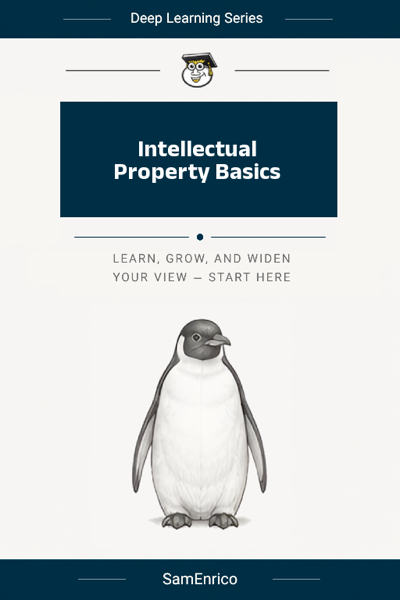
Non-FictionInformativeEducational
Intellectual Property Basics eBook
A Coursebook on Intellectual Property Basics
A Coursebook on Intellectual Property Basics
Formats
Free sample
Chapter 1: The Invisible Fortress...--– Every day, you create property. Not the kind you can lock in a safe or deed in your name at the county recorder’s office. The kind that lives in your mind, flows through your fingers, and exists as nothing more than patterns of information. A recipe your grandmother taught you. A nickname your customers chant.
A software fix you dreamed up at 2 a.m. A photograph you framed just so. These are not things. They are, to the law, intellectual property – and they are, in the modern economy, more valuable than gold, oil, or real estate. Yet most people cannot define them, cannot protect them, and unknowingly give them away every single day.This book is not about law for lawyers.
It is about law for creators, founders, makers, and thinkers. It is about understanding the invisible fortress that surrounds your best ideas – and learning how to build, defend, and monetize that fortress before someone else claims the land for themselves.Why This Chapter Matters Before we dive into patents, trademarks, copyrights, or trade secrets, we must answer a more fundamental question: What is intellectual property, and why does society grant a temporary monopoly over something that doesn't physically exist? The answer is not obvious. In fact, it contradicts how most of us think about ownership. If I steal your car, you no longer have your car.
But if I steal your idea – your song, your logo, your invention – you still have it. So what exactly was stolen? And why should the law intervene?This chapter establishes the conceptual foundation for everything that follows. You will learn:The four distinct species of intellectual property and how to tell them apart The constitutional and economic "grand bargain" that justifies IPWhy trade secrets are the strange exception to nearly every rule The sources of IP law, from statutes to treaties How to spot IP issues in products you encounter daily By the end, you will never look at a can of Coca-Cola, a Nike shoe, or a smartphone the same way again.1.1 Tangible vs. Intangible: The First Great Divide Property law began with land.
You could see it, touch it, fence it, and fight over it. When William the Conqueror compiled the Domesday Book in 1086, he was counting tangible assets – plowlands, oxen, serfs. The law evolved around physical possession. If you had the stronger claim and could prove you were there first, the land was yours.Intellectual property inverts this logic entirely.The Non-Rivalrous Nature of Information Economists describe physical goods as rivalrous – if I consume it, you cannot. Eat an apple; it is gone.
Drive a car; you occupy the seat. Intellectual creations are non-rivalrous. I can sing a song, and you can sing the same song simultaneously. I can write a poem, and a million people can read it without diminishing my copy. This creates a paradox: if information wants to be free (as the digital-age slogan goes), why would anyone pay for it?The answer is that without legal protection, the market for creative and inventive works would collapse.
This is called the public goods problem. Consider a pharmaceutical company that spends $2.6 billion and fifteen years developing a new drug. On the day it launches, a generic manufacturer could reverse-engineer the formula (lawfully, as you will learn in Chapter 2) and sell the identical pill for 90% less, having incurred none of the research costs. Within months, the innovator goes bankrupt. No more new drugs.
Society loses.Intellectual property solves this by creating artificial scarcity. The law says: for a limited time, only you may make, sell, or copy that invention or expression. After that time expires, the work falls into the public domain, where anyone may use it freely. This is not a natural right – like the right not to be physically assaulted. It is a deliberate policy choice, a deal between creators and society.The Fixation Requirement One more distinction matters: intellectual property rights generally require fixation in a tangible medium.
A stunning improvisation at a jazz club, if never recorded or written down, is not protected by copyright. A secret formula scrawled on a napkin, if locked in a safe, becomes a trade secret. A brand name spoken aloud in a focus group, if never used on a product, creates no trademark rights. The law protects the fixed expression of an idea, not the idea itself – a distinction so important that it appears throughout this book.1.2 The Four Pillars of Intellectual Property Every intellectual property falls into one of four categories, each with its own statute, duration, registration requirement, and strategic use case. Think of them as four different tools in a toolbox.
You would not use a hammer to turn a screw. You would not use a trademark to protect an invention.Table 1.1: The Four IP Types at a Glance IP Type What It Protects Duration Registration Required?Source of Law Patent Inventions, processes, designs15-20 years Yes (USPTO)Patent Act (35 U.S.C.)Trademark Brand identifiers (names, logos, sounds)Indefinite (if used)No (but recommended)Lanham Act (15 U.S.C.)Copyright Original expression (books, music, art)Life + 70 years No (but beneficial)Copyright Act (17 U.S.C.)Trade Secret Confidential business information Indefinite (if secret)No DTSA / UTSALet us explore each briefly. Entire chapters later will expand each into full depth.Patents: The Right to Exclude Contrary to popular belief, a patent does not give you the right to make your invention. It gives you the right to exclude others from making, using, selling, or importing it. This subtle distinction matters because your invention might infringe an earlier patent – a phenomenon called "blocking patents." You can patent a new car engine, but if someone else owns the patent on spark plugs, you cannot sell your engine without their permission.Utility patents (Chapter 5) cover what things do – their function, structure, or composition.
Design patents cover how things look. Plant patents cover new varieties of plants reproduced asexually. All require full public disclosure of the invention in exchange for the exclusive right. After the patent expires, anyone may practice the invention. This is the grand bargain in its purest form.Trademarks: The Source Identifier Trademarks protect not inventions but brand identity.
The Nike swoosh, the Mc Donald's golden arches, the sound of the NBC chimes – these are trademarks. Their purpose is to prevent consumer confusion about the source of goods or services. When you buy a Coca-Cola, you want the real recipe, not an imitation. The trademark lets the company sue counterfeiters.Unlike patents, trademarks can last forever – as long as they continue to be used in commerce and do not become generic (think "aspirin," "escalator," or "thermos" – all once trademarks, now common nouns). Registration with the USPTO is optional but provides powerful advantages: nationwide priority, constructive notice to later users, and incontestability after five years.Copyrights: The Expression, Not the Idea Copyright protects original works of authorship fixed in any tangible medium.
This includes novels, songs, photographs, software code, architectural blueprints, and even choreography. What it does not protect – and this is where beginners stumble – is facts, ideas, systems, or methods of operation. You cannot copyright a recipe's list of…
This is the end of the free sample. Get the eBook to keep going. Buy now
About this book
Details
- Author
- Longoria Danita
- Publisher
- SamEnrico
- Language
- English
- Genre
- Non-Fiction, Informative, Educational
- Released
- 2026-05-04
- Pages (approx.)
- 147
- Available as
- eBook, Audiobook

Read better in the ZLOADR app
Your eBooks on your phone or tablet. Sign in with your SamEnrico account and start reading.
More by Longoria Danita
 Migraine and Travel TipsLongoria Danita$11.99
 Contempt Repair Relationship GuideLongoria Danita$11.99
 Handling Interruptions AssertivelyLongoria Danita$11.99
 Punjab Loyalty AnalysisLongoria Danita$11.99
 The Angry Parent VisualizationLongoria Danita$11.99
 Fred Wilson Union SquareLongoria Danita$11.99
 Eisenhower For Law StudentsLongoria Danita$11.99
 Hindsight Bias PreventionLongoria Danita$11.99
 Body Scan EmotionsLongoria Danita$11.99
 The Southern Cross and the Stars: New Zealand's Pioneers of DiscoveryLongoria Danita$11.99
 Love and Ironclads: The Torpedo’s Kiss at JutlandLongoria Danita$11.99
 Fentanyl Frontier: The Deadly Rise of a Shadow EmpireLongoria Danita$11.99
You may also like
 Hong Kong Handover 1997Dunn Johnnie$11.99
 Zumba For Postnatal Recovery CourseNeal Christian$11.99
 Zumba for BeginnersLadner Nikia$11.99
 YouTube Comment Mining GuideHumes Pandora$12.99
 Worry Box MeditationCarlin Rudy$11.99
 Workplace Stress MeditationNguyen Lynn$11.99
 Workplace Stress and Sleep RepairHawley Ivory$11.99
 Workplace Perfectionism CureDelaney Jeffry$11.99
 Workplace Injustice Anger GuideWallen Isabelle$11.99
 Work Addiction and Burnout LinkGreenwood Ester$11.99
 Women in Yoga and WellnessBeattie Galina$11.99
 Women in Stand Up ComedyChun Evangeline$11.99