
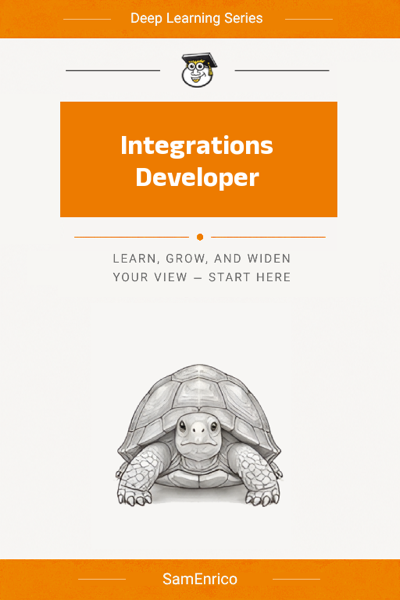
Non-FictionInformativeEducational
Integrations Developer eBook
A Coursebook on Integrations Developer
A Coursebook on Integrations Developer
Formats
Free sample
Chapter 1: The Connector's Burden...--–- The first time an integration broke in production, I was 24 years old, alone in a dark office at 2:47 AM, and wearing a T-shirt that said "It works on my machine." The pager—yes, an actual pager, because some technologies refuse to die—screamed to life on my nightstand. Then my phone buzzed. Then my laptop chimed. Within 90 seconds, every device I owned was shouting at me in different tones, each one a variation on the same urgent message: Something is wrong. Fix it now.I opened my laptop, still half-asleep, and navigated to the dead letter queue.
There they were: 14,327 orders, frozen in digital amber. Each one represented a real customer who had clicked "Purchase" in the last four hours. Each one represented real money that had left a real bank account. And each one was stuck because I had made a single, seemingly harmless assumption three weeks earlier.That assumption was this: "The warehouse system is always available."It was not always available. At 10:00 PM that night, the warehouse team had deployed a routine update.
The update took eight seconds longer than expected. In those eight seconds, our integration—the clever little piece of code I had written to connect the e-commerce frontend to the warehouse backend—received 237 orders. Unable to reach the warehouse, it did what I had programmed it to do: it retried. Every 30 seconds. Forever.By 2:00 AM, the retries had multiplied.
Each failed order spawned a retry. Each retry failed again. The integration was now attempting thousands of calls per second against a system that was still warming up. The warehouse system, now back online, was being crushed by a self-inflicted denial-of-service attack. Every time it processed one request, ten more arrived.
The integration had become its own worst enemy.By 4:00 AM, I had manually cleared the queue, restarted the integration, and written a thousand-line apology email that I never sent. By 8:00 AM, the orders were processing again. By 9:00 AM, the customer service team had issued 237 refunds for orders that had been charged but never acknowledged. By noon, my manager asked me a question that changed my career: "What are you going to do to make sure this never happens again?"I didn't have an answer. But I spent the next decade finding one.This book is that answer.The Invisible Force Integration development is the most important job in modern software that almost no one understands.Think about every digital interaction you had today.
You opened your phone, and your calendar synced with your email. You ordered coffee, and the payment system talked to the loyalty system. You checked your bank balance, and a half-dozen integrations between your bank's core ledger, its mobile app, and third‑party aggregators made that number appear in under two seconds. You worked in a document, and your cloud storage synced across four devices without you thinking about it.None of that works without integrations. None of it.And yet, when was the last time you heard someone say, "I want to grow up to be an integration developer"?
When was the last time a tech conference had a keynote titled "The Beautiful Art of Message Transformation"? When was the last time a coding bootcamp advertised a six‑week course on dead letter queue management?Never. Because integration development is the plumbing of the digital world. It is invisible when it works and catastrophic when it breaks. It is the unsung, unglamorous, absolutely essential work of making computers talk to other computers that were never designed to talk to each other.This book exists to change that.
Not to make integration development glamorous—it will never be that—but to make it teachable, masterable, and reliable. To give you the mental models, practical patterns, and war‑tested strategies that take a decade to learn on your own. To transform you from a developer who occasionally writes integration code into an integration developer—someone who thinks in flows, anticipates failure, and builds systems that survive the 2:47 AM pager.What This Book Is (And What It Is Not)Before we go any further, let me be clear about what you are holding.This book is a practical, vendor‑neutral coursebook. It does not assume you use Mule Soft, Spring Integration, Apache Camel, or any specific platform. The patterns and principles here work across all of them.
When I show code examples, they will be either pseudocode or generic enough to translate to your stack of choice. (If you are using a specific platform, Appendix D contains vendor‑specific tutorials, including Data Weave for Mule Soft and the Salesforce connector ecosystem.)This book is not a reference manual. You will not find an exhaustive catalog of every Enterprise Integration Pattern (though Chapter 4 covers the essential ones). You will not find API documentation for every connector (Chapter 6 gives you the mental framework to learn any connector). You will not find a thousand‑page spec for Open API (Chapter 9 teaches you how to use the spec, not memorize it).This book is a transformation.
It is designed to be read from start to finish, in order. Each chapter builds on the previous ones. The concepts in Chapter 3 (core integration models) assume you understand the mindset from Chapter 1. The implementation details in Chapter 7 assume you know the patterns from Chapter 4. The reliability strategies in Chapter 8 assume you have internalized the failure modes from earlier chapters.This book is also a confession.
Every war story, every cautionary tale, every "never do this" comes from real failures I have caused or witnessed. I have broken production systems in ways you cannot imagine. I have taken down payment gateways, corrupted databases, duplicated millions of records, and once—inexplicably—caused a warehouse robot to print 14,000 shipping labels for the same box of pencils. (The pencils arrived. The customer was confused.
I was mortified.)You will break things too. That is inevitable. But you will break them less often, and when you do, you will know exactly how to fix them.Integration Development vs. Traditional Development To become an integration developer, you must first unlearn some habits that traditional application development rewards.The Traditional Developer's World A traditional application developer lives in a world of control. They control the code.
They control the database schema. They control the deployment environment. When something goes wrong, they can usually trace it to a specific line of code they wrote or a specific dependency they chose.This control creates a certain mindset: deterministic, synchronous, and confident. The traditional developer expects that if they call a function with input X, they will receive output Y. If the database transaction commits, the data is safe.
If the API returns a 200, the operation succeeded.This mindset is not wrong. It is just incomplete. It assumes a world where every system plays by the same rules.The Integration Developer's World An integration developer lives in a world of controlled chaos. They do not control the systems they connect. The e‑commerce platform belongs to one team.
The warehouse system belongs to another. The payment gateway belongs to a third company entirely. Each system has its own assumptions, its own failure modes, its…
This is the end of the free sample. Get the eBook to keep going. Buy now
About this book
Details
- Author
- Mcdonough Vertie
- Publisher
- SamEnrico
- Language
- English
- Genre
- Non-Fiction, Informative, Educational
- Released
- 2026-06-02
- Pages (approx.)
- 159
- Available as
- eBook, Audiobook

Read better in the ZLOADR app
Your eBooks on your phone or tablet. Sign in with your SamEnrico account and start reading.
More by Mcdonough Vertie
 Overland South America Altiplano ExpeditionMcdonough Vertie$11.99
 Low Carb Pasta Alternatives GuideMcdonough Vertie$11.99
 The Walking Meditation and GratitudeMcdonough Vertie$11.99
 Minimalist Muscle BuildingMcdonough Vertie$11.99
 The Golden Debaters: Timbuktu’s Intellectual RenaissanceMcdonough Vertie$11.99
 How to Produce Camping and Hiking EquipmentMcdonough Vertie$11.99
 How to Become a Patch-machine OperatorMcdonough Vertie$11.99
 Derivative Hedge Accounting FormulasMcdonough Vertie$12.99
You may also like
 Hong Kong Handover 1997Dunn Johnnie$11.99
 Zumba For Postnatal Recovery CourseNeal Christian$11.99
 Zumba for BeginnersLadner Nikia$11.99
 YouTube Comment Mining GuideHumes Pandora$12.99
 Worry Box MeditationCarlin Rudy$11.99
 Workplace Stress MeditationNguyen Lynn$11.99
 Workplace Stress and Sleep RepairHawley Ivory$11.99
 Workplace Perfectionism CureDelaney Jeffry$11.99
 Workplace Injustice Anger GuideWallen Isabelle$11.99
 Work Addiction and Burnout LinkGreenwood Ester$11.99
 Women in Yoga and WellnessBeattie Galina$11.99
 Women in Stand Up ComedyChun Evangeline$11.99