
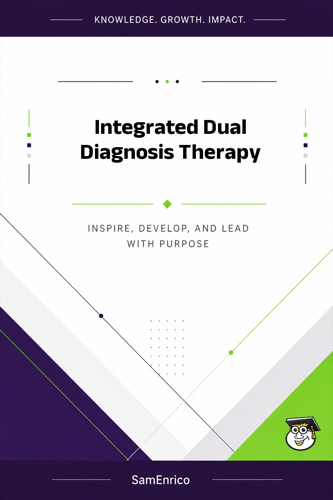
Non-FictionHealth & WellnessIDDT
Integrated Dual Diagnosis Therapy
Use IDDT model combining CBT and motivational inte
Use IDDT model combining CBT and motivational interviewing.
Formats
About this book
Free sample
Chapter 1: The Revolving Door...--The first time Sarah was discharged from a psychiatric hospital, her clinical team celebrated her stability. Her antipsychotic medication had been adjusted, her mood was euthymic, and she denied any suicidal ideation. She was handed a prescription, a follow-up appointment with a community mental health center in six weeks, and a laminated card with a crisis hotline number. What she was not handed was any meaningful discussion about the half-bottle of vodka she had consumed nightly for the preceding eighteen months. When her psychiatrist had asked about alcohol use during the discharge planning meeting, Sarah had said, “I only drink to sleep,” and the note in her chart read: “Denies substance use disorder.
Rule out primary mood disorder.”Forty-seven days later, Sarah was back in the same emergency department. She had stopped taking her medication because, as she later told an intake coordinator, “The pills made my mouth dry and the voices came back anyway after I’d been drinking.” She had lost her apartment after spending her rent money on vodka. She was paranoid, dehydrated, and testing positive for both alcohol and cocaine. The admitting psychiatrist wrote a new note: “Substance-induced psychotic disorder. Will refer to detox after stabilization.”Sarah’s story is not unusual.
It is, in fact, a near-perfect replication of a clinical pattern that has been documented in thousands of case files across every developed nation. The pattern has a name: the revolving door. Patients enter acute care, stabilize, discharge, decompensate, and return. The interval between admissions often shrinks over time. The cost—in human suffering, family trauma, and public expenditure—is staggering.
And yet, for decades, the mental health and addiction treatment systems have continued to operate as if these two conditions exist in separate universes, despite overwhelming evidence that they are almost always entwined.This chapter begins with a difficult truth that most clinicians already suspect but few have been empowered to act upon: the traditional model of parallel treatment—mental health care here, addiction care there—does not work for patients with co-occurring disorders. Worse, it actively harms them. The evidence is…
This is the end of the free sample. Get the eBook to keep going. Buy now
Contents
- Chapter 1
- Chapter 2
- Chapter 3
- Chapter 4
- Chapter 5
- Chapter 6
- Chapter 7
- Chapter 8
- Chapter 9
- Chapter 10
- Chapter 11
- Chapter 12
Details
- Author
- Mccorkle Candy
- Publisher
- SamEnrico
- Language
- English
- Genre
- Non-Fiction, Health & Wellness, IDDT
- Released
- 2026-06-06
- Pages (approx.)
- 151
- Available as
- eBook, Audiobook

Read better in the ZLOADR app
Your eBooks on your phone or tablet. Sign in with your SamEnrico account and start reading.
More by Mccorkle Candy
 International Franchise Whistleblower PolicyMccorkle Candy$11.99
 Anger Management for ChefsMccorkle Candy$11.99
 Sports Nutrition for CyclistsMccorkle Candy$11.99
 The Self Hypnosis for Decision AnxietyMccorkle Candy$11.99
 Understanding Rudiger SyndromeMccorkle Candy$17.99
 Joint Ventures and CTAMccorkle Candy$12.99
 Factoring for Small BusinessesMccorkle Candy$12.99
 NordVPN Privacy and Security BasicsMccorkle Candy$11.99
 How to Become a StamperMccorkle Candy$11.99
You may also like
 Hong Kong Handover 1997Dunn Johnnie$11.99
 Zumba For Postnatal Recovery CourseNeal Christian$11.99
 Zumba for BeginnersLadner Nikia$11.99
 YouTube Comment Mining GuideHumes Pandora$12.99
 Worry Box MeditationCarlin Rudy$11.99
 Workplace Stress MeditationNguyen Lynn$11.99
 Workplace Stress and Sleep RepairHawley Ivory$11.99
 Workplace Perfectionism CureDelaney Jeffry$11.99
 Workplace Injustice Anger GuideWallen Isabelle$11.99
 Work Addiction and Burnout LinkGreenwood Ester$11.99
 Women in Yoga and WellnessBeattie Galina$11.99
 Women in Stand Up ComedyChun Evangeline$11.99