
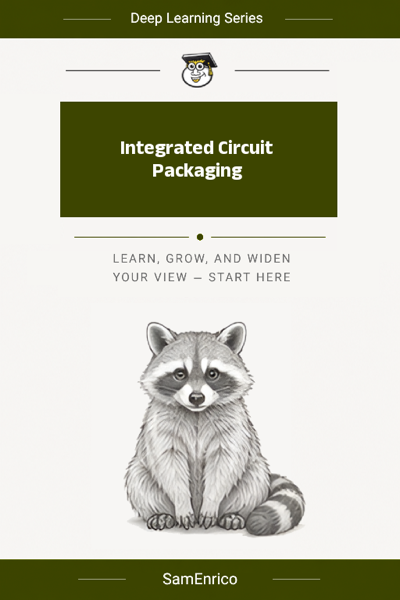
Non-FictionInformativeEducational
Integrated Circuit Packaging eBook
A Coursebook on Integrated Circuit Packaging
by Wooten Ike
A Coursebook on Integrated Circuit Packaging
Formats
Free sample
Chapter 1: The Silent Giant...--– The most important part of your smartphone, your AI computer, and your self-driving car is the part you have never seen, cannot see, and were never meant to see. It sits hidden beneath a dull, metallic lid or a black epoxy blob, doing work that is simultaneously mundane and miraculous. This invisible engine does not perform calculations like the silicon chip it protects, nor does it store data like the memory chips it connects. Instead, it performs a role so fundamental, so utterly essential, that without it, the billion-transistor wonder at its heart becomes nothing more than an exquisitely fragile grain of sand. This is the integrated circuit package, and for decades, it was treated as an afterthought—the "plastic and pins" that you tolerated to get to the real electronics.
Those days are over.We have entered the era of "More than Moore," a phrase that sounds like marketing jargon but describes a profound shift in the very architecture of computation. For fifty years, the engine of progress was transistor scaling, famously codified as Moore's Law. Make the transistor smaller, pack more of them onto a slice of silicon, and the world became faster, cheaper, and more powerful. That engine is sputtering. Not stopping, but slowing.
The physical limits of atomic-scale silicon are no longer a distant theoretical concern; they are a daily constraint in every semiconductor fab on Earth. And yet, the demand for computing performance has not slowed. It has exploded. Artificial intelligence models double in size every few months. Data centers consume power at the scale of small countries.
Your phone contains more computing power than a supercomputer from two decades ago, but you expect it to be thinner, cooler, and last all day on a battery.How is this possible? The answer, increasingly, is not in the chip alone, but in how chips are connected, stacked, cooled, and shielded. The answer is packaging.This chapter makes a simple but radical argument: packaging is no longer the cabling; it is the motherboard for the age of heterogeneous integration. To understand modern electronics, you must understand the four functions of a package, the hierarchy of connections from silicon to system, the historical arc that transformed packaging from a passive container into an active enabler, and the market forces—AI, chiplets, and global supply chains—that have pushed packaging to the center of the semiconductor industry. By the end of this chapter, you will never look at a black box on a circuit board the same way again.1.1 The Four Non-Negotiable Functions of Any Package Every integrated circuit package, from the simplest DIP (Dual In-line Package) in a child's toy to the most advanced 3D-stacked module in an AI accelerator, must perform four fundamental functions.
If any one of these fails, the entire electronic system fails. These functions are not optional features; they are the irreducible minimum for taking a bare silicon die—a sliver of crystalline material that is chemically reactive, mechanically fragile, and thermally sensitive—and turning it into a reliable component that can be manufactured, shipped, and used by billions of people.Function One: Power Distribution A modern microprocessor contains billions of transistors that do nothing until they receive electrical power. This power must be delivered from the voltage regulator on the circuit board, through the package, and into every corner of the die with extremely low loss and extremely stable voltage. The package, therefore, contains a power distribution network (PDN)—a mesh of planes, traces, and vias dedicated to carrying current. This network must accomplish three things simultaneously.
First, it must provide a low-resistance path; any resistance creates an IR drop, reducing the voltage available to the transistors and wasting power as heat. Second, it must maintain a stable voltage despite the wildly fluctuating current demands of a chip that can go from idle to maximum load in nanoseconds; this requires low inductance, which is why power and ground are often delivered through large parallel planes rather than thin traces. Third, it must isolate the power delivery from the signal lines; a noisy power plane can ruin signal integrity. A poorly designed package can starve a perfectly good chip of the power it needs, causing timing failures, logic errors, and premature aging. The power distribution function is the first and most demanding of the package's jobs.Function Two: Signal Distribution The chip must communicate with the rest of the world.
It sends data, addresses, and control signals to memory, to other processors, to input-output devices. These signals travel through the package from the tiny pads on the die—now often less than 50 micrometers apart—to the larger, more robust connections on the circuit board. The signal distribution network must preserve the integrity of those signals as they traverse a complex landscape of copper traces, vias, and solder joints. At low frequencies (think kilohertz), preserving signal integrity is trivial; the package behaves like a simple bundle of wires. At high frequencies (gigahertz and above, which is the realm of modern smartphones, GPUs, and network processors), the package behaves like a transmission line with reflections, crosstalk, and losses.
Every discontinuity in the signal path—a via that changes layers, a corner that is too sharp, a mismatch in impedance—can reflect part of the signal back toward the source, corrupting the intended transmission. Worse, signals can couple electromagnetically to neighboring lines, a phenomenon called crosstalk, where a transition on one wire induces spurious voltage on another. The signal distribution function requires careful engineering of trace geometry, material selection, and termination strategies. A poorly designed signal network can make a perfectly functional chip appear to be randomly failing at speed.Function Three: Heat Dissipation Here is an uncomfortable truth about modern electronics: most of the energy they consume becomes heat. A high-performance processor drawing 300 watts of electrical power dissipates essentially 300 watts of thermal power.
That heat is generated in a silicon die smaller than a fingernail. The resulting heat flux—watts per square centimeter—exceeds that of a kitchen stove burner. Without a path to remove that heat, the die temperature would rise catastrophically. Silicon begins to leak excessive current around 125°C. Solder joints start to creep and fail above 150°C.
At 200°C, most organic packages will delaminate or char. The package's heat dissipation function provides a thermal conduit from the hot spots on the die to a larger surface area—a heat spreader, a heatsink, or the ambient air. This conduit includes the die attach material, the bulk of the package substrate or leadframe, and any thermal interface materials placed between the package and an external cooler. The thermal resistance of this path is measured in degrees Celsius per watt (Θja, Θjc, concepts detailed fully in Chapter 2). The lower the thermal resistance, the cooler the die runs for a given power.
As chips consume more power and become smaller, thermal management has shifted from a secondary consideration to a primary constraint that dictates the maximum performance a package can enable.Function Four: Protection and Isolation The bare silicon die is a marvel of precision engineering, but it is also exquisitely vulnerable. Silicon is a brittle material; a microscopic crack can propagate through…
This is the end of the free sample. Get the eBook to keep going. Buy now
About this book
Details
- Author
- Wooten Ike
- Publisher
- SamEnrico
- Language
- English
- Genre
- Non-Fiction, Informative, Educational
- Released
- 2026-05-04
- Pages (approx.)
- 159
- Available as
- eBook, Audiobook

Read better in the ZLOADR app
Your eBooks on your phone or tablet. Sign in with your SamEnrico account and start reading.
More by Wooten Ike
 Dream Sound JournalWooten Ike$11.99
 Values And Mission Alignment Annual ReportWooten Ike$11.99
 Shopping Addiction And Social Media HandbookWooten Ike$11.99
 Mindful Chores MeditationWooten Ike$11.99
 Binge Eating and Social IsolationWooten Ike$11.99
 The Piltdown Hoax: Britain’s Greatest Scientific Deception (1912-1953)Wooten Ike$11.99
 Lights, Camera, Revolution: How a Silent Film Sparked a Global UprisingWooten Ike$11.99
 Understanding Congenital Adrenal HyperplasiaWooten Ike$17.99
 Healthcare Access StudentsWooten Ike$12.99
 Community Based Marketing GuideWooten Ike$12.99
 How to Start a Mouldings Made of Magnesite Business (Beginners Guide)Wooten Ike$11.99
You may also like
 Hong Kong Handover 1997Dunn Johnnie$11.99
 Zumba For Postnatal Recovery CourseNeal Christian$11.99
 Zumba for BeginnersLadner Nikia$11.99
 YouTube Comment Mining GuideHumes Pandora$12.99
 Worry Box MeditationCarlin Rudy$11.99
 Workplace Stress MeditationNguyen Lynn$11.99
 Workplace Stress and Sleep RepairHawley Ivory$11.99
 Workplace Perfectionism CureDelaney Jeffry$11.99
 Workplace Injustice Anger GuideWallen Isabelle$11.99
 Work Addiction and Burnout LinkGreenwood Ester$11.99
 Women in Yoga and WellnessBeattie Galina$11.99
 Women in Stand Up ComedyChun Evangeline$11.99