
Non-FictionInformativeEducational
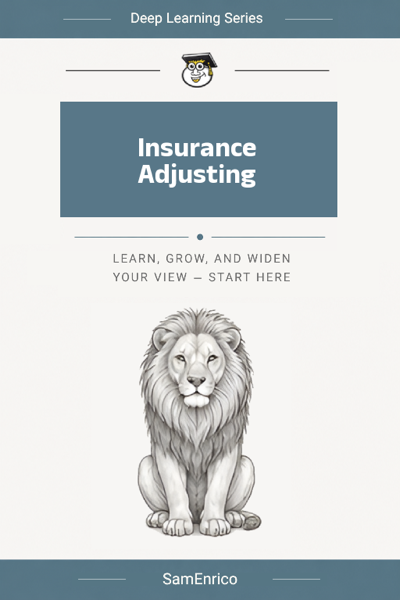
Insurance Adjusting eBook
A Coursebook on Insurance Adjusting
A Coursebook on Insurance Adjusting
Formats
Free sample
Chapter 1: The Restorer’s Mandate--–- The telephone rings at 2:47 on a Tuesday afternoon. On the other end is a stranger whose house just caught fire, whose car was just demolished by a distracted driver, or whose business is now underwater from a burst sprinkler main. Their voice may be shaking, angry, or confused. They may be weeping. They may be lying.
Your job, starting in that very first second of contact, is not merely to process a claim. Your job is to become a professional restorer of financial stability—to return this stranger, as nearly as possible, to the exact economic position they occupied before the world tilted sideways.This is the restorer’s mandate. It is the foundational promise of insurance adjusting, and it rests on a single ancient principle: indemnity. The word comes from the Latin indemnis, meaning “unhurt” or “without loss.” In insurance, indemnity means that after a covered loss, the insured should be neither enriched nor impoverished by the claim. They should stand where they stood before—no better, no worse.
Every decision you make, every dollar you authorize, every denial you issue must be measured against this principle. It sounds simple. It is, in practice, one of the most demanding professional disciplines in commerce.The great misunderstanding about adjusting is that it is about paying claims. It is not. Paying claims is merely the mechanical end of a much deeper process.
Adjusting is about determining, through investigation, contract interpretation, and negotiation, what indemnity actually requires in a specific situation. A roof that was thirty years old and poorly maintained is not worth the same as a roof installed last month. A claimant who ignored a doctor’s advice and worsened their own injury is not entitled to the same damages as someone who diligently pursued treatment. An insured who concealed a pre-existing foundation crack cannot claim the full cost of a new foundation after a minor earthquake. The adjuster’s job is to separate legitimate restoration from opportunistic enrichment.This chapter establishes the intellectual and professional framework for everything that follows.
It answers three fundamental questions: What does an adjuster actually do? Who are the different types of adjusters, and how do their roles and loyalties differ? What are the non-negotiable ethical and legal boundaries within which every adjuster must operate? And finally—critically—how does an adjuster navigate the apparent contradiction between compassionate service and skeptical investigation? The answer to that last question lies in a framework called the Spectrum of Inquiry, which will guide your posture from first notice of loss to final settlement.By the end of this chapter, you will understand that adjusting is not a mechanical trade.
It is a profession requiring legal knowledge, investigative skill, emotional intelligence, and moral courage. It is also, for those who master it, one of the most stable and remunerative careers in the insurance ecosystem.The Three Pillars of Every Claim Every claim that crosses your desk, regardless of whether it involves a burned restaurant, a fender bender, or a stolen laptop, can be reduced to three fundamental questions. These are the Three Pillars of adjusting. If you answer them correctly and completely, you will resolve the claim properly. If you miss one, you will make a mistake—and mistakes in adjusting can cost carriers millions and expose adjusters to bad faith lawsuits.Pillar One: Coverage.
Does the policy actually insure this loss? This question requires you to read the policy as a lawyer would. You must examine the Declarations page to confirm the named insured, policy period, and limits. You must review the Insuring Agreement to understand what perils are covered. You must scrutinize the Exclusions to see what is carved out.
You must check Endorsements for modifications. Coverage analysis is not a casual glance; it is a disciplined legal exercise. A denied claim based on a misreading of an exclusion is a bad faith claim waiting to happen. A paid claim that should have been denied is a loss the carrier never should have sustained.Pillar Two: Liability. If the claim involves a third party—someone alleging that your insured caused them harm—who is legally at fault?
Liability is determined by tort law, specifically the law of negligence. To establish negligence, four elements must be proven: duty (the defendant owed a legal obligation to act reasonably), breach (the defendant failed to meet that duty), causation (the breach directly caused the harm), and damages (actual measurable loss occurred). Your job as an adjuster is to investigate the facts and assess whether these elements are present. You are not a judge or jury, but your assessment will determine whether you offer a settlement, deny the claim, or defend your insured in litigation.Pillar Three: Damages. Assuming coverage exists and liability is established (or the claim is first-party, where no liability dispute exists), what is the proper monetary value of the loss?
Damages valuation is part art and part science. For property losses, you must distinguish between Actual Cash Value (replacement cost minus depreciation) and Replacement Cost Value (full cost to repair or replace). For bodily injury, you must calculate specials (medical bills, lost wages) and generals (pain and suffering, loss of consortium). For time element losses like business interruption, you must determine lost profits and ongoing expenses. The Three Pillars are not sequential in a rigid sense; they often interact.
A coverage question may affect liability. A damages calculation may reveal a coverage issue. But you cannot properly evaluate any claim without explicitly considering all three.The Four Roles in the Adjusting Arena The insurance industry deploys adjusters in several distinct capacities, each with different loyalties, compensation structures, and legal obligations. Understanding these roles is essential both for choosing your career path and for recognizing the interests of the other adjusters you will encounter across the negotiation table.Staff Adjusters. A staff adjuster is a direct employee of an insurance company.
They receive a salary or hourly wage, benefits, and often a company vehicle. Their loyalty is exclusively to their employer—the carrier that signs their paycheck. Staff adjusters handle claims only for that carrier. They work within the carrier’s claims manual, use the carrier’s software, and are evaluated on metrics such as cycle time, customer satisfaction, and accuracy of reserves. The advantage of being a staff adjuster is stability: predictable income, benefits, training, and career progression.
The disadvantage is that you are a single-company person; your fate rises and falls with that carrier’s fortunes. Most staff adjusters work from a regional office or from home, handling a territorial assignment of claims that come in daily.Independent Adjusters. An independent adjuster is a contractor, not an employee. They are typically licensed individuals who own their own business or work for an independent adjusting firm. Carriers hire independent adjusters on a per-claim or per-catastrophe basis, paying a fee per claim or a daily rate.
During normal times, independents might handle daily claims for multiple carriers. During catastrophes—hurricanes, wildfires, tornadoes—the demand for independents explodes. Catastrophe adjusters, often called “CAT adjusters,” travel constantly, living in hotels and working sixteen-hour days for weeks at a time, earning substantial income in concentrated bursts. The…
This is the end of the free sample. Get the eBook to keep going. Buy now
About this book
Details
- Author
- Mulligan Maryanne
- Publisher
- SamEnrico
- Language
- English
- Genre
- Non-Fiction, Informative, Educational
- Released
- 2026-05-04
- Pages (approx.)
- 149
- Available as
- eBook, Audiobook

Read better in the ZLOADR app
Your eBooks on your phone or tablet. Sign in with your SamEnrico account and start reading.
More by Mulligan Maryanne
 TM Brain IntegrationMulligan Maryanne$11.99
 Resentment Journal WorkbookMulligan Maryanne$11.99
 Satanism And The Night StalkerMulligan Maryanne$11.99
 MAT Stigma for Healthcare WorkersMulligan Maryanne$11.99
 Praise Assimilation for Self DoubtMulligan Maryanne$11.99
 The Last Guardian: Unraveling the Mystery of the 1971 Guardians of the GalaxyMulligan Maryanne$11.99
 The Enigma of Fermat's Last Theorem: A 358-Year ChaseMulligan Maryanne$11.99
 How to Start a Cartoonists Business (Beginners Guide)Mulligan Maryanne$11.99
 UN P Level Jobs GuideMulligan Maryanne$12.99
 Lease Arbitration COVID UpdateMulligan Maryanne$12.99
 Understanding CraniostenosisMulligan Maryanne$17.99
You may also like
 Hong Kong Handover 1997Dunn Johnnie$11.99
 Zumba For Postnatal Recovery CourseNeal Christian$11.99
 Zumba for BeginnersLadner Nikia$11.99
 YouTube Comment Mining GuideHumes Pandora$12.99
 Worry Box MeditationCarlin Rudy$11.99
 Workplace Stress MeditationNguyen Lynn$11.99
 Workplace Stress and Sleep RepairHawley Ivory$11.99
 Workplace Perfectionism CureDelaney Jeffry$11.99
 Workplace Injustice Anger GuideWallen Isabelle$11.99
 Work Addiction and Burnout LinkGreenwood Ester$11.99
 Women in Yoga and WellnessBeattie Galina$11.99
 Women in Stand Up ComedyChun Evangeline$11.99