
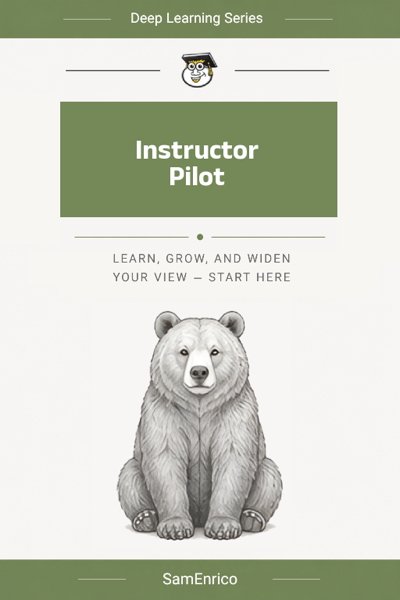
Non-FictionInformativeEducational
Instructor Pilot eBook
A Coursebook on Instructor Pilot
A Coursebook on Instructor Pilot
Formats
Free sample
Chapter 1: The Right Seat Lie...--–- The first lie they tell you in flight school is that the right seat is just the left seat mirrored. It is not. The controls are the same, yes—the yoke still pitches and rolls, the rudder pedals still yaw, the throttle still adds power—but everything else changes. The sight picture is wrong. The student's fear fills the cabin like smoke.
The weight of another human's life shifts from abstract to immediate the first time you watch a seventeen-year-old freeze on short final, hands locked, eyes wide, and realize that if you do not act in the next two seconds, both of you will die. That is the moment you stop being a pilot and start being an instructor. No checkride prepares you for it. No oral exam asks, "What do you do when your student's brain shuts off at fifty feet?" But every instructor faces it. This chapter is about why the FAA's version of flight instruction—the one with lesson plans and endorsements and practical test standards—is necessary but insufficient.
The regulations keep you legal. They do not keep you alive. And they certainly do not prepare you for the right seat lie: the belief that teaching flying is simply flying while talking. It is not. It is a separate skill set, a separate mindset, and a separate legal reality.
Most new Certified Flight Instructors (CFIs) learn this the hard way—usually in the air, usually with a student who just made a mistake that could have killed them. This book exists to ensure you learn it on the ground first.The Myth of the Natural Instructor Every pilot has met the archetype: the CFI who makes it look effortless. They never raise their voice. Their students solo on time, pass checkrides on the first attempt, and seem to emerge from the right seat with the same easy confidence they had going in. Observing them, a new instructor might think, I just need to fly like that.
I just need more hours in the right seat. This is a trap. What you are seeing is not refined flying skills. It is refined teaching skills—skills that have nothing to do with how smoothly you execute a Chandelle or how precisely you hold an altitude. The most technically perfect pilot in the world can be a disastrous instructor if they cannot translate their expertise into someone else's understanding.
Conversely, a pilot of merely competent stick-and-rudder skills can become an extraordinary instructor by mastering the human side of the cockpit.The myth of the natural instructor persists because the FAA's certification process inadvertently reinforces it. The Fundamentals of Instruction (FOI) test is multiple-choice. You can memorize the laws of learning, the domains of learning, and the defense mechanisms without ever applying them to a live, sweating, terrified student. The CFI practical exam tests whether you can present a lesson—not whether you can adapt one when your student's eyes glaze over at the third slide of your carefully prepared Power Point. The system produces instructors who know the theory of teaching but have never practiced the art.This chapter dismantles the right seat lie by establishing three foundational truths that the rest of this book will build upon.
First, the instructor pilot is a distinct professional category, with legal and ethical obligations that exceed those of a commercial pilot. Second, the instructor's primary tool is not the yoke—it is the debrief. And third, the instructor's greatest liability is not a lawsuit (though that is real); it is the silent, accumulating weight of signing off students who were not ready.The Instructor Pilot as a Legal Category Certificates and Ratings: What the Paper Actually Says Before you can teach, you must be certificated. The FAA offers two main instructional certificates: the Certificated Flight Instructor (CFI) and the Ground Instructor (GI). The CFI allows you to teach in an aircraft; the GI limits you to ground instruction only.
Within the CFI certificate, ratings are attached to specific categories and classes: Airplane Single-Engine Land (ASEL), Airplane Multi-Engine Land (AMEL), Instrument, Glider, Helicopter, and so on. You cannot teach what you are not rated to teach. This sounds obvious, but the number of instructors who have given "familiarization flights" in aircraft they were not technically authorized to instruct in would surprise you. The FAA takes this seriously. Violations have resulted in emergency certificate revocation.The path to the CFI certificate is deliberately demanding.
You must hold at least a Commercial Pilot certificate with an instrument rating in the category you wish to teach. You must pass the Fundamentals of Instruction (FOI) knowledge test, which covers the psychology of learning, the teaching process, assessment techniques, and instructor responsibilities. You must pass a second knowledge test specific to your instructor rating (e.g., Flight Instructor Airplane). And you must pass a practical exam that includes both ground instruction and flight instruction maneuvers. The pass rate for initial CFI applicants hovers around 70-75%—significantly lower than the private pilot checkride.
That is by design. The FAA wants the gatekeepers to be thoroughly tested.The Two Types of Instructor Authority Once certificated, you have two distinct types of authority. The first is instructional authority: the right to provide training for which you charge compensation. This is what most people think of when they imagine a CFI. The second, and more consequential, is endorsement authority: the right to sign logbooks and student pilot certificates in ways that grant legal privileges.
A student cannot solo without your endorsement. They cannot take the knowledge test without your endorsement. They cannot take the practical test without your endorsement. Each signature is a legal certification that the student has met specific regulatory requirements. Signing without ensuring those requirements are met is not a mistake.
It is a regulatory violation that can cost you your certificate.The endorsements are not optional. They are not courtesies. They are the legal mechanism by which the FAA delegates its examination authority to you, the instructor. The FAA trusts you to be its eyes and ears in the cockpit. When you sign a student off for their private pilot checkride, you are telling the Designated Pilot Examiner (DPE) that this student has demonstrated, to your professional satisfaction, mastery of every Task in the Airman Certification Standards (ACS).
If the DPE discovers the student cannot perform a power-off stall to standard, the DPE will not simply fail the student. They will ask to see your logbook endorsement. And they will wonder why you signed off a pilot who was not ready.The IACRA Walkthrough: Your First Test of Patience The Integrated Airman Certification and Rating Application (IACRA) is the FAA's online system for processing certificates and ratings. It is also the first true test of an instructor's patience. The system is not intuitive.
It times out aggressively. It requires applicants to create accounts, verify email addresses, and answer security questions that they will inevitably forget by the practical exam date. Your job as the instructor is to guide students through this process without losing your mind or your temper.The IACRA workflow for a typical private pilot applicant follows a…
This is the end of the free sample. Get the eBook to keep going. Buy now
About this book
Details
- Author
- Mccullough Gregoria
- Publisher
- SamEnrico
- Language
- English
- Genre
- Non-Fiction, Informative, Educational
- Released
- 2026-05-08
- Pages (approx.)
- 121
- Available as
- eBook, Audiobook

Read better in the ZLOADR app
Your eBooks on your phone or tablet. Sign in with your SamEnrico account and start reading.
More by Mccullough Gregoria
 Behind the MicMccullough Gregoria$11.99
 Lab Research Pressure Management HandbookMccullough Gregoria$11.99
 401k Default Investment GuideMccullough Gregoria$11.99
 Loving Kindness for First Responder PTSIMccullough Gregoria$11.99
 Honking and Gesture Control GuideMccullough Gregoria$11.99
 Riot of the Unseen: The Forgotten Uprising of 1863Mccullough Gregoria$11.99Riot of the Unseen: The Forgotten Uprising of 1863Mccullough Gregoria$11.99
 Understanding Neural Crest TumorMccullough Gregoria$17.99
 Excel Economics Formula BuilderMccullough Gregoria$12.99
 Alibaba Retail SWOTMccullough Gregoria$12.99
 How to Become a Lay-out Worker IiMccullough Gregoria$11.99
You may also like
 Hong Kong Handover 1997Dunn Johnnie$11.99
 Zumba For Postnatal Recovery CourseNeal Christian$11.99
 Zumba for BeginnersLadner Nikia$11.99
 YouTube Comment Mining GuideHumes Pandora$12.99
 Worry Box MeditationCarlin Rudy$11.99
 Workplace Stress MeditationNguyen Lynn$11.99
 Workplace Stress and Sleep RepairHawley Ivory$11.99
 Workplace Perfectionism CureDelaney Jeffry$11.99
 Workplace Injustice Anger GuideWallen Isabelle$11.99
 Work Addiction and Burnout LinkGreenwood Ester$11.99
 Women in Yoga and WellnessBeattie Galina$11.99
 Women in Stand Up ComedyChun Evangeline$11.99