
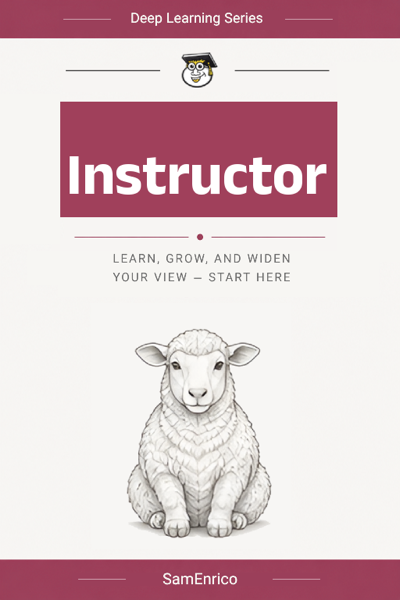
Non-FictionInformativeEducational
Instructor eBook
A Coursebook on Instructor
A Coursebook on Instructor
Formats
Free sample
Chapter 1: The Great Lie…--– You have been lied to. Not maliciously, not conspiratorially, but lied to nonetheless. The lie has been repeated so often, by so many well-intentioned experts, that it has become indistinguishable from common sense. Here it is: If you explain something clearly, with enthusiasm and good slides, your students will learn it.This is the operating assumption of almost every classroom, training room, and lecture hall on the planet. It is the reason instructors spend hours perfecting their Power Point presentations, rehearsing their jokes, and polishing their analogies.
It is the reason teaching evaluations focus on “clarity of explanation” and “instructor enthusiasm.” And it is almost completely wrong.The truth is both simpler and more brutal: Clear explanation produces the illusion of learning, not learning itself. Your students can nod along, laugh at your jokes, write down your elegant bullet points, and then walk out of the room having retained almost nothing of lasting value. Twenty-four hours later, they will remember perhaps thirty percent of what you said. A week later, ten percent. A month later, they will look at their notes and wonder if they ever attended the session at all.This is not a failure of your talent, your effort, or your charisma.
It is a failure of your model of teaching. You have been operating under a model that treats the human brain as a recording device—empty, passive, and ready to accept whatever is transmitted into it. But the human brain is not a recording device. It is a prediction engine that actively filters, discards, and forgets almost everything that does not meet specific, demanding criteria. If you want your teaching to produce durable, transferable learning—learning that changes what your students can do, not just what they can recognize—you must stop being a performer and start being something else entirely.This chapter is about that transformation.
It is about dismantling the performance model of teaching that dominates our culture and replacing it with a different identity, a different set of questions, and a different measure of success. By the end of this chapter, you will understand why the traditional lecture is one of the least effective instructional methods ever devised, why “covering content” is a trap, and what it really means to engineer learning rather than simply deliver instruction. You will also meet the core framework that will guide every chapter of this book: the shift from “sage on the stage” to learning engineer.The Most Dangerous Word in Teaching: “Cover”Let us begin with an experiment. Imagine two instructors preparing for the same class session. The first instructor, Maria, opens her lesson plan and writes: “Today I will cover Chapter 4: The Principles of Supply and Demand.
I will explain the law of demand, the law of supply, the concept of equilibrium, and the effects of price ceilings and floors. I will use five real-world examples and a fifteen-minute video.”The second instructor, James, opens his lesson plan and writes: “By the end of today’s session, my students will be able to predict the effects of a price ceiling on a market for rental housing. They will be able to identify the shortage that results, calculate its size given supply and demand curves, and explain at least two unintended consequences (such as reduced quality or black markets). They will demonstrate this ability by analyzing a novel scenario they have never seen before.”What is the difference? Maria is focused on coverage.
James is focused on capability. Maria asks: “What will I say?” James asks: “What will my students do at the end of this session that they could not do before?” This single shift in framing—from input to output, from teaching to learning, from performance to transfer—is the foundation of everything that follows.Here is the uncomfortable truth that decades of cognitive science have established beyond any reasonable doubt: Coverage is not a teaching goal. It is a scheduling convenience. When you say “I covered Chapter 4,” you are describing your own behavior, not your students’ learning. You could “cover” Chapter 4 to an empty room.
The word covers you, not them. Yet the vast majority of instructional planning—from kindergarten through corporate training—is organized around coverage. We have units, pacing guides, syllabi, and scope-and-sequence documents that specify what material will be presented on which day. None of these documents measure what actually entered the student’s long-term memory, what they can retrieve on demand, or what they can apply in a novel context.The coverage model persists because it is easy. It is easy to measure how many chapters you have “covered.” It is easy to check a box next to “taught the Industrial Revolution” or “explained recursion” or “reviewed the sales pipeline.” It is much harder to measure whether your students can actually use that information.
And because we measure what is easy rather than what matters, the coverage model has become the default architecture of education worldwide.But the coverage model is not just neutral—it is actively harmful. When instructors prioritize coverage, they rush. They cram more information into less time, ignoring the severe capacity limits of working memory. They sacrifice depth for breadth, ensuring that nothing sticks. And they train students to be passive recipients—note-takers rather than thinkers, memorizers rather than problem-solvers.
The coverage model produces students who can pass a multiple-choice exam on Friday and forget everything by Monday. It produces training sessions where participants nod enthusiastically and then return to their desks, changing nothing about how they work.This book is an intervention against coverage. Every chapter, every tool, every framework is designed to replace the question “What will I cover?” with the question “What will my learners do?” If you take nothing else from this chapter, take that. Write it on a sticky note and attach it to your computer monitor. Tattoo it on your forearm.
Because until you stop asking the wrong question, you will never get the right answer.Why the Traditional Lecture Fails (And Why It Feels Like It Succeeds)The lecture is the default instructional method of the modern world. It has been for a thousand years. Universities were founded on the lecture. Corporate training is built on the lecture. You Tube tutorials, conference keynotes, webinar after webinar—all variations on the same basic format: an expert stands (or sits) in front of a group and talks.The lecture persists because it feels like learning.
To the instructor, the lecture feels productive: “I said the words. They heard the words. Mission accomplished.” To the student, the lecture feels informative: “I understood what she was saying. It made sense in the moment.” This feeling—the sensation of comprehension—is what psychologists call fluency. Fluency is the subjective experience of ease during learning.
When information flows smoothly, when examples are clear, when the instructor is engaging, the learner experiences fluency. And fluency is entirely unrelated to long-term retention.This is one of the most replicated findings in cognitive science: Fluency is a liar. The things that feel easiest to learn are often the things we forget most quickly. The effortlessness of a well-delivered lecture creates the illusion of…
This is the end of the free sample. Get the eBook to keep going. Buy now
About this book
Details
- Author
- Earley Lakendra
- Publisher
- SamEnrico
- Language
- English
- Genre
- Non-Fiction, Informative, Educational
- Released
- 2026-05-04
- Pages (approx.)
- 154
- Available as
- eBook, Audiobook

Read better in the ZLOADR app
Your eBooks on your phone or tablet. Sign in with your SamEnrico account and start reading.
More by Earley Lakendra
 International Franchise Exit StrategyEarley Lakendra$11.99
 Vietnamese Seller Amazon USEarley Lakendra$11.99
 Self Hypnosis for Pain ReliefEarley Lakendra$11.99
 Field of Light VisualizationEarley Lakendra$11.99
 The Metta for Imposter SyndromeEarley Lakendra$11.99
 Roar of the Crowd: How 19th-Century Football Stadiums Shaped Australia and New Zealand’s Sporting SoulEarley Lakendra$11.99
 Cable vs Streaming GuideEarley Lakendra$12.99
 African Marketplaces ComparisonEarley Lakendra$12.99
 How to Start a Nailing Machines Business (Beginners Guide)Earley Lakendra$11.99
 Understanding Reinhardt–pfeiffer SyndromeEarley Lakendra$17.99
You may also like
 Hong Kong Handover 1997Dunn Johnnie$11.99
 Zumba For Postnatal Recovery CourseNeal Christian$11.99
 Zumba for BeginnersLadner Nikia$11.99
 YouTube Comment Mining GuideHumes Pandora$12.99
 Worry Box MeditationCarlin Rudy$11.99
 Workplace Stress MeditationNguyen Lynn$11.99
 Workplace Stress and Sleep RepairHawley Ivory$11.99
 Workplace Perfectionism CureDelaney Jeffry$11.99
 Workplace Injustice Anger GuideWallen Isabelle$11.99
 Work Addiction and Burnout LinkGreenwood Ester$11.99
 Women in Yoga and WellnessBeattie Galina$11.99
 Women in Stand Up ComedyChun Evangeline$11.99