
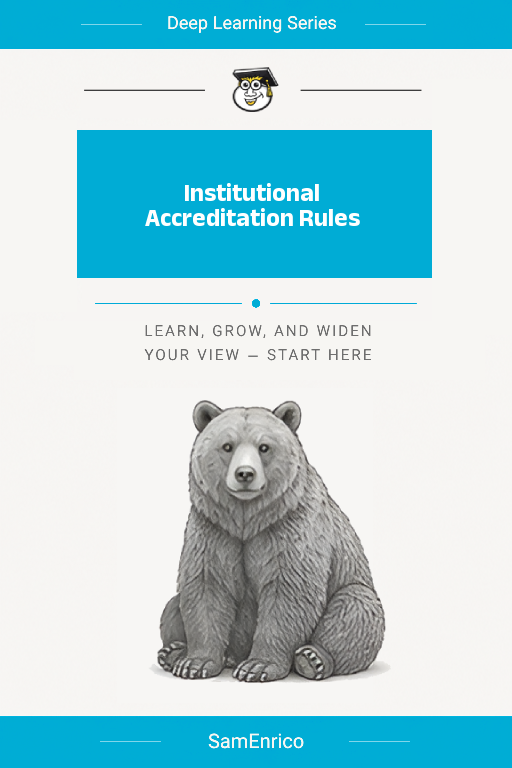
Non-FictionAnnual CheckupEdtechAccreditation
Institutional Accreditation Rules Audiobook
Navigate institutional accreditation requirements
by Rushing Nery
Navigate institutional accreditation requirements for edtech offering degree programs including regional vs national.
Formats
Free sample
Chapter 1: The Accreditation Trap...–- In the winter of 2015, a well-funded Ed Tech startup called Compass U had everything investors dream of: a sleek direct-assessment platform, a subscription model with 20,000 paying students, and a 47million Series Bledbyatop−tierventurefirm.Theircompetency−basedbusinessdegreerequirednotextbooks,nolectures,andnotraditionalfaculty—justproject−basedchallengesmentoredbyindustrypractitioners.Studentspaid47 million Series B led by a top-tier venture firm. Their competency-based business degree required no textbooks, no lectures, and no traditional faculty—just project-based challenges mentored by industry practitioners. Students paid 47million Series Bledbyatop−tierventurefirm.Theircompetency−basedbusinessdegreerequirednotextbooks,nolectures,andnotraditionalfaculty—justproject−basedchallengesmentoredbyindustrypractitioners.Studentspaid299 per month and could complete the program in as little as twelve months. The only problem? Compass U was not accredited.
When they applied for regional accreditation through the Higher Learning Commission, they received a devastating response after fourteen months of work: denial of candidacy. The reason? The institution lacked "sufficient autonomous control over its academic programs" because the curriculum was owned and operated by a third-party content developer. Worse, their mentors—brilliant industry professionals with decades of experience—did not hold terminal degrees, making them ineligible as faculty under regional standards. Compass U spent $2.3 million on the attempt.
They never recovered. By 2017, the company had dissolved, its assets acquired for pennies on the dollar by a competitor who understood the single most important rule of degree-granting Ed Tech: accreditation is not a checkbox. It is the gate, the moat, and the map—all at once.This book is written for every founder, executive, and administrator who refuses to become the next Compass U. It is for the leaders who see the massive opportunity in digital-first degree programs but recognize that the path to legitimacy runs through a system designed in the nineteenth century and codified in the twentieth. Institutional accreditation in the United States is simultaneously the gold standard of quality assurance and a labyrinth of arcane rules, unwritten expectations, and high-stakes compliance.
For Ed Tech companies launching degree programs, navigating this terrain is not optional—it is existential. This chapter explains why accreditation matters more than you think, why the timeline is longer than you want, and why the alternative pathways (unaccredited degrees, bootcamp-style certificates, corporate universities) rarely lead to sustainable degree-granting institutions.The Triad: Why Three Gatekeepers Control Your Future Before a student can receive federal financial aid—Pell Grants, Direct Loans, or work-study funds—an institution must satisfy three separate authorities. This is called the triad, and understanding it is the difference between…
This is the end of the free sample. Get the Audiobook to keep going. Buy now
About this book
Details
- Author
- Rushing Nery
- Publisher
- SamEnrico
- Language
- English
- Genre
- Non-Fiction, Annual Checkup, Edtech, Accreditation
- Released
- 2026-05-28
- Pages (approx.)
- 148
- Available as
- eBook, Audiobook

Listen in the VoxFlicks app
Audiobooks and audio dramas wherever you go. Sign in with your SamEnrico account and press play.
More by Rushing Nery
 Emotional Safety Restoration WorkbookRushing Nery$11.99
 Beginner Fitness Safety GuideRushing Nery$11.99
 Cyber Liability Insurance RegisterRushing Nery$11.99
 Metta for Pet Loss Grief CourseRushing Nery$11.99
 Body Scan Meditation for FibromyalgiaRushing Nery$11.99
 The Quantum Nomads: Ancient Secrets of the SteppeRushing Nery$11.99
 Spice Wars: How a Tiny Indian Restaurant Took on the Fast-Food GiantsRushing Nery$11.99
 How to Become a Treater HelperRushing Nery$11.99
 Principal Machine Learning EngineerRushing Nery$11.99
 Turkish Student LibrariesRushing Nery$12.99
 Understanding Dental Aberrations Steroid Dehydrogenase DeficienciencyRushing Nery$17.99
You may also like
 Hong Kong Handover 1997Dunn Johnnie$11.99
 Zumba For Postnatal Recovery CourseNeal Christian$11.99
 Zumba for BeginnersLadner Nikia$11.99
 YouTube Comment Mining GuideHumes Pandora$12.99
 Worry Box MeditationCarlin Rudy$11.99
 Workplace Stress MeditationNguyen Lynn$11.99
 Workplace Stress and Sleep RepairHawley Ivory$11.99
 Workplace Perfectionism CureDelaney Jeffry$11.99
 Workplace Injustice Anger GuideWallen Isabelle$11.99
 Work Addiction and Burnout LinkGreenwood Ester$11.99
 Women in Yoga and WellnessBeattie Galina$11.99
 Women in Stand Up ComedyChun Evangeline$11.99